

Privacy Policy Generic in 2026: 7 Live Checks Before You Publish Copy-Paste Text
If you are searching for privacy policy generic on November 24, 2026, the tempting move is to copy a decent-looking notice, swap in your company name, and move on.
That is also how teams publish privacy pages that are polished, easy to read, and still wrong.
A privacy policy generic draft is not dangerous because it is generic. It becomes dangerous when nobody turns it into a truthful description of the live forms, cookies, vendors, retention rules, and rights paths behind the site or app.
Current official guidance still points in that direction. California’s Department of Justice says a business privacy policy should be “updated at least once a year.” The CPPA says covered businesses must post and maintain the privacy policy through a link using the word “privacy.” GDPR Article 12 still requires privacy information in “clear and plain language.” The ICO still says to “know what personal data you have” before drafting privacy information. And the FTC put the enforcement lesson plainly in its March 30, 2026 OkCupid and Match case: it enforces the “privacy promises that companies make.”
If you want the closest companion reads first, start with our guides to privacy policy template, privacy policy for website, and website privacy checker. This page stays narrower. It is the privacy policy generic review I would use this week before publishing copy-paste text on a live property.
If your team keeps finding that the public policy no longer matches the live stack, DataShyre can help close that gap with data mapping, consent management, and implementation QA so the privacy story users read still matches the systems behind it.

1. Treat generic text as a starting structure, not as your source of truth
The first privacy policy generic mistake is assuming the copied draft already knows your business.
It does not.
Before you edit the page, map the live collection points and systems the policy is supposed to describe:
- contact, demo, support, and quote forms;
- newsletter, gated-content, and event signups;
- checkout, billing, booking, or registration flows;
- analytics, advertising, and session technologies;
- chat widgets, embedded video, maps, and social tools;
- CRM, email, support, and payment vendors; and
- privacy-request and preference-management paths.
This is the part the ICO keeps emphasizing. You cannot responsibly publish privacy information until you know what personal data you have, why you process it, where it came from, who gets it, and how long you keep it.
That means a privacy policy generic draft should be treated like a scaffold. The live inventory is the real source material.
2. Replace vague catch-all paragraphs with the disclosure blocks the law still expects
A weak privacy policy generic draft usually sounds broad and safe:
We may collect information to improve our services and share information with trusted partners.
That style fails because it hides the questions people and regulators still ask first.
California’s public privacy guidance says the policy should answer basic questions about what personal information is collected, how it is collected, why it is collected, how it is used, who can access it, and what choices the person has. The current CCPA notice materials also still expect a privacy policy link and clear explanations of rights and information practices. Article 13 GDPR still adds the disclosure blocks many generic U.S. templates miss, including purposes, legal basis, recipients, transfer information where relevant, retention, and rights.
So a practical privacy policy generic rewrite should make sure the final page clearly covers:
- who operates the service and how to contact them;
- what categories of personal data are collected;
- where the data comes from;
- why each category is used;
- who receives it or what categories of recipients receive it;
- how long it is kept or how retention is decided;
- what rights or choices people have; and
- how someone can actually exercise those rights.
If the generic draft cannot support those sections without becoming evasive, the draft is too thin.
3. Give cookies, pixels, and embedded technologies their own review branch
This is where a privacy policy generic page most often drifts away from reality.
Many copied notices do a reasonable job on form fields and account details, then flatten the browser side of the stack into a generic line about usage data.
That is rarely enough in 2026.
The California DOJ still points people to the privacy policy for a fuller description of the business’s privacy practices and rights. The WordPress Plugin Handbook is useful here too because it says plugins that collect, use, store, or pass user data to an external source or third party should contribute suggested policy text. In other words, the live plugin and tag stack can change the privacy page faster than the generic draft changes.
So when reviewing privacy policy generic copy, pressure-test whether it explains:
- what cookies or similar technologies are active;
- whether they are necessary, analytics, advertising, personalization, or support-related;
- which third parties may receive data through them;
- how consent, opt-out, or settings choices affect them; and
- where users can revisit those choices later.
This is also where generic copy often becomes visibly false. If the page suggests light analytics only, but the browser is running ad tech, embedded video, or cross-site sharing logic, the draft has not been localized to the real site.
4. Turn the rights section into a usable route instead of decorative prose
Another common privacy policy generic problem is naming rights without building the path behind them.
California’s CCPA materials still expect businesses to explain consumer rights and how to exercise them. The CPPA also still says businesses subject to the CCPA must post their privacy policy through a link using the word “privacy” on the homepage and other webpages, and for mobile apps through the download page or settings area.
That means the rights section in a privacy policy generic draft should not stop at lines like contact us if you have any concerns about your data.
It should explain, in plain language:
- which rights may apply;
- how a person submits a request;
- what form, email, or settings path they should use;
- whether account holders have an in-product route;
- whether browser-based or regional privacy controls are honored where applicable; and
- what happens after the request is submitted.
The page does not have to become a full rights portal. It does have to act like real wayfinding.
5. Compare the generic copy to the vendors and promises the business is really making
This is where enforcement risk gets practical.
The FTC’s March 30, 2026 action against OkCupid and Match alleged the company shared users’ personal data with an unrelated third party contrary to what its privacy policies promised. The FTC’s summary line matters because it is so simple: it enforces the “privacy promises that companies make.”
That is why a serious privacy policy generic review compares the draft against the actual services handling user data, including:
- analytics and advertising platforms;
- CRM, email, and support tools;
- payment, subscription, or booking systems;
- embedded media, chat, and mapping providers;
- fraud, security, and hosting vendors; and
- affiliates, processors, or partner categories named elsewhere.
Generic phrases like trusted partners are easy to paste and hard to defend. Recipient categories that map to reality are much better.
If this is the gap your team keeps tripping over, DataShyre can help connect the runtime inventory, consent layer, and published disclosures so the policy does not become a stale promise page.
6. Publish privacy information where collection actually begins
A privacy policy generic page can be legally thoughtful and still be badly deployed.
California’s public guidance points consumers to privacy policies posted on website homepages and app download or landing pages. The ICO recommends thinking about audience, presentation, and layered delivery instead of burying everything in one long page. That means the final page should not live only as a footer asset if your real collection starts in a lead form, checkout, onboarding flow, or settings area.
So a stronger privacy policy generic deployment review checks whether privacy information is reachable:
- in the footer on key public pages;
- near forms that collect new categories of personal data;
- from cookie, privacy, or preference settings;
- on mobile layouts where the collection actually happens; and
- on app landing or download paths that start the user journey.
That is how generic copy becomes useful instead of ceremonial.
7. Add change triggers before the next release makes the page false
The biggest long-term privacy policy generic failure is drift.
The California DOJ’s annual-update reminder is only the floor. The ICO goes further and says if you plan to use personal data for a new purpose, you need to update the privacy information and bring the change to people before the new processing starts.
That means the better privacy policy generic workflow includes a required review whenever:
- a new form starts collecting new fields;
- a new pixel, SDK, embed, or plugin is added;
- a new vendor or processor is onboarded;
- retention rules or data uses change;
- a new region or rights flow goes live; or
- the consent, opt-out, or preference experience changes.
If the generic draft is not tied to release change management, it will go stale much faster than most teams expect.
A practical 7-step review for this week
If I were fixing a privacy policy generic draft today, I would use this order:
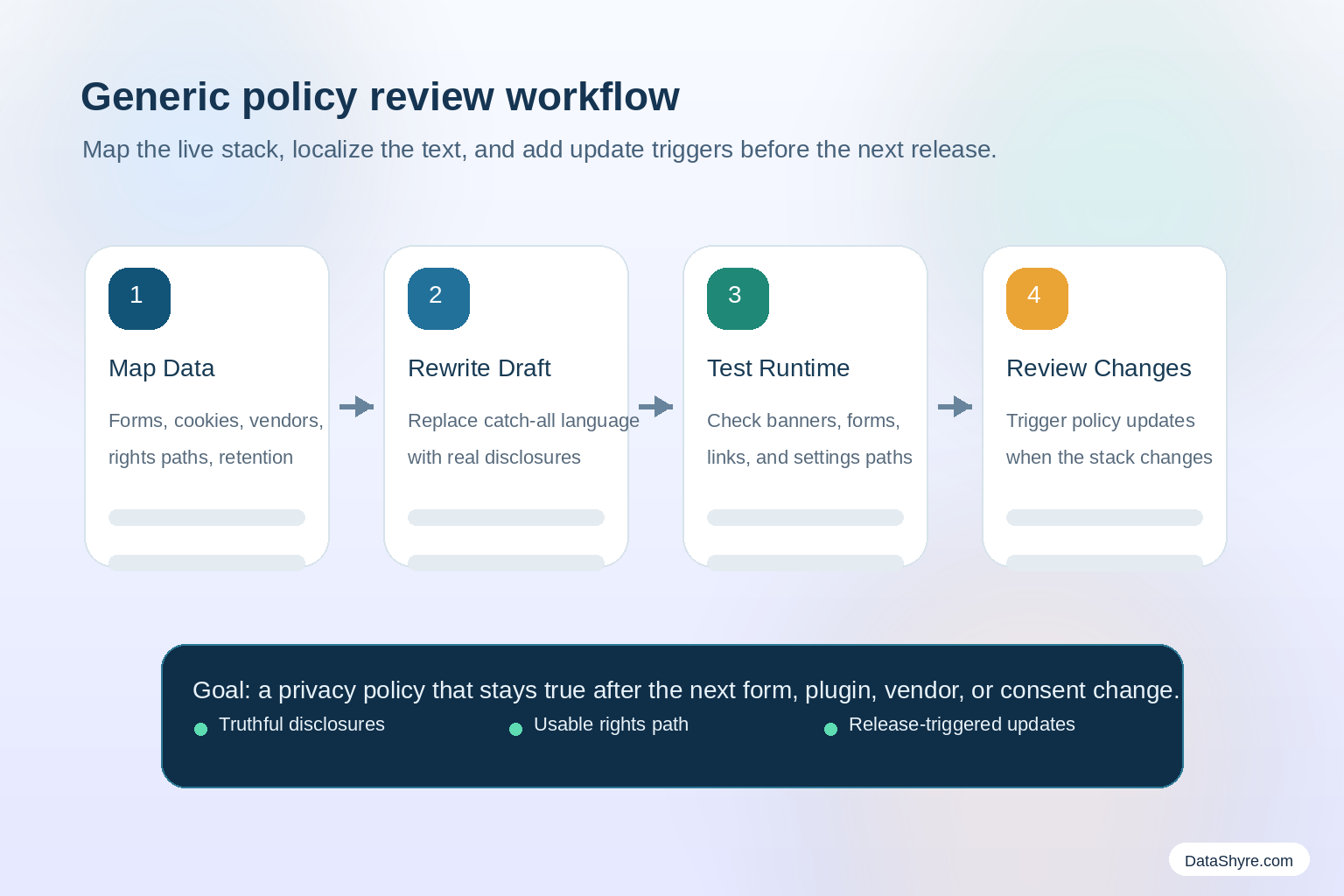
- map the live collection points and vendors first;
- fill the core disclosure sections with real categories, purposes, recipients, retention, and rights;
- separate browser-side tracking and embeds from ordinary form collection;
- test whether the rights path is clear and usable;
- compare the published promises against the real vendor stack;
- place privacy information where collection starts, not only in the footer; and
- tie product and marketing changes to a mandatory policy review.
That order usually reveals more than another round of copy polishing.
FAQ
Is a generic privacy policy legal if I edit the company name and contact details?
Usually that is not enough. The real question is whether the final page accurately describes your actual forms, tracking technologies, vendors, retention choices, and rights path.
Do I need a separate cookie section if I already have a privacy policy?
If the site uses cookies or similar technologies, the privacy policy should explain that clearly and connect users to the right settings or deeper cookie information. Generic text that hides the tracking layer is usually weak.
Can a generic privacy policy make my website compliant by itself?
No. It can help structure the transparency layer, but it does not replace consent controls, vendor governance, request handling, or implementation testing.
Bottom line
The best privacy policy generic draft in 2026 is not the one that sounds the most official.
It is the one your team can turn into a truthful explanation of the live forms, cookies, vendors, rights paths, and update triggers behind the property.
If the copy stays generic after publication, the policy may still read smoothly.
It just will not stay true.
Sources
- California Department of Justice, How to Read a Privacy Policy: https://oag.ca.gov/privacy/facts/online-privacy/privacy-policy
- California Department of Justice, California Consumer Privacy Act (CCPA): https://www.oag.ca.gov/privacy/ccpa
- California Privacy Protection Agency, What General Notices Are Required by the CCPA?: https://cppa.ca.gov/pdf/general_notices.pdf
- California Privacy Protection Agency, Frequently Asked Questions (FAQs): https://cppa.ca.gov/faq.html
- EUR-Lex, Regulation (EU) 2016/679, Articles 12 and 13: https://eur-lex.europa.eu/eli/reg/2016/679/oj/eng
- ICO, How should we draft our privacy information?: https://ico.org.uk/for-organisations/uk-gdpr-guidance-and-resources/individual-rights/the-right-to-be-informed/how-should-we-draft-our-privacy-information/
- FTC, Match and OkCupid action dated March 30, 2026: https://www.ftc.gov/news-events/news/press-releases/2026/03/ftc-takes-action-against-match-okcupid-deceiving-users-sharing-personal-data-third-party
- WordPress Developer Resources, Suggesting text for the site privacy policy: https://developer.wordpress.org/plugins/privacy/suggesting-text-for-the-site-privacy-policy/