

GDPR Security in 2026: 7 Live Checks for Access, Resilience, Breach Readiness, and Proof
If you are searching for gdpr security on November 18, 2026, the useful answer is not turn on encryption and call it done.
It is whether the organisation can show that security was designed into the processing, that access is actually controlled, that vendors and subprocessors are not the weak point, that recovery works when something breaks, and that breach decisions can be made fast enough to survive the first ugly day.
That is still where the official sources point. GDPR Article 32 remains risk-based and still points teams to measures such as pseudonymisation or encryption, the ability to restore availability and access in time, and a process for “regularly testing, assessing and evaluating” security measures. Article 25 still pushes controls into the design stage, not only after launch. The European Commission’s current business guidance also still says a reportable breach must be notified “without undue delay” and at the latest within 72 hours after awareness if the risk threshold is met.
If you want nearby context first, start with our guides to general data protection regulation, GDPR requirements, and comply with GDPR. This page stays narrower. It is the gdpr security review I would use this week before telling a team its controls are ready.
If your team already has policies but needs help tying them to real systems, DataShyre can help with data mapping, processor review, privacy-by-design checks, consent implementation, and release QA. Most GDPR security failures are not caused by a missing sentence in the policy. They happen because the live stack and the proof layer drift apart.

1. Start with the risk model, not with a generic checklist
The first gdpr security mistake is assuming every system needs the same controls in the same depth.
Article 32 still says you have to consider the “state of the art”, the cost of implementation, the nature, scope, context, and purposes of the processing, and the likelihood and severity of the risks to people. In other words, GDPR security is still about what is “appropriate to the risk”, not about copying a fixed shopping list.
That means your review should begin by asking:
- what categories of personal data are actually in scope;
- which workflows expose the biggest harm if they fail;
- which systems, APIs, vendors, and support tools can reach that data;
- what attack paths or human-error paths are most realistic for this processing.
A brochure site with a simple contact form is not the same problem as a product with account data, behavioral analytics, customer support logs, and third-party enrichment feeds.
So the first real gdpr security check is whether the team can explain why the chosen measures fit this processing and these risks, not some other company’s stack.
2. Build security into the design and default settings
Another common gdpr security failure is treating privacy and security as post-launch hardening work.
GDPR Article 25 still requires measures at the time the processing is designed and during the processing itself. The European Commission’s current guidance still describes this as “data protection by design” and by default.
That matters because many security problems are really product-design decisions:
- collecting more data than the workflow needs;
- keeping admin access wider than necessary;
- exposing personal data in logs, test environments, or support screenshots;
- defaulting retention to forever because nobody set an expiry path;
- enabling new tags, plugins, or vendors without a privacy review.
For gdpr security, a strong design-stage review asks:
- are we collecting only what this feature truly needs;
- are default settings privacy-protective for storage, sharing, and visibility;
- do new environments and tools inherit secure defaults or insecure convenience settings;
- does the release workflow force a review when the data path changes.
If the answer is we will clean that up after launch, the risk is already in the architecture.
3. Treat access control as a live operations problem
The cleanest security policy in the world does not help much if too many humans, service accounts, and vendors can still see too much data.
The ICO’s current security guidance translates the same GDPR security principle into practical outcomes around managing, limiting, and controlling access to personal data. That is useful because access drift is one of the fastest ways a decent system becomes a risky one.
A serious gdpr security review should inspect:
- role-based access and least-privilege rules;
- multi-factor authentication for admin and support paths;
- joiner, mover, and leaver processes;
- service-account scope and secret rotation;
- whether support, marketing, engineering, and contractors all have access they still need;
- whether access grants and unusual reads leave an audit trail.
This is also where many teams discover their real weak point is not the production database. It is the connected support console, ad platform, warehouse export, or shared spreadsheet that quietly copied the same data elsewhere.
4. Cover confidentiality, integrity, availability, and resilience together
People often hear gdpr security and think only about confidentiality.
Article 32 is broader than that. It still talks about the “ongoing confidentiality, integrity, availability and resilience” of systems and services, and the ability to restore access in a timely manner after a physical or technical incident.
That means the review should cover more than keeping intruders out:
- can unauthorised users see the data;
- can authorised users trust that the data has not been altered incorrectly;
- can the business still reach the data when a system fails;
- can the organisation restore service and prove what happened.
For gdpr security, that usually means checking:
- encryption and key management where appropriate;
- backups and restoration drills;
- environment separation between production and non-production;
- monitoring for destructive or unusual changes;
- resilience assumptions hidden inside cloud or SaaS vendors;
- whether one bad deploy, expired certificate, or broken identity provider can lock everyone out.
A system that keeps data secret but cannot restore it, or cannot trust its accuracy after an incident, is still weak under the GDPR security model.
5. Review processors and vendors as part of your own control set
One of the most expensive gdpr security mistakes is acting as if outsourced processing sits outside your real risk surface.
The European Commission’s current guidance still says a controller should use processors that provide sufficient guarantees that they will implement appropriate technical and organisational measures. Article 28 still makes that a controller obligation, not a nice-to-have.
So a practical gdpr security review should ask:
- which processors and subprocessors handle the personal data;
- what each one actually does with it;
- whether contracts, instructions, and security responsibilities are current;
- whether the vendor’s logs, deletion paths, incident reporting, and support access are good enough for your use case;
- whether a new vendor increases collection or exposure more than the team admits.
This is where glossy vendor assurances stop mattering and evidence starts mattering.
If the team cannot explain which processor stores the data, who can access it, and how quickly the vendor escalates incidents or fulfils deletion instructions, the gdpr security story is incomplete no matter how polished the main product is.
6. Practice breach readiness before the first ugly day
GDPR security is not only about prevention. It is also about what happens after something goes wrong.
The European Commission’s current obligations guidance still says a breach that is likely to pose a risk to individuals’ rights and freedoms must be notified to the supervisory authority without undue delay, and at the latest within 72 hours after the organisation becomes aware of it. The same guidance still says a processor must notify the controller of every data breach.
That changes what a good gdpr security program needs operationally:
- a clear escalation path from engineering or support to privacy and legal owners;
- a way to decide quickly whether personal data was involved;
- preserved logs and evidence collection;
- a repeatable method for assessing likely harm to individuals;
- draft internal playbooks for regulator notice and individual notice decisions;
- processor contracts that force timely incident reporting upstream.
If your incident workflow depends on improvisation, on one absent employee, or on a vendor answering slowly with incomplete facts, then the 72-hour clock gets uncomfortable very fast.
7. Make testing and change control part of the proof layer
The long-term gdpr security risk is rarely launch day.
It is quiet drift after launch.
Article 32 still expects a process for “regularly testing, assessing and evaluating” the effectiveness of security measures. The ICO’s current guidance frames the same expectation around access control, resilience, and ongoing testing. That means proof is not just a penetration test report saved somewhere last quarter.
For gdpr security, the stronger question is whether security review is triggered when the processing changes:
- a new vendor or plugin goes live;
- a GTM or analytics branch starts collecting something new;
- support tooling changes;
- a new region, customer segment, or data category is added;
- retention rules or deletion paths change;
- infrastructure or identity architecture shifts.
That is the proof layer regulators, customers, and enterprise buyers usually care about. They want to know whether the control set still matches the current system, not whether it matched a nicer system six months ago.
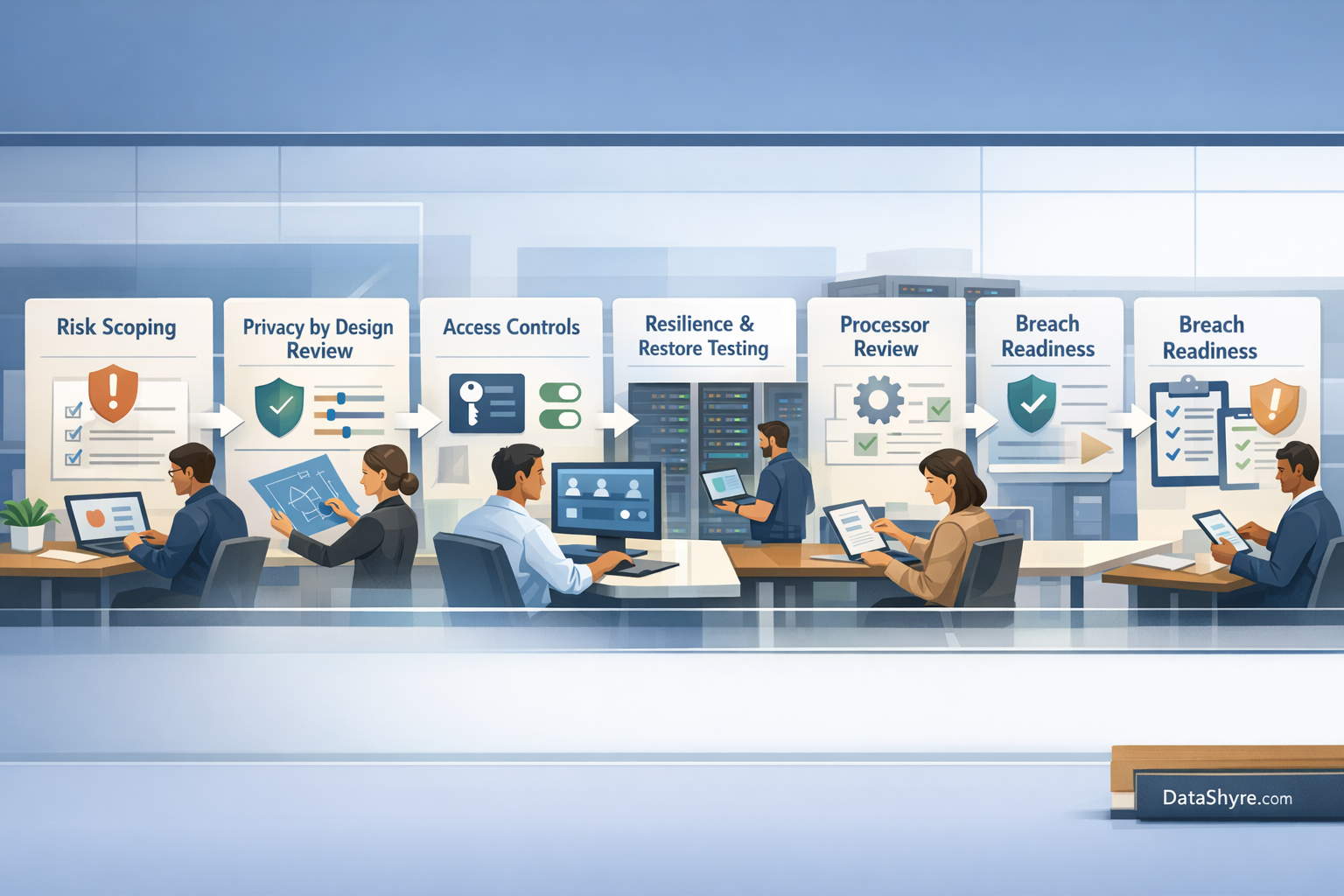
A practical GDPR security review order for this week
If I were reviewing gdpr security today, I would do it in this order:
- define the personal-data risk surface and the highest-harm workflows;
- review privacy by design and default choices in the current product and release flow;
- test human, vendor, and service-account access paths;
- check resilience, restoration, and logging evidence;
- review processor guarantees, contracts, and incident paths;
- walk the first 72 hours of a likely breach scenario;
- confirm what events force re-testing before the next release.
That order usually tells you more than another round of policy edits.
FAQ
Is GDPR security just another name for cybersecurity?
No. gdpr security overlaps with cybersecurity, but it is narrower in some places and broader in others. It focuses specifically on protecting personal data through design choices, access control, processor oversight, breach handling, and provable governance around the processing.
Does the GDPR require encryption in every case?
No. Article 32 still lists pseudonymisation and encryption as examples of possible measures, but the law stays risk-based. The question is whether the measures used are appropriate for the processing and the risks involved.
When do you have to report a breach under the GDPR?
If a personal-data breach is likely to result in a risk to individuals’ rights and freedoms, the European Commission’s current guidance says the organisation must notify the supervisory authority without undue delay and, at the latest, within 72 hours after becoming aware of it.
Bottom line
The best gdpr security program in 2026 is not the one with the most impressive policy PDF.
It is the one that can explain the risk model, show privacy by design decisions, control access, restore service, manage processors, respond to incidents fast, and prove that the controls still match the live system.
If your team cannot do that yet, the gap is operational before it is editorial.
Official sources used
- https://eur-lex.europa.eu/eli/reg/2016/679/oj
- https://commission.europa.eu/law/law-topic/data-protection/information-business-and-organisations/application-gdpr_en
- https://commission.europa.eu/law/law-topic/data-protection/information-business-and-organisations/obligations_en
- https://commission.europa.eu/law/law-topic/data-protection/information-business-and-organisations/principles-gdpr_en
- https://commission.europa.eu/law/law-topic/data-protection/information-business-and-organisations/legal-grounds-processing-data_en
- https://commission.europa.eu/law/law-topic/data-protection/information-business-and-organisations/dealing-requests-individuals_en
- https://ico.org.uk/for-organisations/uk-gdpr-guidance-and-resources/security/a-guide-to-data-security/
- https://ico.org.uk/for-organisations/uk-gdpr-guidance-and-resources/security/a-guide-to-data-security/security-outcomes