

Cookie Security in 2026: 7 Checks for Secure, HttpOnly, SameSite, Scope, and Lifetime
If you are searching cookie security on November 13, 2026, the useful question is not do we set a cookie.
It is:
are our cookies narrow enough, protected enough, short-lived enough, and honest enough about what they do on the live site?
That matters because weak cookie posture usually shows up in two different ways at once:
- session or preference cookies are broader, longer-lived, or more exposed than they need to be; and
- the privacy layer claims control that the runtime behavior does not actually deliver.
MDN’s current secure-cookie guidance still says to limit access to cookies as much as possible. That remains the right starting point. But in 2026, a real cookie security review also has to look at JavaScript access, cross-site behavior, partitioning, third-party embeds, and whether optional technologies are still loading before a valid user choice.
If you want nearby context first, start with our guides to cookie checker, browser cookies, and website privacy checker. This page stays focused on cookie security and the concrete checks I would run this week.
If your team needs help reviewing live cookie behavior, tightening attributes, testing third-party scripts, or aligning the security layer with the consent layer, DataShyre can help with implementation review, consent management, and runtime privacy testing.
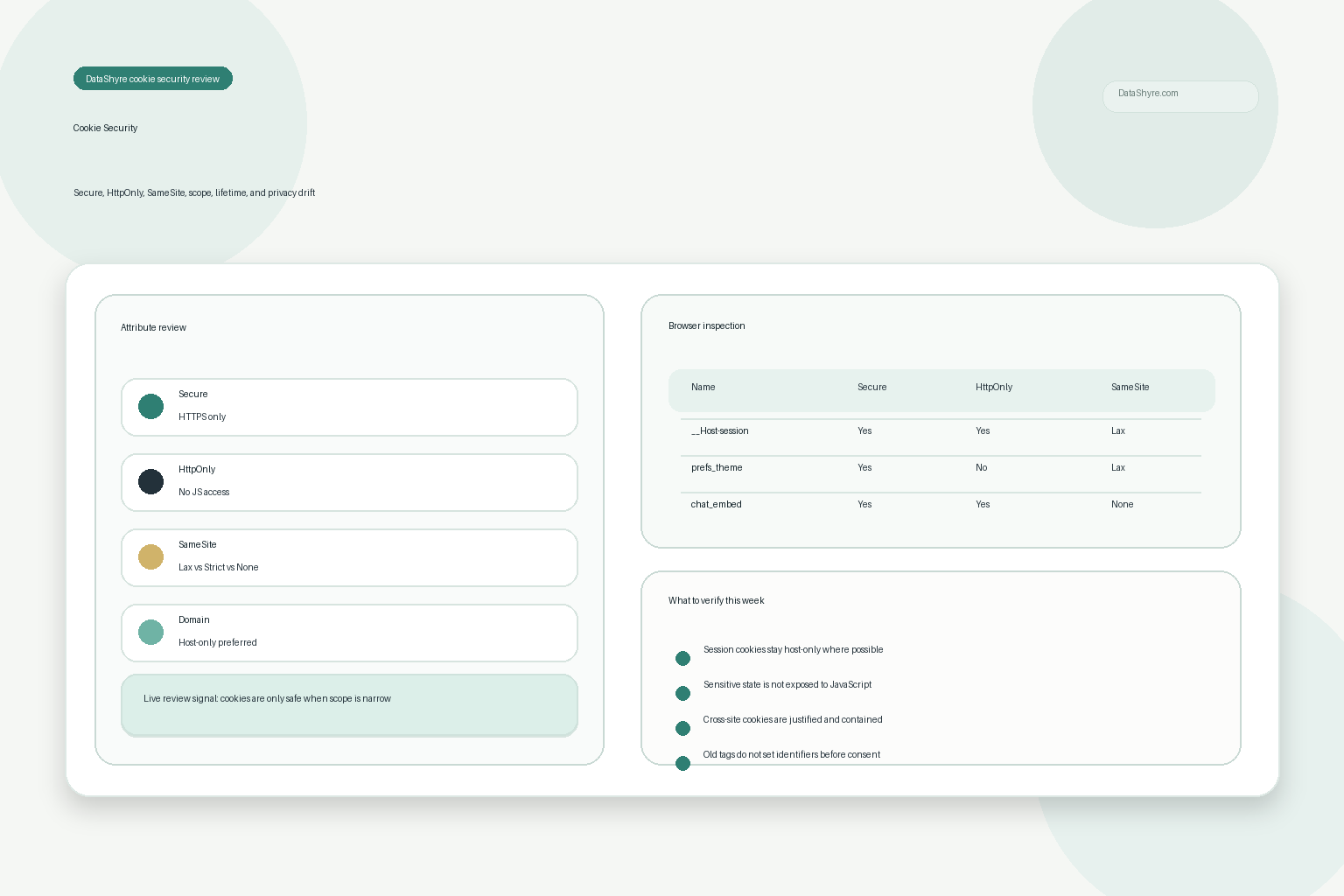
1. Start by protecting session cookies like session cookies
The first cookie security mistake is treating session identifiers like generic frontend state.
MDN still recommends using cookie prefixes such as Host- or Secure-, always setting Secure, setting HttpOnly when JavaScript access is not needed, choosing the most restrictive Domain and Path, and using SameSite=Strict or SameSite=Lax where possible.
That means the first review should ask:
- which cookies carry authentication or session state;
- whether those cookies are HTTPS-only;
- whether those cookies are inaccessible to JavaScript; and
- whether they are constrained to the narrowest host and path that still works.
If your session cookie is available to every subdomain, readable by scripts, and valid longer than the actual session needs, the cookie security story is already weaker than most teams think.
2. Default to HttpOnly unless JavaScript genuinely needs access
This is one of the highest-signal cookie security checks because it exposes whether a site is confusing convenience with safety.
MDN’s current cookie references still say HttpOnly blocks JavaScript access through APIs like Document.cookie, which helps mitigate cookie theft through cross-site scripting. OWASP’s session guidance is even blunter: do not store authentication tokens, session IDs, JWTs, refresh tokens, or similar credentials in localStorage or sessionStorage. It recommends HttpOnly; Secure; SameSite=Strict cookies as the preferred pattern.
So for cookie security, I would ask:
- which cookies truly need to be read by JavaScript;
- whether a server-side pattern could remove that need;
- whether sensitive tokens have drifted into
localStorageorsessionStorage; and - whether any script-readable cookie really deserves to stay script-readable.
If the answer is the SPA wanted it, that is not much of a security rationale.
3. Treat SameSite as a real design decision, not a default afterthought
Many teams still reduce cookie security to Secure + HttpOnly.
That is incomplete.
MDN’s current Set-Cookie reference still documents SameSite=Strict, SameSite=Lax, and SameSite=None; Secure, and Chrome DevTools still highlights cookie fields like SameSite, Secure, HttpOnly, and Partition Key directly in the Cookies pane.
So the useful cookie security question is:
- should this cookie travel on cross-site requests at all;
- if not, can we use
Strict; - if cross-site navigation support is needed, is
Laxenough; and - if the cookie truly needs
SameSite=None, have we justified that decision and contained the surrounding risk.
OWASP’s CSRF guidance also still treats SameSite as one control, not the whole defense. So if a team says we set SameSite, done, the review is probably unfinished.
4. Narrow the domain and path before a small mistake becomes a broad mistake
This part of cookie security is easy to skip because the site may appear to work either way.
MDN’s current documentation still says that omitting Domain creates a more restrictive host-only cookie, while setting a broader domain makes the cookie available to that domain and its subdomains. It also warns that broader domain access can contribute to session fixation risk.
That means a serious cookie security check should verify:
- whether a host-only cookie would work instead of a cross-subdomain cookie;
- whether the
Pathcan be narrower than/; - whether old subdomains, staging hosts, or vendor-owned subdomains can receive the cookie today; and
- whether multiple applications under the same parent domain are sharing more state than they should.
The safest cookie is usually the one that cannot leak sideways.
5. Review lifetime like it affects both security and privacy, because it does
Weak cookie security often hides inside the expiry date.
MDN still says session identifiers should expire as soon as they are no longer needed. The ICO’s current PECR guidance adds the privacy side: duration should be proportionate to the purpose, limited to what is necessary, and not left to giant defaults just because the browser allows them.
That matters because a long-lived cookie is not only a privacy issue. It can also widen the window for misuse if the device, browser profile, or account state is exposed later.
So a practical cookie security review should test:
- whether session cookies really die with the session when they should;
- whether persistent cookies have a purpose-based retention window;
- whether old preference or analytics cookies linger long after they are useful; and
- whether retention choices are deliberate or inherited from framework defaults.
If a cookie’s real expiry logic is basically forever, that is usually a sign nobody made an intentional choice.
6. Re-check embedded and third-party scenarios with partitioning in mind
This is where modern cookie security gets more current than the old first-party good, third-party bad shortcut.
Chrome’s current privacy guidance tells developers to use CHIPS, the Partitioned attribute, for 1:1 embeds that do not need to share state across top-level sites. MDN’s current Set-Cookie reference also says that when Partitioned is used, Secure must be set.
That does not mean every embedded tool is suddenly safe.
It means your cookie security review should ask:
- which cookies are being set through embeds, widgets, chat tools, video players, or sign-in helpers;
- whether those cookies need cross-site reach or should be partitioned;
- whether the site is still relying on unpartitioned
SameSite=Nonebehavior where a more privacy-preserving design would work; and - whether third-party scripts are collecting more than the product team thinks they are.
Chrome’s privacy guidance also explicitly warns not to rely on unpartitioned SameSite=None cookies. That is a useful red flag for any embed-heavy site.
7. Remember that cookie security is not the same thing as consent compliance
This is the part many teams miss.
A technically secure cookie can still be deployed in a non-compliant or misleading way if it supports optional tracking and loads before the user makes a valid choice.
The ICO’s current storage-and-access-technologies guidance still says that unless a technology fits one of the exceptions, you must seek consent before using it. The same guidance also says you should carry out regular reviews of the technologies in use and confirm their purposes.
So the last cookie security check is not purely about attributes. It is about whether the live behavior and the privacy story still line up:
- do optional cookies or related storage technologies load before consent where prior consent is required;
- do the banner, settings panel, and policy describe the real runtime accurately;
- do old tags or vendor scripts keep setting identifiers even after rejection;
- are the purposes still classified honestly; and
- does the retention story match the actual cookies in the browser.
That is why I do not trust a cookie security review that never opens DevTools or compares pre-consent, reject, and accept states on the live site.
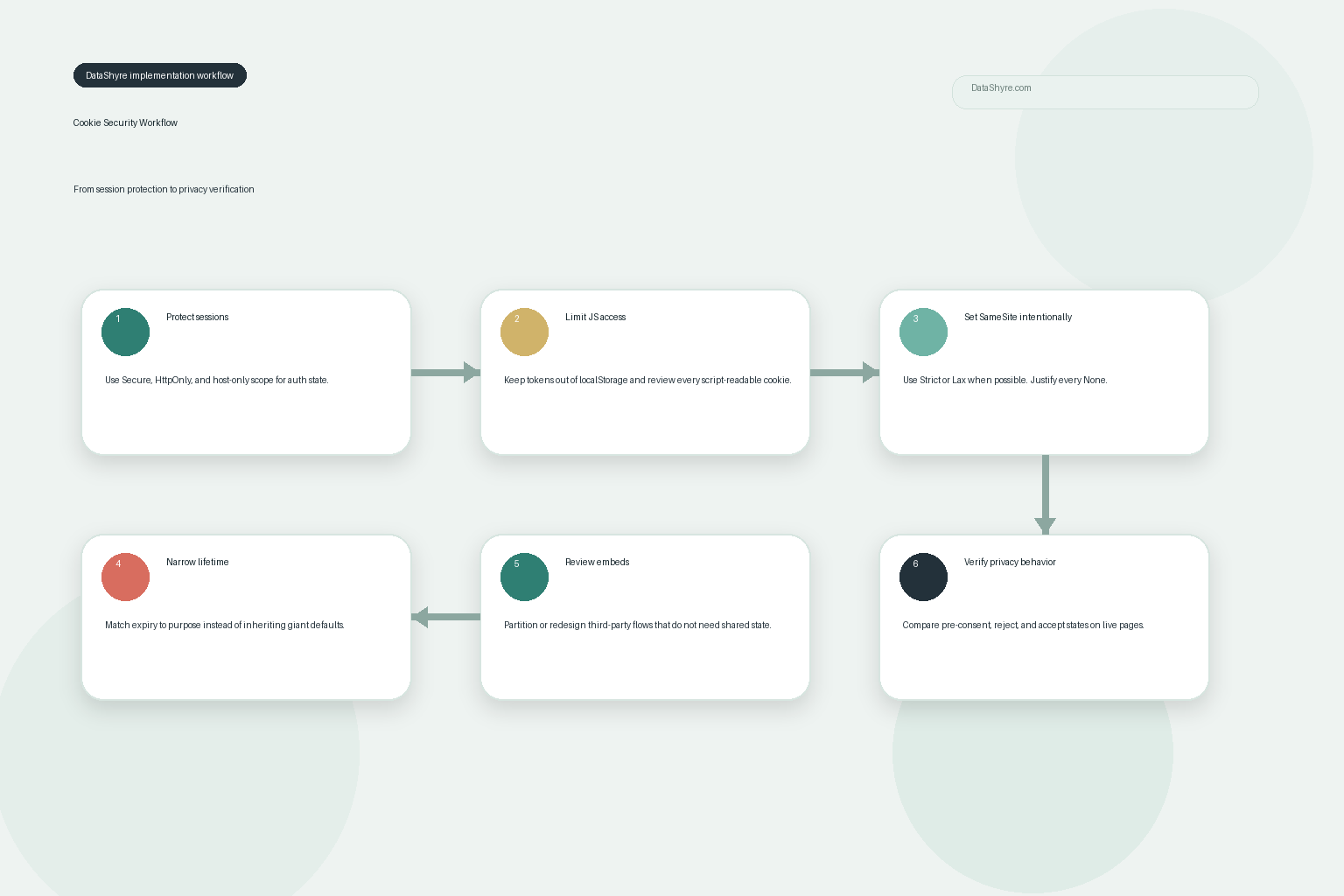
What I would test this week for cookie security
If I were reviewing cookie security today, I would use this order:
- identify all authentication, session, and preference cookies on the live site;
- check
Secure,HttpOnly,SameSite, host-only behavior, and path scope; - look for sensitive tokens in
localStorageorsessionStorage; - compare the expiry logic against the real purpose of each cookie;
- inspect embedded third-party scenarios for
SameSite=None, partitioning, and unexpected recipients; - compare pre-consent, reject, and accept states on pages that use optional technologies; and
- repeat the review after releases, plugin changes, new embeds, or tag-manager updates.
That order catches far more real risk than a spreadsheet of cookie names alone.
FAQ
What makes a cookie secure in practice?
Usually a combination of narrow scope, HTTPS-only transport, HttpOnly where JavaScript does not need access, a defensible SameSite setting, and a lifetime that matches the purpose.
Is Secure enough for cookie security?
No. Secure helps protect transport over HTTPS, but it does not by itself solve JavaScript exposure, overbroad domain scope, long retention, cross-site use, or misleading consent behavior.
Is cookie security only a security-team problem?
No. Product, frontend, privacy, and marketing decisions all affect cookie behavior. Cookie security often breaks through tag managers, embeds, analytics choices, and policy drift just as much as through backend code.