

GDPR Regulations in 2026: 7 Practical Checks for Scope, Notices, Rights, and Transfers
If you are searching for gdpr regulations on November 5, 2026, the most useful question is not whether your team can recite the articles.
It is whether the way your site, product, forms, vendors, and support flows actually behave would survive a serious review this week.
The GDPR itself is one regulation, but people searching for gdpr regulations usually mean the full operating rule set around scope, lawful basis, transparency, rights, accountability, security, and international transfers. The current European Commission and European Data Protection Board materials still point to that same practical structure.
If you want nearby context first, start with our guides to general data protection regulation, gdpr requirements, and gdpr rules. This page stays narrower. It is the version of gdpr regulations I would use this week to compare legal wording against the live operating model.
If your team is trying to turn gdpr regulations into something your stack can actually execute, DataShyre can help connect the policy layer to runtime controls through consent management, data mapping, and DSR automation. If you want the short version, book a demo.

1. Start with scope before debating consent banners or notices
The first gdpr regulations mistake is jumping straight into banners, policies, or form language before anyone settles whether the GDPR applies to the processing in question.
The European Commission still frames scope around the same three practical branches:
- processing in the context of an establishment in the EU or EEA;
- offering goods or services to people in the EU; and
- monitoring the behaviour of people in the EU.
That means a real gdpr regulations review should begin with a few blunt questions:
- which user journeys are aimed at people in the EU;
- which analytics, advertising, or product behaviors could amount to monitoring;
- which teams or vendors touch the data inside or outside the EEA.
If that threshold question is still fuzzy, the rest of the gdpr regulations discussion will usually stay fuzzy too.
2. Match each processing purpose to the lawful basis that actually fits
Another common gdpr regulations problem is acting as if consent is the safe answer to every data use.
It is not.
The current Commission and EDPB guidance still pushes teams back to the same discipline: identify the specific purpose first, then choose the lawful basis that genuinely fits it. Consent is only one of the available bases. Contract, legal obligation, vital interests, public task, and legitimate interests still matter too.
That is why the useful gdpr regulations review is not Do we have a checkbox?
It is:
- what precise processing purpose is happening here;
- which lawful basis supports that purpose;
- whether the notice and the user experience describe that basis honestly; and
- whether the basis still matches the current workflow after product and vendor changes.
The EDPB still emphasizes that consent must be freely given, specific, informed, and unambiguous. So if the live experience is coercive, bundled, or confusing, the answer is not to label it consent more aggressively.
3. Treat transparency as a collection-point problem, not only a policy-page problem
Many weak gdpr regulations programs look acceptable from the footer and fall apart everywhere else.
The Commission’s current business guidance still says privacy information has to be concise, transparent, intelligible, easily accessible, and written in clear and plain language. That is not just a style preference. It changes where and when the information should appear.
For a practical gdpr regulations check, confirm that people can understand at the right moment:
- who the controller is;
- what categories of personal data are collected;
- why the processing happens;
- what lawful basis supports it where relevant;
- who receives the data;
- whether data is transferred outside the EEA; and
- how the person can exercise their rights.
This matters even more when data is not collected directly from the individual. The Commission still says that in those cases the information generally has to be provided at the latest within one month, or earlier when the first communication or disclosure happens.
So the real gdpr regulations question is not Do we have a privacy page?
It is Would a normal person understand the collection and the control path when it actually matters?
4. Turn rights handling into a repeatable workflow with deadlines and evidence
The next gdpr regulations failure point is assuming the rights section is finished because a request form exists.
The official guidance is stricter than that.
The Commission still says organisations must respond to rights requests without undue delay and, in principle, within one month. The request path should also be available electronically where the data is processed by electronic means.
That means a functioning gdpr regulations workflow should show how your team handles:
- access;
- rectification;
- erasure;
- restriction;
- portability where applicable; and
- objection, especially for direct marketing.
The practical test is simple: can your team intake, verify, route, fulfil, and document those requests without rebuilding the process from scratch every time?
If the answer depends on a shared inbox, scattered spreadsheets, or manual vendor chasing, the rights posture is weaker than the policy page suggests.
5. Keep records, roles, and processor controls current enough to prove the story
This is where gdpr regulations stop sounding like policy copy and start sounding like operations.
Article 30 recordkeeping still matters where it applies. So do controller and processor distinctions, processor instructions, retention logic, and evidence that the written disclosures still match the live stack.
The EDPB’s current small-business materials still frame accountability around knowing who is acting as controller or processor, keeping records where required, and making sure processors act only on instructions with the right contractual controls in place.
A grounded gdpr regulations review should check whether you have:
- a current processing record where required;
- processor agreements that match the real vendor list;
- a clear role decision for controller, joint controller, or processor relationships;
- retention rules more specific than
as long as necessary; and - evidence that new tools, forms, and integrations were actually reflected in notices and controls.
The weakness here is rarely dramatic. It is drift. Marketing adds a tag, procurement adds a vendor, product launches a new form flow, and the paperwork quietly stops matching the system.
6. Build privacy by design, security, and DPIA triggers into release work
Some of the most important gdpr regulations controls only work if they happen before launch.
The current EDPB materials still tie compliance back to privacy by design, secure processing, and DPIAs where processing is likely to result in a high risk to people’s rights and freedoms. Security is not a side discipline here. It is part of the regulation’s operating model.
That changes the review order.
For a practical gdpr regulations check, ask:
- are we collecting only the data we actually need;
- are default settings exposing more than necessary;
- do access controls, training, and technical safeguards match the sensitivity of the data;
- has any planned or recent processing crossed into a high-risk branch that should trigger a DPIA before release.
Teams often discover too late that the product and engineering workflow had no formal place to ask those questions. By then, the feature is live and the cleanup gets expensive.
7. Review transfers before data leaves the EEA, not after procurement
This is one of the most underestimated gdpr regulations branches.
The Commission and EDPB still describe a familiar framework for transfers outside the EEA: adequacy decisions where available, appropriate safeguards such as standard contractual clauses where needed, and limited derogations for specific situations.
That means the useful gdpr regulations review is not simply Do we use a US vendor?
It is:
- what personal data leaves the EEA;
- which processor, affiliate, or service provider receives it;
- which transfer mechanism applies;
- whether notices and records describe that transfer accurately; and
- whether onward transfers by vendors are actually mapped.
The European Commission’s current transfer materials still point to active adequacy decisions as one route, and its EU-US data transfer guidance still highlights the EU-US Data Privacy Framework adequacy decision adopted on July 10, 2023. But even where one route exists, teams still need the facts straight about which transfers happen and which entities receive the data.
A practical review order for this week
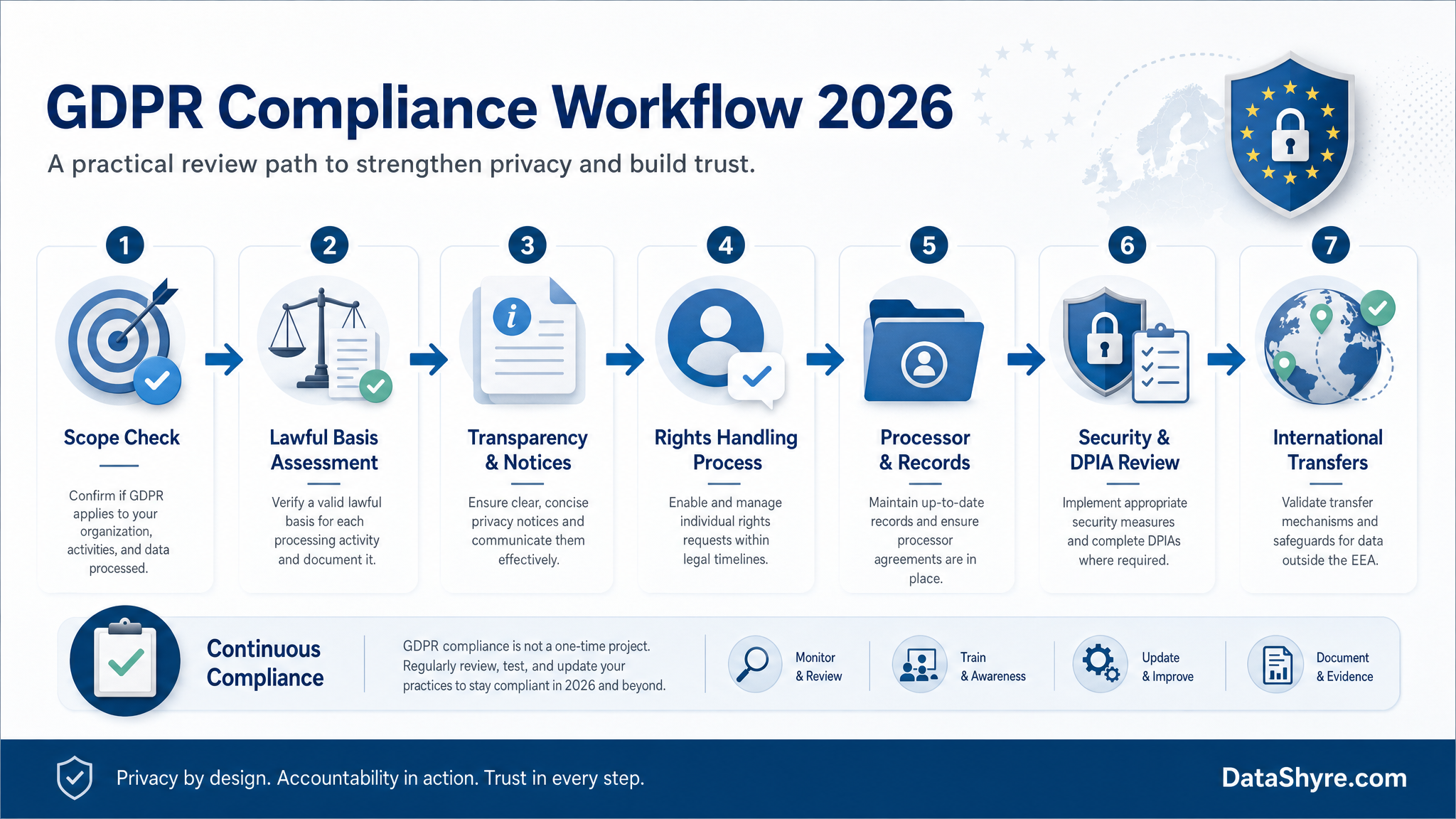
If I had to turn gdpr regulations into one working review this week, I would use this order:
- settle scope first;
- map each important processing purpose to its lawful basis;
- compare collection points against the notice users actually see;
- test the rights workflow and one-month response discipline;
- review records, roles, processor controls, and retention rules;
- check release-stage privacy-by-design, security, and DPIA triggers;
- confirm which data leaves the EEA and under what transfer mechanism.
That order usually surfaces real problems faster than starting with policy wording alone.
FAQ
Are GDPR regulations the same thing as a cookie banner?
No. A banner may be part of the user-choice layer, but gdpr regulations also cover lawful basis, transparency, rights handling, accountability, security, and transfers.
Do GDPR regulations apply only to companies based in Europe?
No. The official scope rules can also apply to organisations outside the EU when they offer goods or services to people in the EU or monitor their behaviour.
What usually weakens GDPR regulations in practice?
Usually drift between the live stack and the documents that are supposed to describe it. When notices, records, processor controls, and request workflows stop matching the real systems, the compliance story weakens quickly.
Sources
- EUR-Lex, Regulation (EU) 2016/679 (official GDPR text): https://eur-lex.europa.eu/eli/reg/2016/679/oj/eng/
- European Commission, Application of the GDPR: https://commission.europa.eu/law/law-topic/data-protection/information-business-and-organisations/application-gdpr_en
- European Commission, Obligations: https://commission.europa.eu/law/law-topic/data-protection/information-business-and-organisations/obligations_en
- European Commission, Dealing with requests from individuals: https://commission.europa.eu/law/law-topic/data-protection/information-business-and-organisations/dealing-requests-individuals_en
- European Commission, Rules on international data transfers: https://commission.europa.eu/law/law-topic/data-protection/international-dimension-data-protection/rules-international-data-transfers_en
- European Commission, EU-US data transfers: https://commission.europa.eu/law/law-topic/data-protection/international-dimension-data-protection/eu-us-data-transfers_en
- European Data Protection Board, Process personal data lawfully: https://www.edpb.europa.eu/sme/be-compliant/process-personal-data-lawfully_en
- European Data Protection Board, Data controller or data processor: https://www.edpb.europa.eu/sme/learn-the-basics/data-controller-or-data-processor_en
- European Data Protection Board, Secure personal data: https://www.edpb.europa.eu/sme/be-compliant/secure-personal-data_en
- European Data Protection Board, International data transfers: https://www.edpb.europa.eu/sme/be-compliant/international-data-transfers_en
- European Data Protection Board FAQ, What is a data protection impact assessment and when is this mandatory?: https://www.edpb.europa.eu/sme/find-practical-info/faq_en?page=1
Published: November 5, 2026. Updated using current official European Commission and EDPB materials available at publication time.