

GDPR Rules in 2026: 7 Operating Rules Teams Should Check This Week
If you are searching for gdpr rules on November 5, 2026, the easiest mistake is treating the GDPR like a static legal document instead of a live operating model.
That is not how the rules behave in practice.
The text of the GDPR is stable, but the day-to-day burden still falls on how your site, product, forms, vendors, and support flows actually work. The official EU and EDPB materials still point to the same core pattern: decide whether the GDPR applies, choose the right lawful basis, explain processing clearly, respect individual rights, keep records, secure the data, and control high-risk processing and transfers.
If you want nearby context first, start with our guides to general data protection regulation, gdpr requirements, and gdpr compliant privacy notice. This page stays narrower. It is the version of gdpr rules I would use this week with an operations, product, or privacy team that needs a workable review order instead of a slogan.
If your team already knows the rulebook but struggles to keep the live stack aligned with it, DataShyre can help connect those rules to runtime controls through consent management, data mapping, and DSR automation. If you want the short path, book a demo.

1. Confirm the GDPR applies before you debate the details
The first gdpr rules failure is assuming the law only matters if your company is physically located in the EU.
That is too narrow.
The current European Commission guidance says the GDPR applies when processing happens in the context of an EU establishment, when a non-EU business offers goods or services to people in the EU, or when it monitors the behaviour of people in the EU.
That means a practical gdpr rules review should begin with three questions:
- do we have an establishment in the EU or EEA tied to this processing;
- are we targeting people in the EU with products, forms, pricing, or support flows; and
- are we tracking or profiling behaviour in a way that pulls this activity into GDPR scope.
You can waste a lot of time debating lawful basis, notices, or consent mechanics before anyone settles this threshold question.
2. Match every processing purpose to a lawful basis
Another common gdpr rules mistake is treating consent as the safe default for everything.
It is not.
The GDPR still gives controllers six main lawful bases, and the EDPB’s current materials still frame the first job as choosing the basis that actually fits the processing purpose. Consent remains one option, but so do contract, legal obligation, vital interests, public task, and legitimate interests.
That changes the review you should run.
Instead of asking Do we have consent?, ask:
- what specific purpose each collection or reuse supports;
- which lawful basis the team is relying on;
- whether that basis still matches the real workflow;
- whether the privacy notice and consent experience describe that basis honestly.
This matters because the rights that attach to processing can change depending on the basis chosen. It also matters because the EDPB still says consent has to be freely given, informed, specific, and unambiguous. If the live experience does not meet that standard, the answer is not to call it consent louder.
3. Keep notices concise, clear, and close to collection
The next gdpr rules failure is publishing a privacy page and assuming transparency is handled.
Transparency is broader than that.
The official GDPR text still requires information to be provided in a concise, transparent, intelligible, and easily accessible form, using clear and plain language. The Commission’s business guidance and the EDPB’s SME materials still treat this as a timing and placement issue as much as a writing issue.
That means a solid gdpr rules check should confirm that people can see, at the right moment:
- who the controller is;
- what categories of data are collected;
- why the data is being processed;
- which lawful basis supports the processing where relevant;
- who receives the data;
- whether data is transferred outside the EEA; and
- how the person can exercise their rights.
If data is collected indirectly, the Commission still says that information generally has to be provided at the latest within one month after obtaining the data, or sooner in certain communication or disclosure scenarios. So the real gdpr rules question is not just whether a notice exists. It is whether the notice meets the user where the processing starts.
4. Treat rights handling as an operating workflow, not a form link
Many teams can list GDPR rights from memory and still fail the live test when a request arrives.
That is because the hard part is not naming the rights. It is fulfilling them.
The Commission and the EDPB still point to the same practical expectation: organisations must respond without undue delay and, in principle, within one month. If more time is needed because a request is complex, the extension logic still has to be communicated properly.
For most teams, the gdpr rules review should cover the operating path for:
- access;
- rectification;
- erasure;
- restriction;
- portability, where applicable; and
- objection, especially in direct-marketing contexts.
The useful question is simple: can your team intake, verify, route, fulfil, and document a request without inventing the process from scratch every time?
If the answer depends on a shared inbox, manual detective work, or undocumented vendor escalation, your rights posture is weaker than the policy page suggests.
5. Keep records and processor controls current enough to prove the story
This is where gdpr rules stop being abstract.
Article 30 still requires records of processing activities in the scenarios where it applies, and the EDPB’s current small-business guidance still treats those records as part of accountability rather than paperwork for its own sake. The same is true for controller and processor roles. If a vendor is acting on your instructions, the relationship should not be handled like a casual integration with no defined obligations.
A practical gdpr rules review should check whether you have:
- a current record of processing activities where required;
- processor agreements that match the live vendor stack;
- a clear understanding of who acts as controller, joint controller, or processor;
- retention logic that is more concrete than
as long as necessary; - evidence that notices, consent controls, and downstream recipients still match reality.
This is also where many organisations drift after adding new forms, marketing tools, support vendors, or analytics destinations. The rule is not just keep records. The real rule is keep the records current enough to explain the system you are actually running.
6. Build privacy by design, security, and DPIA checks into release work
Some gdpr rules are impossible to retrofit cleanly after launch.
That is why Articles 25, 32, and 35 still matter so much.
The GDPR text still requires controllers to implement data protection by design and by default, and to apply technical and organisational security measures appropriate to the risk. The EDPB’s current SME guidance also still says a DPIA is mandatory where processing is likely to result in a high risk to individuals.
Operationally, that means your gdpr rules review should ask:
- are we collecting only the data we actually need;
- are default settings exposing more data than necessary;
- do security controls match the sensitivity and risk of the processing;
- does any new feature trigger a high-risk branch that should lead to a DPIA before launch.
This is the difference between a privacy program that reacts after complaints and one that prevents predictable failures before they ship.
7. Check transfer rules before data leaves the EEA
This is one of the easiest gdpr rules branches to underbuild.
The GDPR’s Chapter V still requires transfers outside the EEA to meet specific conditions, and the Commission and EDPB still describe the same basic pathways: adequacy decisions, appropriate safeguards such as standard contractual clauses, and limited derogations for specific cases.
So the practical gdpr rules question is not Do we use an international vendor?
It is:
- which data leaves the EEA;
- which vendor or affiliate receives it;
- which transfer mechanism applies;
- whether the privacy notice and internal records reflect that transfer accurately; and
- whether a processor is making any onward transfer you have not fully mapped.
For many teams, this branch fails because the transfer logic lives inside a vendor contract nobody reviews after procurement. That is too passive for 2026.
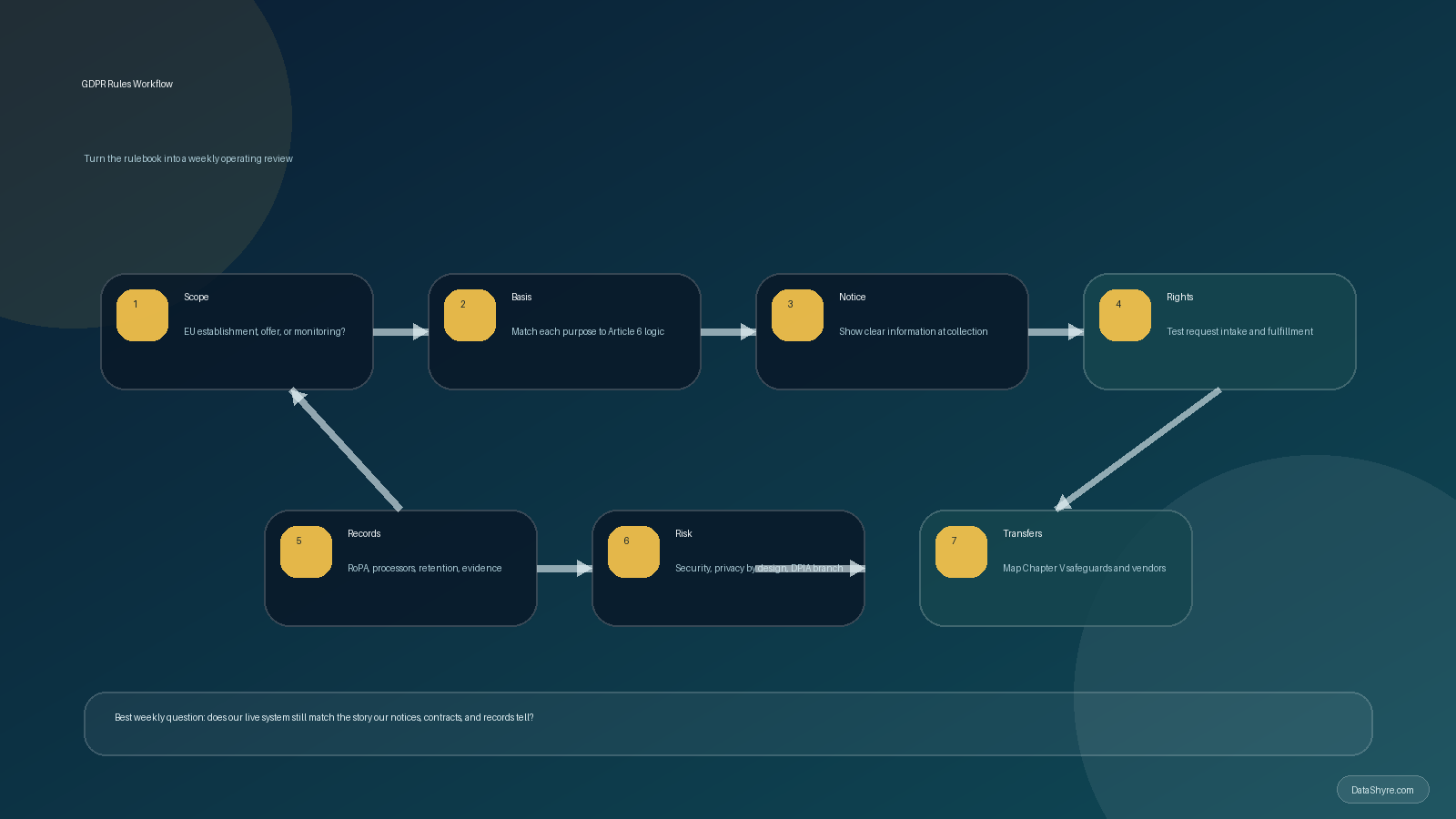
A practical review order for this week
If I had to turn gdpr rules into a short operating review this week, I would do it in this order:
- confirm scope first;
- map each important processing purpose to a lawful basis;
- compare collection points against the notices users actually see;
- test the request path for access, erasure, and objection;
- review records, processor contracts, and retention logic;
- check security and whether any active project needs a DPIA;
- confirm what data leaves the EEA and under which transfer mechanism.
That order usually surfaces real problems faster than starting with policy wording alone.
FAQ
Are GDPR rules basically the same thing as a cookie banner?
No. Cookies can be part of the picture, but gdpr rules also cover lawful basis, notices, rights handling, records, security, and transfers.
Do GDPR rules only apply to companies based in the EU?
No. The official scope rules can also apply to organisations outside the EU when they offer goods or services to people in the EU or monitor their behaviour.
What is the fastest way to weaken a GDPR rules program?
Usually by letting the live stack change faster than the notices, records, rights workflow, or transfer map that are supposed to describe it.
Sources
- EUR-Lex, Regulation (EU) 2016/679 (official GDPR text): https://eur-lex.europa.eu/eli/reg/2016/679/oj/eng/
- European Commission, Application of the GDPR: https://commission.europa.eu/law/law-topic/data-protection/information-business-and-organisations/application-gdpr_en
- European Commission, Dealing with requests from individuals: https://commission.europa.eu/law/law-topic/data-protection/information-business-and-organisations/dealing-requests-individuals_en
- European Commission, Information for individuals: https://commission.europa.eu/law/law-topic/data-protection/information-individuals_en
- European Commission, Rules on international data transfers: https://commission.europa.eu/law/law-topic/data-protection/international-dimension-data-protection/rules-international-data-transfers_en
- European Data Protection Board, Legal basis: https://www.edpb.europa.eu/topics/key-gdpr-concepts/legal-basis_en
- European Data Protection Board, Process personal data lawfully: https://www.edpb.europa.eu/sme/be-compliant/process-personal-data-lawfully_en
- European Data Protection Board, Respect individuals’ rights: https://www.edpb.europa.eu/sme/be-compliant/respect-individuals-rights_en
- European Data Protection Board, Secure personal data: https://www.edpb.europa.eu/sme/be-compliant/secure-personal-data_en
- European Data Protection Board, International data transfers: https://www.edpb.europa.eu/sme/be-compliant/international-data-transfers_en
- European Data Protection Board, Data controller or data processor: https://www.edpb.europa.eu/sme/learn-the-basics/data-controller-or-data-processor_en
- European Data Protection Board, Guidelines 05/2020 on consent under Regulation 2016/679: https://www.edpb.europa.eu/our-work-tools/our-documents/guidelines/guidelines-052020-consent-under-regulation-2016679_en
Published: November 5, 2026. Updated using current official EU and EDPB materials available at publication time.