

GDPR Compliant Privacy Notice in 2026: 7 Checks Before You Publish or Update It
A gdpr compliant privacy notice in 2026 is not just a footer page with legal text.
It is the explanation layer that has to match your real collection points, your actual purposes, your retention and sharing practices, and the rights path a person can use when they want to act.
That is an especially practical topic this year. On March 19, 2026, the European Data Protection Board launched its 2026 Coordinated Enforcement Framework action on compliance with the transparency and information obligations in Articles 12, 13, and 14 GDPR. At the same time, the ICO’s privacy-notice guidance currently says it is under review because of changes made by the UK’s Data (Use and Access) Act. So the safest approach right now is not to chase clever wording. It is to make the notice accurate, usable, and easy to maintain.
If you want the adjacent website-control context first, start with our guides to cookie consent, cookie consent requirements, and website privacy checker. This article stays narrower. It is the seven-check review I would use this week before calling a gdpr compliant privacy notice ready for publication.
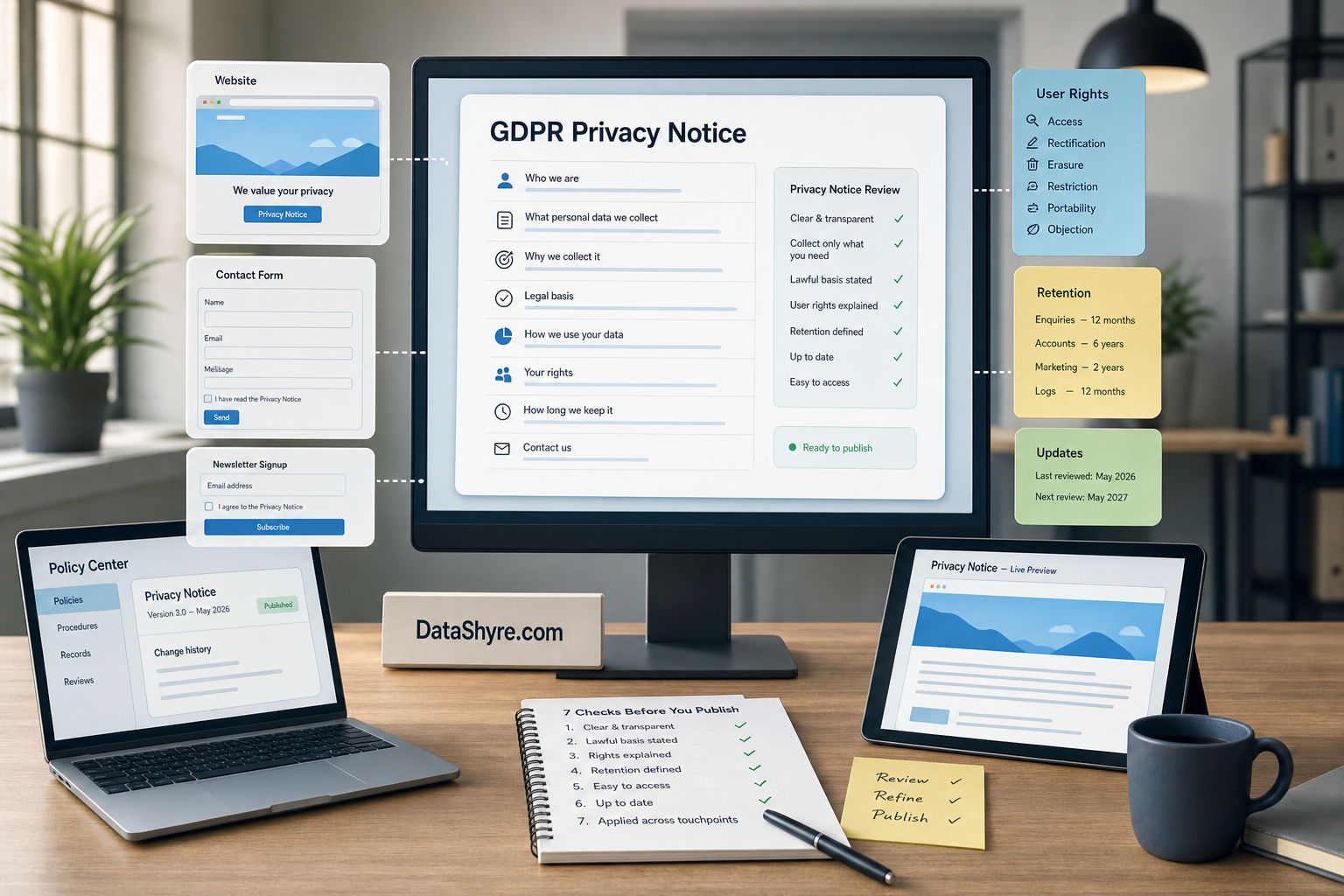
1. Start with the Article 12 standard, not with legal padding
The core drafting standard still comes from the GDPR itself.
Article 12 says the information must be concise, transparent, intelligible, and easily accessible, using “clear and plain language.” That requirement sounds simple, but it disqualifies a lot of notices that are technically complete and still hard to use.
So the first review question is not whether the document feels formal enough.
It is whether a normal person can quickly work out:
- who is using their data;
- what data is involved;
- why it is being used;
- what happens next; and
- what they can do about it.
If the answer only becomes clear after several dense paragraphs of umbrella wording, the gdpr compliant privacy notice is already weaker than it should be.
2. Separate direct collection from indirect collection
This is one of the easiest places for teams to miss a required element.
Articles 13 and 14 are similar, but they are not identical. Article 13 applies when you collect personal data from the individual. Article 14 applies when the data comes from another source.
That distinction matters because timing changes:
- when data is collected directly, the notice should be provided at the time the data is obtained;
- when data is obtained indirectly, the GDPR generally requires the information within a reasonable period and no later than one month.
For a gdpr compliant privacy notice, that means your drafting should reflect how the business actually collects data. A lead form, support form, newsletter signup, and account registration flow do not raise the same timing questions as purchased lists, partner feeds, data enrichment, referral imports, or CRM syncs.
If the business uses both direct and indirect collection, the notice should make that visible instead of pretending every data point came from the same route.
3. Make the required fields concrete enough to be useful
The transparency problem is rarely that teams forgot every required heading.
It is that the content under those headings stays too abstract.
The European Commission and ICO materials still point back to the same essential fields: controller identity and contact details, purposes, lawful basis, recipients or recipient categories, retention, rights, complaint route, and extra detail where data did not come directly from the person.
The EDPB’s transparency guidance is useful here because it stresses that the information required by Articles 13 and 14 is all important, not a menu of optional extras.
So when reviewing a gdpr compliant privacy notice, pressure-test whether it says things a person can actually use:
- not only
we use your information to improve services, but which services and for what specific purpose; - not only
we may share data with trusted partners, but what kinds of recipients those are; - not only
we retain data as needed, but the period or the criteria that decide it; - not only
you have rights, but how to exercise them in practice.
The notice does not need to become encyclopedic. It does need to stop hiding the substance behind safe legal phrasing.
4. Use layered and just-in-time delivery where the user actually needs it
A strong gdpr compliant privacy notice does not have to be one giant block of text.
The ICO explicitly says it is often effective to provide privacy information through a combination of techniques including layering, dashboards, and just-in-time notices. Its methods guidance also gives a concrete example: if you collect information through an online form, a “just-in-time notice” can appear as the person fills it in.
That is the right direction for 2026 because many products collect data in stages:
- account creation;
- marketing signup;
- location or camera access;
- optional personalization;
- connected analytics or advertising tools.
One static page can still do important legal work, but it may not be enough on its own.
For a real-world review, ask:
- what does the person see at the exact moment data is collected;
- what fuller detail can they reach quickly from that point;
- where do high-surprise features need a second, contextual explanation;
- does mobile presentation make the key facts harder to find.
Layering should reduce confusion, not create a scavenger hunt.
5. Keep the privacy notice aligned with the live stack
This is the failure mode that matters most operationally.
A gdpr compliant privacy notice is not only a drafting deliverable. It is a change-management deliverable.
The ICO says you should regularly review your privacy information and bring any new uses of personal data to people’s attention before the processing starts. The same logic shows up in broader transparency guidance: people should not discover a meaningful new use of their data only after the feature, vendor, or tracking path is already live.
That creates a simple but valuable review loop:
- compare the notice to the actual forms, app screens, and account flows;
- compare the notice to the cookie and tracking layer if the site uses them;
- compare the notice to the actual vendors, recipient categories, and transfer routes;
- check whether recent launches created a new purpose that the notice does not explain yet.
This is also where California context can sharpen the review even when the article focus is GDPR. If your site has a California branch, make sure the notice and controls do not drift apart there either. Our California consumer privacy guide is a useful companion for that narrower branch.
6. Treat rights wording as an action path, not as a recital
Many privacy notices list rights correctly and still do a poor job helping people use them.
The GDPR and ICO guidance both expect people to be told about their rights in a way they can understand, including the right to withdraw consent where consent is the legal basis and the right to complain to a supervisory authority.
That means a gdpr compliant privacy notice should help a person answer practical questions fast:
- which rights are likely to matter here;
- how do I make a request;
- which email address, form, or dashboard should I use;
- what happens if consent was the basis and I want to withdraw it;
- where can I complain if I am unhappy.
If the rights section reads like a list copied from a template with no clear route into the real workflow, the notice is incomplete in the way that matters most to the reader.
7. Build an update trigger before the next release, not after it
The EDPB’s 2026 coordinated enforcement action is a reminder that transparency is being looked at as a living obligation, not only as a publishing checkbox.
Because 25 DPAs are taking part in the 2026 action, controllers in different sectors should expect closer attention to how Articles 12 to 14 work in practice, including what people are told and whether that explanation stays accurate over time.
For a gdpr compliant privacy notice, the final check is therefore operational:
- does product or marketing launch review include a privacy-notice check;
- do vendor additions or purpose changes trigger notice review;
- is there an owner who can approve changes quickly;
- can the team show what version of the notice was in use when a person gave data.
Without that update discipline, even a strong draft will drift.
A short review order for this week
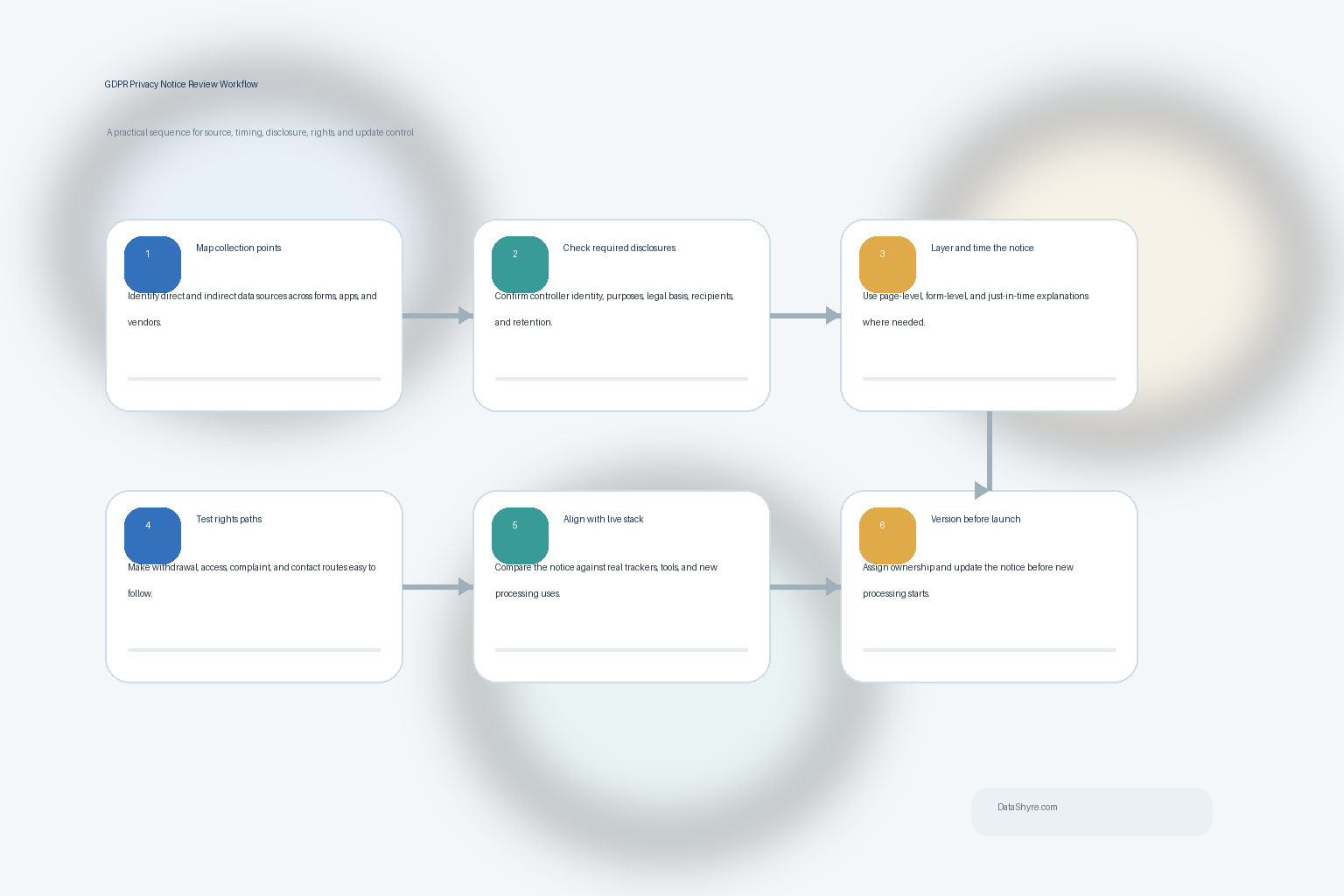
If I were reviewing a gdpr compliant privacy notice today, I would do it in this order:
- read the first screen and first paragraph for clarity, not completeness;
- separate direct-collection and indirect-collection scenarios;
- test whether the purpose, recipient, retention, and rights statements are concrete enough to be useful;
- inspect whether form-level or feature-level just-in-time notices are needed;
- compare the notice against the real forms, trackers, vendors, and new features now live;
- check whether rights routes actually work;
- confirm there is an update trigger before the next release.
That sequence usually exposes more risk than a copyedit alone.
Bottom line
The best gdpr compliant privacy notice in 2026 is not the one with the longest document.
It is the one that explains the real processing model in language people can follow, appears at the right moments, and gets updated before the business changes outgrow it. If the notice is clear, layered, timely, and aligned with the live stack, it does much more than satisfy a policy-page requirement. It becomes something a regulator and a real user can both make sense of.
Sources
- EUR-Lex, GDPR Articles 12 to 14 and Recital 58: https://eur-lex.europa.eu/eli/reg/2016/679/oj/eng/
- European Commission, obligations of companies and organisations: https://commission.europa.eu/law/law-topic/data-protection/information-business-and-organisations/obligations_en
- European Commission, legal grounds for processing data: https://commission.europa.eu/law/law-topic/data-protection/information-business-and-organisations/legal-grounds-processing-data_en
- EDPB, CEF 2026 launch on transparency and information obligations: https://www.edpb.europa.eu/news/cef-2026-edpb-launches-coordinated-enforcement-action-on-transparency-and-information_en
- EDPB, Guidelines on transparency under Regulation 2016/679: https://www.edpb.europa.eu/documents/guideline/transparency_en
- ICO, how to write a privacy notice and what goes in it: https://ico.org.uk/for-organisations/advice-for-small-organisations/privacy-notices-and-cookies/how-to-write-a-privacy-notice-and-what-goes-in-it/
- ICO, the right to be informed: https://ico.org.uk/for-organisations/uk-gdpr-guidance-and-resources/individual-rights/the-right-to-be-informed/
- ICO, what methods can we use to provide privacy information?: https://ico.org.uk/for-organisations/uk-gdpr-guidance-and-resources/individual-rights/the-right-to-be-informed/what-methods-can-we-use-to-provide-privacy-information/
—
Published: October 22, 2026. Updated using current official regulator and government materials available at publication time.