

OneTrust Vs in 2026: 7 Checks Before You Compare CMP Alternatives
If you are searching for onetrust vs on October 18, 2026, you are probably not looking for a cartoon scoreboard where one platform gets a trophy and the rest disappear.
You are usually trying to compare OneTrust against other consent and privacy options without missing the operational details that make the choice expensive later: publisher requirements, runtime tag behavior, regional rule coverage, preference sync, and the amount of manual work your team inherits after launch.
That is still the right frame. OneTrust’s current public materials separate Consent Management Platform (CMP), Universal Consent & Preference Management (UCPM), and broader Privacy Automation packaging. Google’s current publisher help still says personalized ads in the EEA, UK, and Switzerland require a Google-certified CMP integrated with the IAB TCF, and the current certified-CMP list includes Onetrust / Cookiepro CMP for web, app, and CTV. At the same time, official EU, UK, French, and California guidance still cares less about your vendor logo than whether the live experience uses “clear and plain language,” makes rejection “just as easy as accepting” cookies, and avoids interfaces where “Dark patterns aren’t about intent, they’re about effect.”
If you want nearby context first, start with our guides to OneTrust privacy management, OneTrust cookie consent, and consent management platform. This article is narrower. It is the seven-check comparison I would use this week before deciding onetrust vs any other serious CMP or preference-management option.
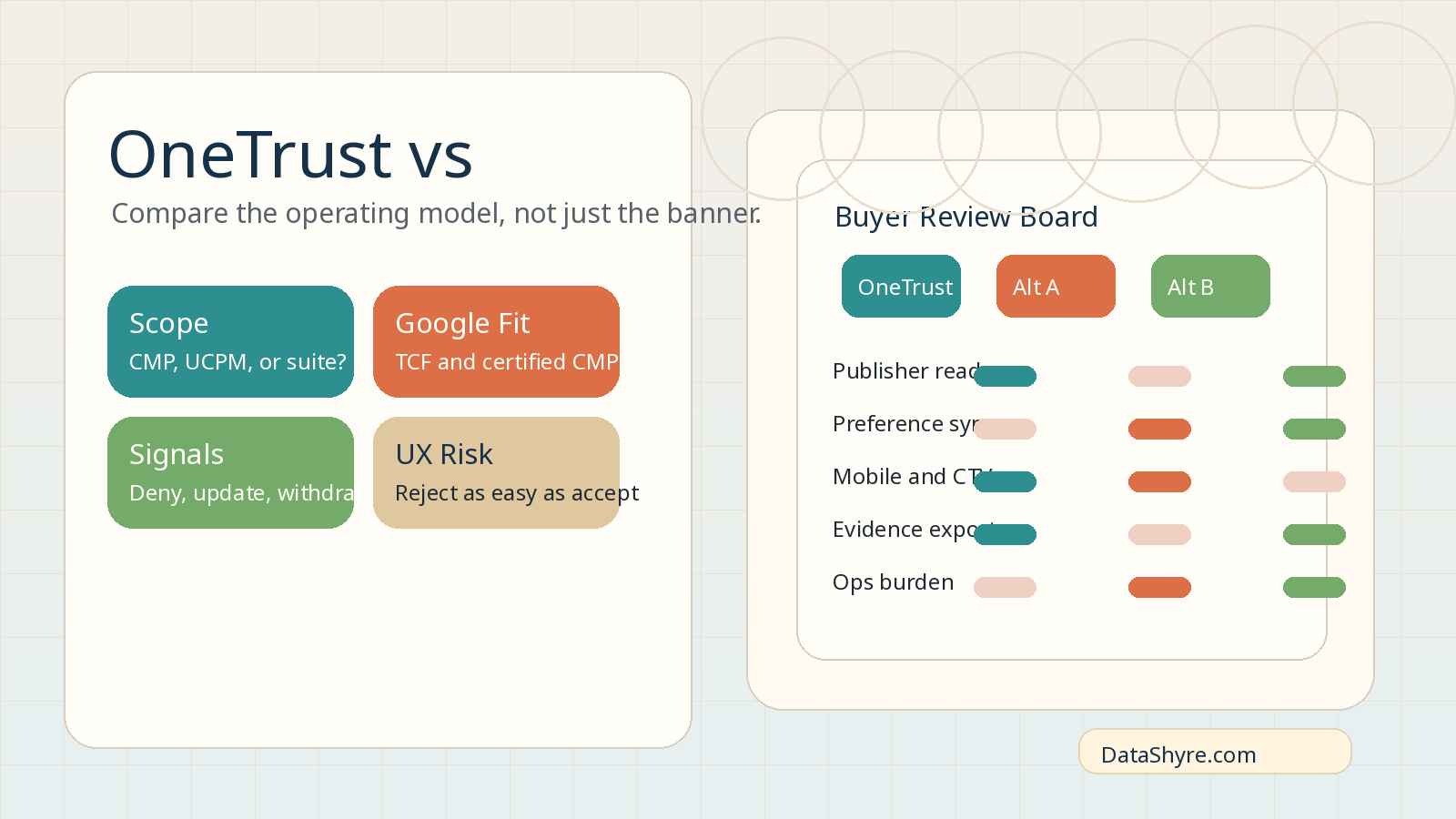
1. Decide whether you are comparing a CMP, a preference platform, or a broader privacy stack
This is the first cleanup step in any onetrust vs discussion.
OneTrust’s current packaging does not present everything as one undifferentiated product. The pricing and product pages separate a CMP suite, a UCPM layer for known-customer preferences, and broader Privacy Automation workflows such as data mapping, assessments, DSR handling, and incident management.
That matters because buyers often compare OneTrust to tools that only solve one slice of the problem:
- website and app banner collection;
- publisher and ad-tech signaling;
- known-user preference management across channels;
- internal privacy operations and request workflows.
If the other vendor is only solving one of those layers, the comparison can look cheaper or simpler than it really is.
2. Compare the channel coverage and identity model, not just the banner demo
Many onetrust vs comparisons stay too visual.
OneTrust’s current Consent & Preferences materials say its CMP supports consent collection across web, mobile, OTT, and CTV and supports standards and signals including IAB TCF, GPP, GPC, Google Consent Mode v2, MSPA, and ePrivacy-related requirements. The same solution family places UCPM next to the CMP for teams that need consent and granular preferences to persist across channels, devices, and touchpoints.
So when you compare platforms, ask:
- are you only collecting anonymous website consent, or also syncing known-user preferences;
- do mobile apps, CTV apps, or logged-in experiences matter this year;
- will the platform need to honor US opt-out signals such as GPC, which California’s DOJ still calls a “stop selling or sharing my data switch”;
- can preferences follow the person across systems you already use.
If the answer is “we only need a web banner,” a lighter platform may be enough. If the answer is broader, the identity and synchronization layer matters more than the banner skin.
3. Treat Google publisher eligibility as a separate buyer check
This is one of the easiest places for a weak onetrust vs comparison to go wrong.
Google’s current publisher guidance still says that partners using AdSense, Ad Manager, or AdMob must use a Google-certified CMP integrated with the IAB TCF when serving personalized ads to users in the EEA, UK, or Switzerland. Its current certified list includes Onetrust / Cookiepro CMP for web, app, and CTV. But Google also says certification does not check a CMP for full compliance with the TCF or applicable privacy laws.
So the right comparison question is not only “is it certified?”
It is also:
- is the platform certified for the environments you actually run;
- can it handle your publisher vendor list and consent strings cleanly;
- what happens to eligible traffic when consent is denied or certification is missing;
- who owns ongoing recertification or policy updates.
If ad revenue matters, I would run that publisher check separately from the general privacy-software decision.
4. Compare runtime consent signaling, not just admin screens
The real test in onetrust vs work is whether the consent state reaches the systems that need it before those systems collect or activate data.
OneTrust’s current developer documentation says its CMP can send consent signals for Google Consent Mode and trigger updates when choices change. Google’s current Consent Mode overview still distinguishes basic and advanced implementations, and its materials continue to treat the timing and state of consent signals as an implementation issue, not a design extra.
That means the comparison should include live technical questions:
- how are default consent states set;
- when do Google tags or other tags load;
- what happens when a visitor rejects analytics or advertising;
- how is withdrawal handled later;
- what debugging or audit tooling exists when the deny path breaks.
This is where a polished admin UI can hide a weak runtime path.
5. Compare choice design against regulator expectations, not marketing aesthetics
Vendor comparisons often overrate surface polish and underrate enforcement risk.
The European Commission’s current GDPR guidance still says consent requests must use “clear and plain language” and be distinguishable from other information. CNIL’s cookie-banner enforcement notice still says rejecting cookies should be “just as easy as accepting them.” The CPPA’s enforcement advisory still warns that “Dark patterns aren’t about intent, they’re about effect.”
So during an onetrust vs review, I would pressure-test:
- whether
Reject allis genuinely easy to find; - whether button weight and hierarchy stay balanced on mobile;
- whether the first layer pushes people toward acceptance;
- whether the same fairness survives localization and A/B testing.
The nicest-looking banner in a sales demo can still become your biggest compliance problem on a live site.
6. Compare the operating burden your team inherits after launch
The harder question in onetrust vs is not whether the platform can be configured. It is how much work it leaves behind.
OneTrust’s current CMP materials say the platform can scan digital properties and categorize cookies and trackers using a database of more than 45 million tracking technologies. The ICO’s final storage-and-access-technologies guidance, published on April 29, 2026, also makes clear that the compliance surface is broader than old-style cookie lists alone: it covers cookies, tracking pixels, device fingerprinting, and similar techniques.
That means a practical comparison should ask:
- how much vendor and tracker classification is automated;
- how often properties are rescanned;
- how regional rules are maintained;
- how easily new marketing tags or app SDKs are caught;
- who has to fix drift when a site change breaks the setup.
The cheapest contract can become the most expensive operating model if your team has to hand-maintain everything.
7. Compare evidence, export paths, and ownership before you sign
The best onetrust vs comparison ends with proof, not promises.
Google says certification is not full legal compliance by itself. EU guidance still expects controllers to be able to demonstrate valid consent where consent is the basis. California rules still care about whether opt-out choices are honored in effect, not simply offered on paper.
So before choosing a platform, I would want to see:
- what the consent record actually stores;
- whether you can reconstruct the language, region rule, timestamp, and action later;
- what can be exported if you migrate vendors;
- who owns banner rules, preference logic, and publisher settings after the implementation team leaves;
- how evidence is preserved when policies or vendors change.
If those answers are fuzzy, the tool may be easy to buy and hard to defend.
A practical comparison order for this week
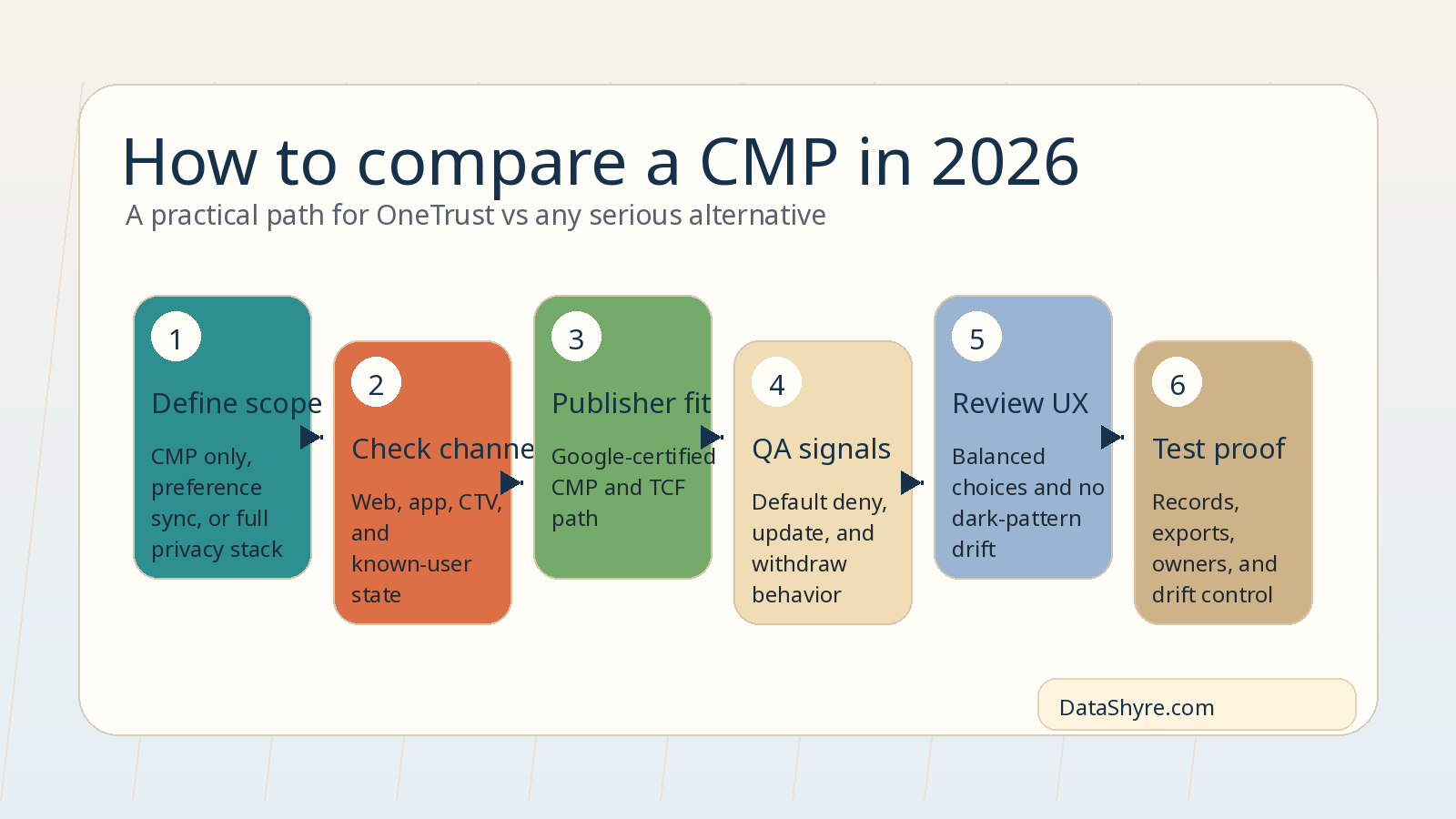
If I were reviewing onetrust vs alternatives right now, I would do it in this order:
- define whether the comparison is CMP-only, CMP plus preference sync, or broader privacy operations;
- map the channels and identity model you actually need this year;
- run the Google publisher certification and TCF check separately if ad monetization matters;
- test the live consent-signaling path, including deny and withdrawal states;
- review the banner and preference UX for dark-pattern risk;
- estimate the manual operating burden after launch;
- confirm evidence exports and named owners before procurement.
That process is much more useful than scoring vendors by homepage screenshots.
Bottom line
The phrase onetrust vs sounds vague because most real buying decisions are broader than a banner.
In 2026, the smart comparison is not OneTrust versus a logo wall. It is OneTrust versus the exact runtime, publisher, preference, and operational requirements your team must satisfy after the contract is signed. If you compare at that level, the right answer gets clearer fast.
Sources
- OneTrust Consent & Preferences
- OneTrust Pricing and Packaging
- OneTrust Developer Docs: Google Consent Mode
- Google Ad Manager Help: Google consent management requirements for serving ads in the EEA, the UK, and Switzerland (for publishers)
- Google Ad Manager Help: Google consent management requirements for serving ads in the EEA, the UK, and Switzerland (for CMPs)
- Google for Developers: Consent Mode Overview
- European Commission: Information for Individuals
- European Commission: Legal Grounds for Processing Data
- CNIL: Dark Patterns in Cookie Banners: CNIL issues formal notice to website publishers
- ICO: Final storage and access technologies guidance published
- ICO: Guidance on the use of storage and access technologies
- CPPA: Enforcement Advisory Stresses the Importance of Avoiding Dark Patterns
- California DOJ: Global Privacy Control (GPC)
—
Published: October 18, 2026. Updated using current official OneTrust, Google, European Commission, CNIL, ICO, CPPA, and California DOJ materials available at publication time.