

Consent Management in 2026: A Practical Guide to Notices, Signals, and Proof
If you are searching for consent management in 2026, the shortest useful answer is this: it is not the banner by itself.
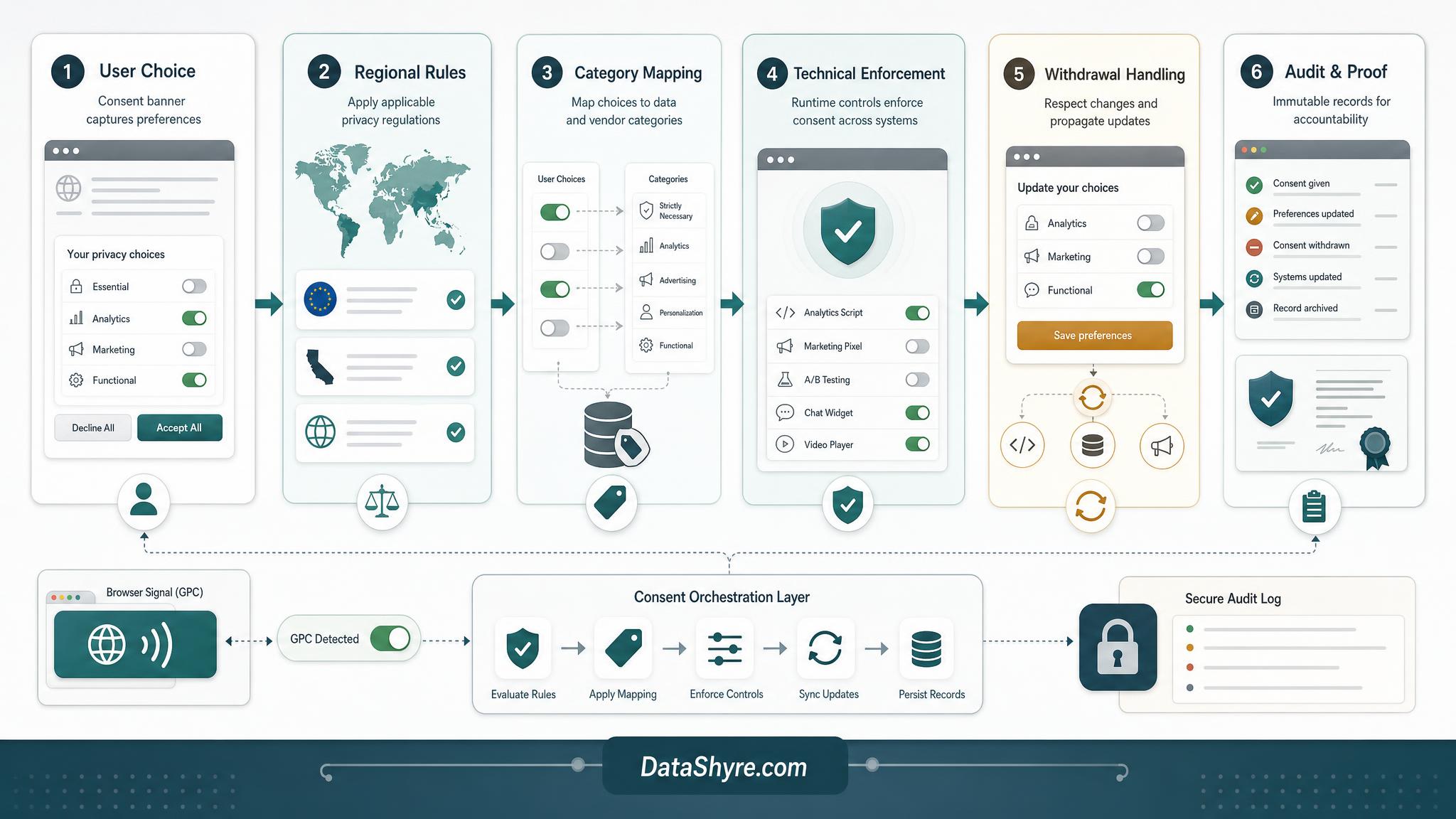
Consent management is the control layer that decides when a user choice is needed, how that choice is presented, where the resulting signal travels, and what evidence your team can still show later. On a live site or app, that means connecting notices, region logic, tags, embeds, opt-out signals, and records that still make sense after the next release.
The current official materials all push in that direction. The European Commission still says valid consent must use “clear and plain language” and that withdrawal should be “as easy to use as giving consent.” The ICO said when it finalized its storage-and-access-technologies guidance on April 29, 2026 that people need “meaningful control” over how their data is used online. California’s Department of Justice still describes Global Privacy Control as a “stop selling or sharing my data switch.” And the CPPA’s enforcement advisory still warns that “Dark patterns aren’t about intent, they’re about effect.”
If you want the closest companion reads first, start with our guides to what is consent management, consent management process, and consent management systems. This page is broader. It is the practical guide I would use this week to evaluate consent management on a live property.

1. Start by deciding whether consent is actually the right control
The first mistake in consent management is assuming every privacy choice belongs inside a consent prompt.
Sometimes the right mechanism is consent. Sometimes it is an opt-out, an unsubscribe flow, a contractual necessity, or a statutory rights workflow. The European Commission’s current business guidance is still useful here because it keeps the core test simple: consent has to be freely given, informed, specific, and expressed through an affirmative act.
That means a real review starts with four questions:
- what exact purpose are you asking about;
- whether consent is the right legal basis for that purpose;
- whether refusal leaves the person free from pressure or disadvantage;
- whether the purpose is narrow enough to stay meaningful later.
If this step is vague, the rest of the consent management stack usually becomes a record of confusion rather than a reliable control.
2. Map every technology the choice is supposed to control
Weak consent management programs often stop at the visible user interface.
The ICO’s final guidance from April 29, 2026 is a good reminder that the operational surface is much wider. Its storage-and-access-technologies guidance covers cookies, tracking pixels, link decoration and navigational tracking, device fingerprinting, web storage, and scripts or tags. In practice, that means your inventory has to go beyond the CMP dashboard.
I would expect consent management to account for:
- analytics tags and advertising pixels;
- tag-manager rules and hardcoded scripts;
- chat, video, form, and scheduling embeds;
- mobile SDKs where the same user journey continues in app;
- downstream partner sharing or audience syncs where they apply.
If the choice only governs one layer while other tools keep firing beside it, the program is incomplete.
3. Separate region logic instead of forcing one universal flow
This is where average consent management often looks clean in documentation and weak in reality.
EU and UK flows frequently center on prior consent before optional storage or access technologies run. California often raises a different implementation issue: can the business honor opt-out rights, recognize a valid GPC signal, and stop sale or sharing where required. The California DOJ still says GPC must be honored as a valid consumer request, and its February 11, 2026 Disney settlement shows what happens when an opt-out does not travel across linked services and devices.
So practical consent management should branch clearly:
- EU or UK prior-consent paths for optional technologies;
- California opt-out and GPC handling where applicable;
- separate communication-preference flows for email, SMS, or account messaging;
- separate rights workflows for deletion, access, or correction requests.
When all of that is collapsed into one drawer, the interface may look simple while the obligations become blurry.
4. Make the choice symmetrical and the withdrawal path easy
The user-interface layer still matters because it is where the promise is made.
CNIL’s cookie-banner enforcement update from December 12, 2024 says the possibility of rejecting cookies must be as easy as accepting them and calls out designs that bury or visually weaken the reject option. The CPPA’s advisory makes the same point from a California angle by focusing on symmetrical choices and clear language when businesses offer privacy controls.
For consent management, that means checking whether:
- reject is visible where prior consent is required;
- the wording is specific instead of evasive;
- a person can reopen settings later without hunting for the control;
- withdrawal changes what the site or app actually does, not just the saved preference.
That is where decorative banners start to separate from real consent management.
5. Enforce the choice before optional data starts moving
This is the technical center of consent management.
Google’s current setup guidance for consent mode says the default consent state should be set on every page before commands that send measurement data, and that consent updates should be tracked on the page where they occur before any page transition. Even if your stack is not centered on Google tooling, the operating principle is the same: the signal has to reach runtime behavior early enough to matter.
On a live property, I would test at least these states:
- no choice yet;
- explicit reject;
- explicit accept;
- later withdrawal or preference change.
Then I would compare the network and vendor behavior against the promise on screen:
- are optional tags blocked or constrained before they run;
- do updates apply quickly enough to matter on the same page;
- do non-Google vendors obey the same choice;
- do later page views or route changes preserve the same state.
If optional activity starts first and the interface catches up later, the consent management layer is mostly paperwork.
6. Keep records that explain both the notice and the behavior
Good consent management does not end when a click is stored.
The evidence should help another person reconstruct what happened. That usually means preserving more than a yes-or-no value in a database. The record should let you see what the person was shown, what region or rule set applied, what they selected, when they selected it, and what technical state followed from that choice.
Useful consent management records usually include:
- the notice or banner version displayed;
- the category or purpose presented;
- the region or rules applied;
- the timestamp and identifier;
- the resulting technical state;
- any later update, withdrawal, or opt-out.
Those records become much stronger when they can be reconciled with real browser behavior instead of standing alone.
7. Re-test after every meaningful release
The biggest operational mistake in consent management is treating it as a launch task instead of a release-sensitive control.
The ICO’s guidance explicitly addresses what happens when technologies or purposes change. That is the practical reason retesting matters. A new embed, republished tag container, revised category map, or vendor-side change can turn yesterday’s valid setup into today’s gap.
So I would treat these as automatic re-test triggers for consent management:
- a new tag, pixel, SDK, or vendor;
- a banner or preference-center redesign;
- a GTM or script-order change;
- a new region branch or policy update;
- a change in downstream sharing or audience logic.
That is usually where the truth of the program shows up.
A short live review sequence for this week
If I were pressure-testing consent management today, I would work in this order:
- confirm the purpose and legal basis for each choice;
- inventory every tool the choice is meant to control;
- test region branches separately instead of trusting one default path;
- verify that reject and withdrawal are as usable as accept;
- inspect runtime behavior before and after the choice;
- compare stored records with browser and vendor behavior;
- rerun the checks after the latest release.
That sequence usually reveals more than another round of screenshots from an admin panel.
Bottom line
In 2026, strong consent management is not the prettiest banner or the longest preference center.
It is the operating layer that connects a fair request, the right regional logic, real technical enforcement, and proof that still matches what happened on the site or app. If the stack can still do that after the next tag change or vendor update, the program is working. If not, the gap is probably not in the policy text. It is in the runtime behavior.
Sources
- European Commission: Legal grounds for processing data
- UK ICO: Final storage and access technologies guidance published
- UK ICO: Guidance on the use of storage and access technologies
- California Department of Justice: California Consumer Privacy Act
- California Department of Justice: Global Privacy Control
- California Department of Justice: California Won’t Let It Go: Attorney General Bonta Announces $2.75 Million Settlement with Disney, Largest CCPA Settlement in California History
- California Privacy Protection Agency: CPPA Enforcement Advisory Stresses the Importance of Avoiding Dark Patterns
- CNIL: Dark Patterns in Cookie Banners: CNIL issues formal notice to website publishers
- Google for Developers: Set up consent mode on websites
—
Published: October 17, 2026. Updated using current official regulator, government, and platform materials available at publication time.