

OneTrust Privacy Management in 2026: 7 Checks Before You Trust the Stack
If you are searching for onetrust privacy management on October 17, 2026, you are usually not asking only about a cookie banner.
You are usually trying to answer a broader operations question: can OneTrust actually help your team manage data mapping, assessments, privacy rights, consent boundaries, and evidence without creating a second admin burden?
That is the right framing. OneTrust’s current public materials still split the story into distinct layers. Privacy Operations focuses on asset detection, data mapping, recordkeeping, risk workflows, and remediation. Consent & Preferences sits separately for CMP and broader preference orchestration. The pricing and packaging pages also separate base privacy automation from suite-level workflows such as DSR fulfillment and privacy incident handling.
If you want nearby context first, start with our guides to OneTrust cookie consent, consent management platform, and GDPR compliant privacy notice. This page is narrower. It is the seven-check review I would use before trusting onetrust privacy management in a live program.

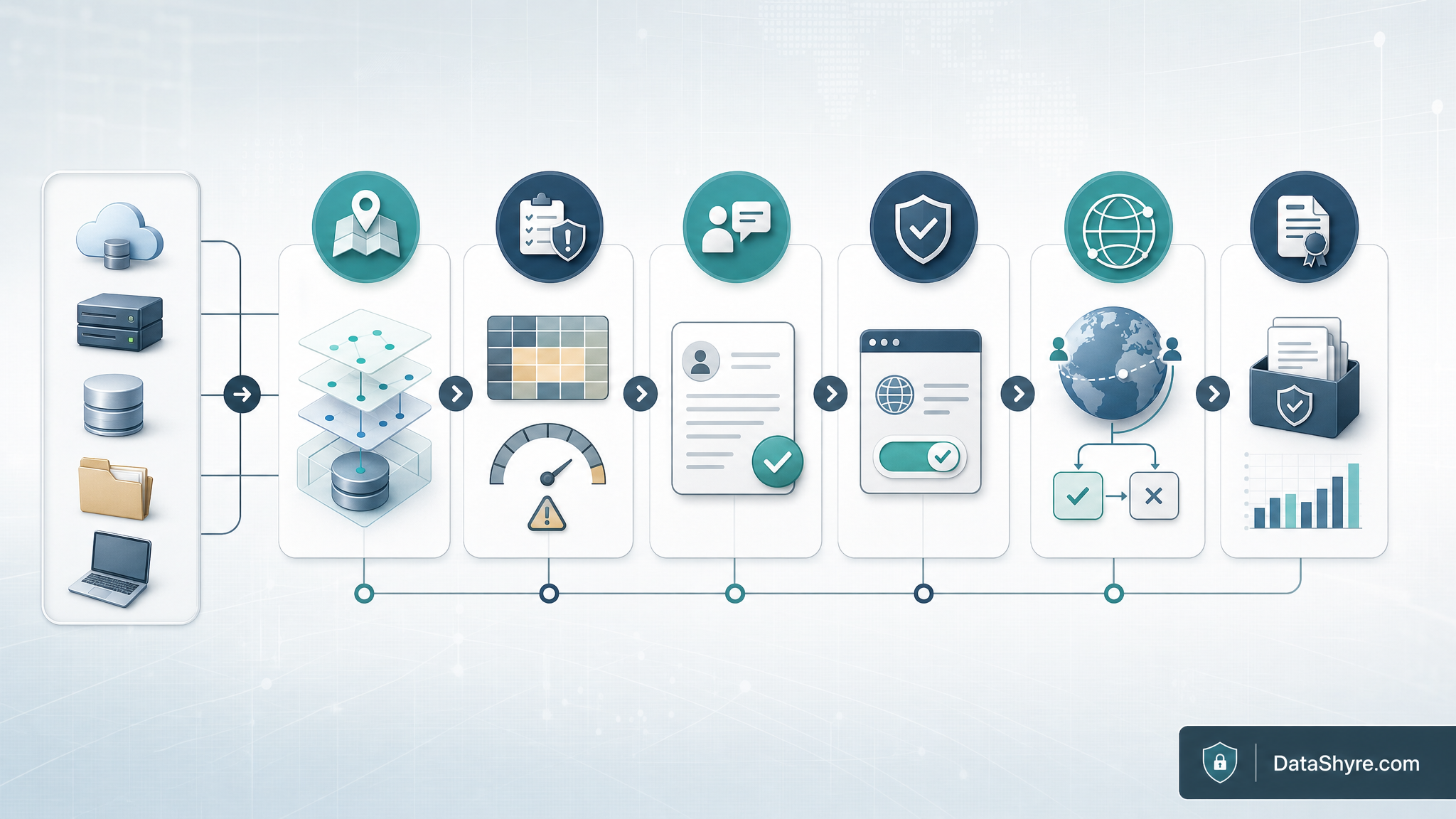
1. Decide whether you are evaluating Privacy Operations, Consent & Preferences, or both
This is the first reset I would make in any onetrust privacy management conversation.
OneTrust’s current product pages still describe separate but connected tracks:
- Privacy Operations for data mapping, recordkeeping, privacy assessments, and remediation workflows;
- Consent & Preferences for CMP and preference capture across digital properties and channels; and
- DSR and incident workflows that the pricing page places inside the broader Privacy Automation suite rather than treating as an automatic default everywhere.
That split matters because buyers often use onetrust privacy management as shorthand for “all of our privacy problems.” The software scope may not match that assumption unless you define it first.
2. Test data mapping against the systems you really run
OneTrust’s Privacy Operations page still says the platform can connect to IAM services, cloud providers, and CMDBs to continuously detect data assets and trigger downstream workflows. The same material says it can identify personal data, map processing activities, auto-generate records of processing activities, and help surface data transfers.
That sounds strong, but the real test is simple: does it work on your stack?
For onetrust privacy management, I would ask for proof using the systems that actually matter in your environment:
- core cloud platforms;
- identity systems;
- business apps that contain customer or employee data;
- vendor relationships that create transfer or disclosure risk; and
- the systems your team always forgets until an assessment or DSR arrives.
If the map only looks clean in a demo tenant, it is not yet an operating advantage.
3. Verify that assessments and mitigation workflows match how your team governs risk
OneTrust’s current Privacy Operations materials still say the platform can automate privacy impact, vendor, and AI risk assessments, including workflows such as PIA, DPIA, and TIA reviews. The pricing page also still says Privacy Automation includes mitigation workflows and DataGuidance intelligence for understanding regulatory change.
That makes onetrust privacy management more than an inventory tool. It is also supposed to be a workflow system.
So I would check whether the setup can actually support:
- who opens an assessment;
- who approves or rejects it;
- how mitigations are assigned and tracked;
- how transfer-related issues get reviewed; and
- how evidence survives after the original requestor leaves the team.
If the workflow still lives in email and spreadsheets, the platform may be recording privacy work rather than running it.
4. Confirm whether DSR and incident handling are included or merely assumed
This is a common buying mistake.
OneTrust’s pricing page still says the Privacy Automation suite includes automated DSR fulfillment, including intake, ID verification, retrieval, deletion, and secure communication, plus privacy incident management. OneTrust’s DSR product page is still live separately, and its October 7, 2026 DSR operations write-up stresses growing pressure around validation, system matching, workflow automation, and evidence.
For onetrust privacy management, that means you should ask direct scoping questions:
- are DSR intake and fulfillment in the package you are reviewing;
- who owns identity verification and exception handling;
- how does deletion or no-match evidence get documented;
- what does incident intake look like; and
- which steps still depend on manual coordination outside the platform.
If those answers stay vague, you may be pricing only part of the privacy-operations problem.
5. Keep consent and preference management as a separate implementation branch when needed
This is where many teams over-assume what onetrust privacy management covers by default.
OneTrust’s current Consent & Preferences page still positions CMP and Universal Consent & Preference Management as a separate solution family. It says the CMP scans digital properties and categorizes cookies and trackers using a database of more than 45 million tracking technologies, while UCPM keeps consent and granular preferences in one profile across channels, devices, and touchpoints.
That means a privacy-operations purchase does not automatically solve customer-facing consent orchestration.
If your scope includes websites, apps, or ad-tech routing, check the separate runtime path too:
- how the CMP is deployed;
- how Google consent mode signals are sent and updated;
- whether preference changes persist correctly; and
- whether known-user preferences stay synchronized across touchpoints.
Google’s current consent mode materials still say consent states must be set before tags rely on them, and its debugging guidance still tells teams to verify the default consent state before any tags fire. So if marketing consent is part of your onetrust privacy management plan, the runtime branch needs its own QA rather than a procurement assumption.
6. Pressure-test choice and rights handling against current regulator expectations
The legal standard is still about outcomes, not screenshots.
The European Commission still says valid consent must use clear and plain language and that it should be “as easy to withdraw as to give consent.” The ICO’s final storage-and-access-technologies guidance, published on April 29, 2026, says the rules cover cookies, tracking pixels, device fingerprinting, and similar technologies, and William Malcolm said organizations want “clear, practical guidance” they can rely on. In California, the CPPA says businesses must honor opt-out preference signals such as Global Privacy Control under the effective January 1, 2026 regulations, and the California DOJ still describes GPC as a “stop selling or sharing my data switch.”
So if onetrust privacy management also touches live rights or consent interfaces, test whether:
- refusal is genuinely usable;
- withdrawal remains easy later;
- GPC or equivalent opt-out signals are honored where relevant;
- notices and runtime behavior match; and
- the implementation avoids dark-pattern drift over time.
That last point matters because the CPPA’s enforcement advisory still says “Dark patterns aren’t about intent, they’re about effect.”
7. Demand audit-ready evidence and named operating owners
OneTrust says Privacy Operations is meant to help teams manage risk, demonstrate accountability, and meet regulatory requirements. That promise is only useful if another person can reconstruct what happened later.
For onetrust privacy management, I would want the operating model to answer:
- who keeps the map current;
- who owns assessment templates and approvals;
- who handles DSR and incident exceptions;
- who maintains consent and preference rules if those modules are in scope; and
- what records the team can export quickly during an audit, complaint, or internal review.
If ownership is fuzzy, the platform usually degrades into a partly trusted system of record instead of a trusted operating system.
A short review sequence for this week
If I were evaluating onetrust privacy management on a live program today, I would use this order:
- define whether the scope is privacy operations, consent, or both;
- validate data mapping against real systems;
- test assessment and mitigation workflows with real owners;
- confirm DSR and incident handling scope in writing;
- separately QA CMP and preference runtime behavior where relevant;
- test rights handling against current EU, UK, and California expectations; and
- make sure evidence exports and ownership still work after the implementation team steps away.
That sequence reveals the real gaps faster than another feature comparison sheet.
Bottom line
The phrase onetrust privacy management sounds broad because the operational problem is broad.
The useful 2026 question is not whether OneTrust has a lot of privacy features. It is whether your chosen mix of OneTrust products can map the right systems, route the right workflows, handle rights and consent boundaries honestly, and leave evidence another team can trust later.
If the answer is yes, the platform can be an operational backbone. If not, you may still end up with a polished dashboard sitting on top of manual privacy work.
Sources
- OneTrust Privacy Operations
- OneTrust Pricing and Packaging
- OneTrust Consent & Preferences
- OneTrust Data Subject Request (DSR) Automation
- OneTrust Developer Docs: Google Consent Mode
- Google for Developers: Consent Mode Overview
- Google for Developers: Troubleshoot Consent Mode with Tag Assistant
- European Commission: Legal Grounds for Processing Data
- ICO: Final Storage and Access Technologies Guidance Published
- ICO: Guidance on the Use of Storage and Access Technologies
- California Privacy Protection Agency FAQs
- California Department of Justice: California Consumer Privacy Act
- California Department of Justice: Global Privacy Control
- CPPA Enforcement Advisory on Dark Patterns
—
Published: October 17, 2026. Updated using current official OneTrust, Google, European Commission, ICO, CPPA, and California DOJ materials available at publication time.