

Cookie Consent for Agency in 2026: 7 Client Checks Before You Deploy
If you are searching for cookie consent for agency on October 13, 2026, the useful question is not whether your team can install one more banner plugin.
It is whether your agency can ship a client setup that still makes sense after regional rules, Google tags, ad vendors, CMS changes, and the next rushed publish.
That is where current official guidance points. The European Commission still says a valid consent request must use “clear and plain language” and be tied to a specific purpose. The ICO’s final storage-and-access-technologies guidance, published on April 29, 2026, now expressly covers cookies, tracking pixels, device fingerprinting, web storage, and scripts or tags. California’s Department of Justice still says a valid Global Privacy Control signal must be honored and describes GPC as a “stop selling or sharing my data switch.” Google’s current consent documentation also still expects teams to set consent defaults before tags fire and to verify the behavior with Tag Assistant.
That mix is why cookie consent for agency work is not mainly a design task. It is a client-delivery control task.
If you want the closest related reads first, start with our guides to consent management process, cookie consent Google Tag Manager, and CCPA cookie consent. This article is narrower. It is the seven-check review I would use before an agency pushes a consent setup live for a client this week.
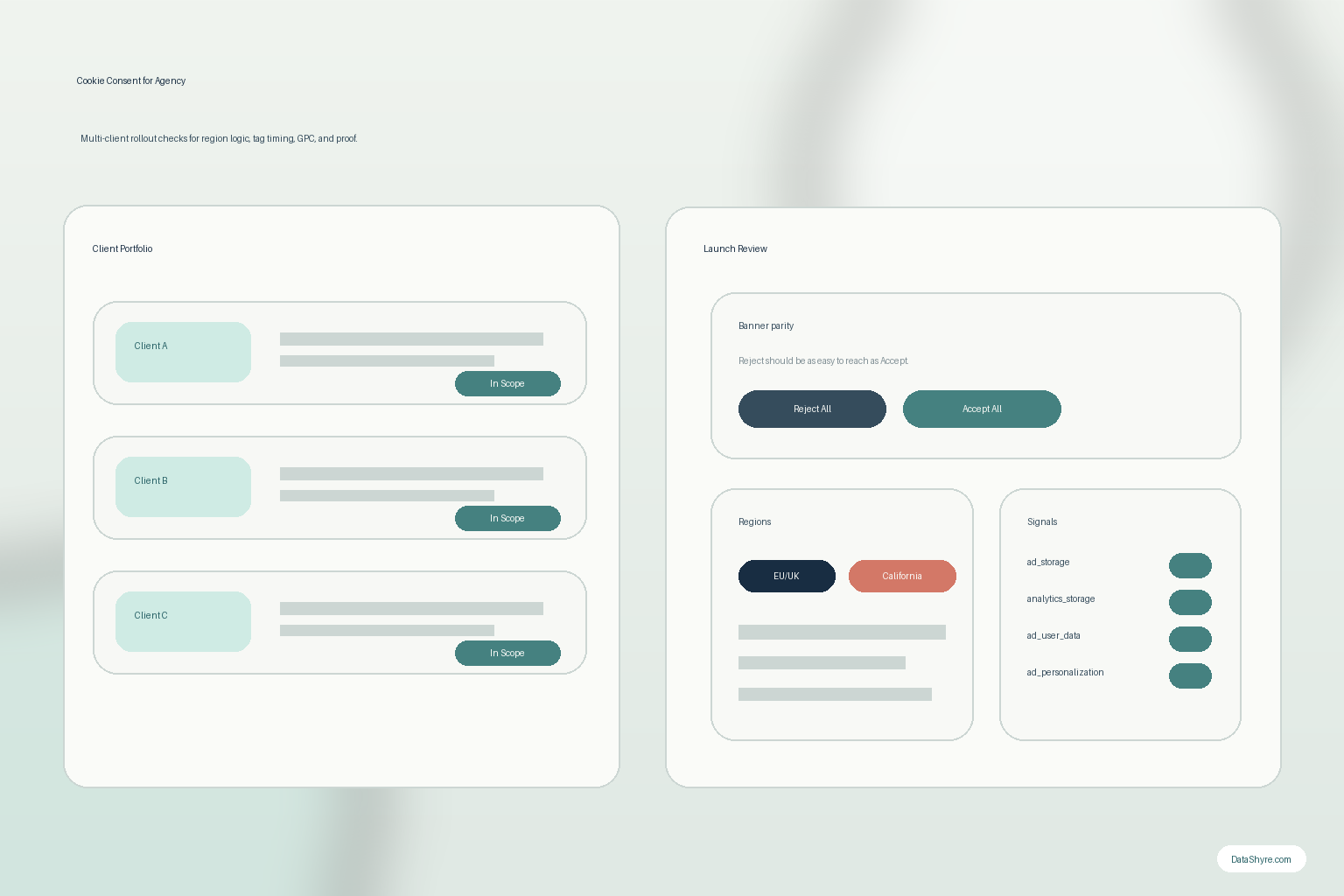
1. Scope the client by region, stack, and business model before you touch the banner
The first cookie consent for agency mistake is treating every client like the same website with different colors.
That shortcut breaks fast because the compliance shape changes with region and stack. The European Commission’s current consent guidance still ties valid consent to specific purposes, visibility, and easy withdrawal. The ICO’s current SAT guidance also makes clear that the audit surface is broader than classic cookies alone.
So before your agency ships anything, define:
- which regions the client actually serves;
- which properties are in scope;
- which trackers, pixels, embeds, and tag managers are live;
- whether the client is ad-supported, lead-generation driven, ecommerce, or mostly informational.
If you skip that discovery step, the banner usually ends up describing a simpler website than the one that really exists.
2. Set ownership in the statement of work, not in Slack messages
Many cookie consent for agency projects fail because legal, engineering, media, and the client all assume somebody else owns the final call.
The agency should pin down at least five responsibilities before launch:
- who approves the cookie categories and wording;
- who maps the live vendors into those categories;
- who owns Google Tag Manager or the equivalent tag layer;
- who responds when a new script appears after launch;
- who exports evidence if the client gets a complaint or questionnaire.
That sounds operational because it is operational. Consent is hard to defend when the agency controls the code, the client controls the policy text, and nobody controls the change process.
3. Make the denied default land before measurement tags do
This is the most important technical check in cookie consent for agency work.
Google’s current developer guidance still says the default consent state must be set before any command that sends measurement data, and its troubleshooting guide for Tag Manager says consent-writing template tags should fire on Consent Initialization. The same materials still expect the four current consent fields to be handled: ad_storage, analytics_storage, ad_user_data, and ad_personalization.
For agencies, that means the review should answer:
- what default state lands for EU, UK, and other mapped regions;
- whether the consent update happens immediately after user choice;
- whether Google tags and non-Google tags both respect the same logic;
- whether a reject flow and a later withdrawal flow both behave correctly.
If the client says “the banner is installed” but Tag Assistant shows defaults missing or arriving late, the deployment is not finished.
If the client is an ad-supported publisher, add one more branch. Google’s current publisher help still says personalized ads to users in the EEA, the UK, and Switzerland require a Google-certified CMP integrated with the IAB TCF. That is a separate platform requirement, not a shortcut to broader legal compliance.
4. Test the first layer for real refusal, not visual politeness
Agencies often review the first layer for brand fit when they should be reviewing it for actual choice.
The ICO still says valid cookie-style consent requires “unambiguous positive action” and that continuing to browse is not enough. CNIL’s current cookie-banner enforcement language is even plainer: rejecting cookies should be just as easy as accepting them.
So the first live test for cookie consent for agency should be boring on purpose:
- can the visitor refuse on the first layer where prior consent is required;
- is the reject control as visible as the accept control;
- does the site technically behave like refusal happened.
If refusal is visually weaker, buried in copy, or delayed until a second panel, the agency should treat that as a release blocker rather than a styling issue.
5. Handle California as its own workflow, not a weak footer add-on
For multi-region clients, cookie consent for agency work usually becomes unstable when California is bolted onto an EU banner as an afterthought.
California’s official CCPA pages still frame opt-out of sale or sharing as a real consumer right, and the DOJ’s GPC page still says a covered business must honor a valid GPC signal. That means the California branch needs its own working checks:
- does the site detect and honor GPC where applicable;
- does the opt-out change downstream sharing or ad-tech behavior;
- can the visitor exercise the right without account friction or a misleading path.
The agency should not assume one banner toggle proves any of that. The proof is in whether the signal reaches the actual vendors, audiences, and transfers that matter.
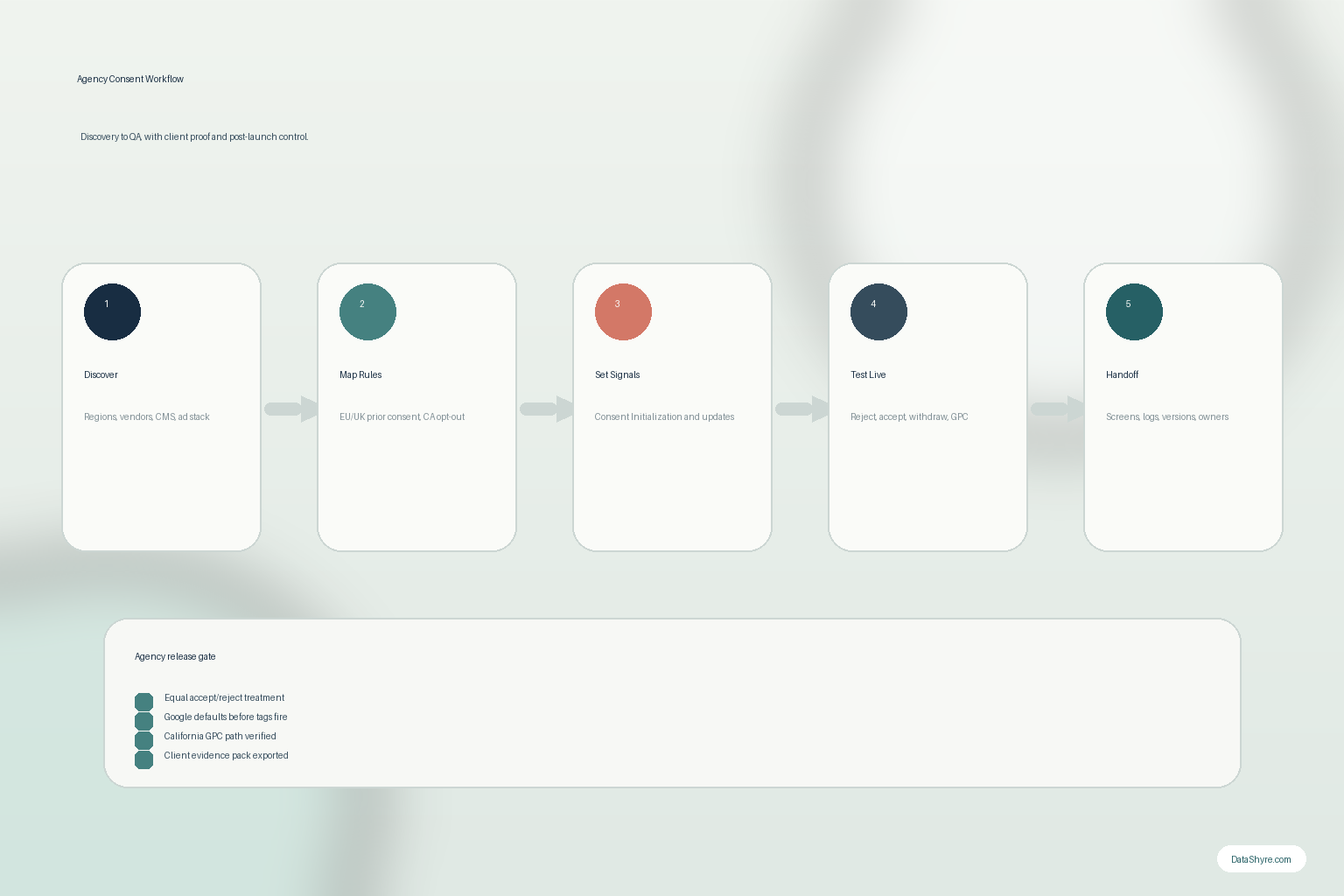
6. Preserve evidence per client, per version, and per release
Another common cookie consent for agency failure is leaving the client with only a screenshot and a vendor invoice.
The European Commission says the controller must be able to show valid consent. The ICO’s current guidance also pushes teams toward usable records of user preferences and withdrawal.
For agency delivery, I would want the handoff pack to preserve:
- the banner and preference-center version shown to users;
- the category definitions in force at launch;
- the GTM or CMP version that wrote the signal;
- the regional logic applied;
- the policy links and wording approved at that point in time;
- the test result for accept, reject, and withdrawal.
If the agency cannot reconstruct that package later, the client is buying implementation without evidence.
7. Build a post-launch change loop or the client will drift out of compliance
The last cookie consent for agency check is maintenance, not launch.
The ICO’s current SAT guidance now explicitly asks what happens when technologies or purposes change. That matters because agency-managed sites change constantly. A marketing team adds a pixel. A new chat widget appears. Somebody republishes the GTM container. A new landing-page tool gets pasted into the header. The banner copy stays the same while the live behavior changes underneath it.
So the agency operating model should include:
- rescanning or re-auditing after meaningful releases;
- reviewing new vendors before they go live;
- retesting regional behavior after template, routing, or tag changes;
- rechecking Google consent signals in Tag Assistant after container publishes;
- giving the client a clear escalation path when marketing wants something new quickly.
Without that loop, the client does not really have a consent program. It has a launch artifact.
A practical agency review sequence for this week
If I were reviewing cookie consent for agency on a live client property today, I would work in this order:
- map regions, properties, vendors, and business model;
- confirm ownership for copy, categories, tags, and evidence;
- verify denied defaults and updates before measurement tags fire;
- test first-layer refusal on desktop and mobile;
- run a separate California GPC and opt-out check where relevant;
- export the evidence pack;
- repeat the tests after the most recent publish or container change.
That usually exposes the real weak point faster than another feature comparison between CMPs.
Bottom line
The best way to think about cookie consent for agency in 2026 is not “which banner can we install fastest?”
It is “can we ship a client workflow that matches the real site, the real regions, the real tag behavior, and the real evidence burden after launch?”
If the answer is yes, the agency is delivering a working control layer. If not, it is delivering interface polish with a runtime gap underneath it.
Sources
- European Commission: Legal grounds for processing data
- ICO: Final storage and access technologies guidance published
- ICO: Guidance on the use of storage and access technologies
- ICO: Cookies and similar technologies
- CNIL: Dark Patterns in Cookie Banners: CNIL issues formal notice to website publishers
- California Department of Justice: California Consumer Privacy Act (CCPA)
- California Department of Justice: Global Privacy Control
- Google for Developers: Set up consent mode on websites
- Google for Developers: Troubleshoot consent mode with Tag Assistant
- Google AdSense Help: Google consent management requirements for serving ads in the EEA, the UK and Switzerland (for publishers)
—
Published: October 13, 2026. Updated using current official regulator, government, and platform materials available at publication time.