

GDPR Cookies Consent in 2026: 7 Live Checks Before You Trust the Banner
If you are reviewing gdpr cookies consent in 2026, the most useful question is not whether your site has a banner.
The useful question is whether non-essential cookies and similar tracking technologies actually stay off until the user makes a valid choice, whether rejecting is genuinely easy, and whether your records still explain what happened after the next tag change or design refresh.
That is the practical standard in current official materials. The European Commission still says consent must be freely given, specific, informed, and based on a clear affirmative act, using “clear and plain language.” The UK’s ICO says people should have “meaningful control” over how their data is used online. CNIL says “rejecting cookies should be just as easy as accepting them.” And in July 2026, the EDPB told the Belgian DPA it had to assess a NOYB cookie-banner complaint on the merits instead of dismissing it procedurally. Cookie consent is still an active enforcement topic.
If you want nearby context first, start with our guides to GDPR cookie consent requirements, cookie consent requirements, and cookie consent Google Tag Manager. This article stays narrower. It is the seven-check review I would use before trusting gdpr cookies consent on a live site this week.

1. Start by checking the real scope of what your consent layer is supposed to govern
The first mistake teams make with gdpr cookies consent is assuming the job begins and ends with classic browser cookies.
The ICO’s finalized storage-and-access-technologies guidance, published on April 29, 2026, explicitly covers cookies, tracking pixels, device fingerprinting, and similar technologies. That matters because a clean banner can still sit on top of a messy runtime.
So before you assess button labels or banner layout, map the full scope:
- cookies and local storage;
- analytics and advertising tags;
- embedded chat, video, and scheduling tools;
- fingerprinting or similar identifier logic;
- downstream vendors receiving tracking data.
If one of those layers runs outside the consent control plane, the interface may look compliant while the implementation is not.
2. Confirm that non-essential technologies truly wait for prior consent
This is still the core operational test.
The ICO’s current cookie guidance says you cannot set non-essential cookies on a website’s homepage before the user has consented to them, and that continuing to use the site is not enough. Ireland’s DPC also says analytics cookies require consent, not just advertising cookies. That makes gdpr cookies consent a runtime question before it becomes a copy question.
On a live property, I would test at least these states:
- first page load with no choice yet;
- explicit reject;
- explicit accept;
- later withdrawal or settings change.
Then compare what the browser actually does. If optional analytics, ad, personalization, or social scripts still fire on first load, the compliance story breaks immediately.
3. Make refusal as easy to find and use as acceptance
This is where many banners still fail even when the backend is reasonably disciplined.
CNIL’s December 12, 2024 formal-notice announcement remains one of the clearest current statements on banner design. It says “rejecting cookies should be just as easy as accepting them” and lists misleading design patterns it found in the wild, such as hidden refusal links, weak typography for rejection, and banners that repeat the accept path more prominently than the reject path.
For gdpr cookies consent, that means checking whether:
- the reject option appears at the same layer where accept appears;
- refusal language is explicit rather than softened;
- color, spacing, and emphasis do not push the user toward yes;
- the banner does not multiply acceptance opportunities while minimizing refusal.
If the site claims freedom of choice while the interface nudges acceptance, the banner is harder to defend than it looks.
4. Use specific categories and plain language instead of vague labels
A surprising amount of weak consent starts with generic wording.
The European Commission says consent requests should use “clear and plain language” and clearly state the reasons for the processing. For gdpr cookies consent, that usually means category names and explanations should tell the user what will actually happen, not hide behind polished placeholders.
That means a better banner usually says something like:
- necessary cookies to keep the site working;
- analytics cookies to measure site use;
- advertising or marketing cookies for ad delivery or remarketing;
- personalization cookies for saved preferences or content tailoring.
It also means avoiding vague phrases such as improve your experience when the real outcome is cross-site measurement, third-party audience building, or behavioral advertising.
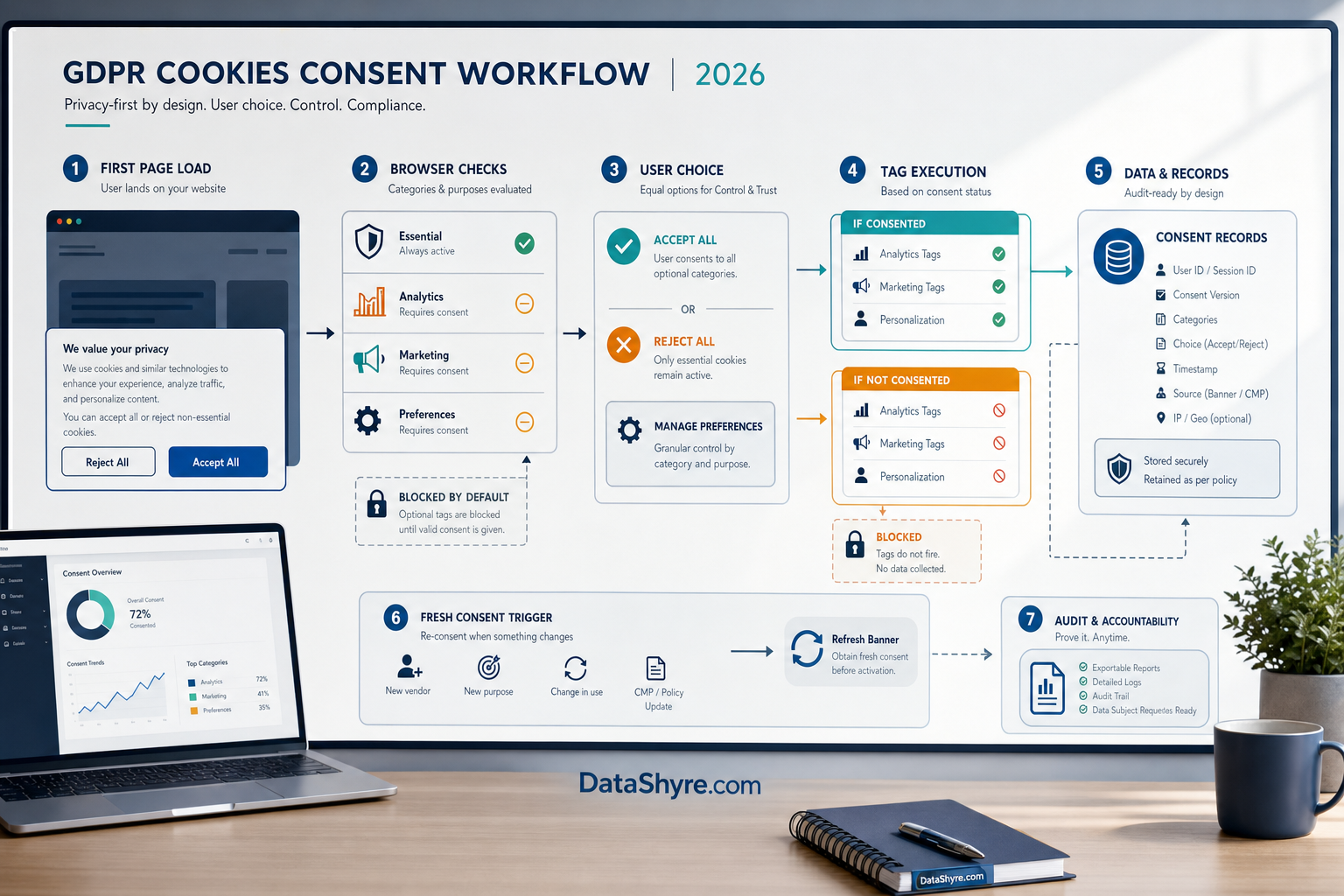
5. Re-check consent whenever the technology or purpose changes
Cookie consent does not stretch indefinitely to cover later decisions.
The ICO’s storage-and-access-technologies guidance says you must obtain fresh consent if you introduce new storage and access technologies for a different purpose than the one originally stated when consent was granted. That is one of the most important operational rules around gdpr cookies consent because tracking stacks drift constantly.
In practice, this check catches problems such as:
- a new pixel added through a tag manager container;
- a video or chat embed that now sets identifiers earlier than before;
- an analytics configuration that expands into advertising or cross-site use;
- a vendor change that adds new recipients or new purposes.
This is why mature teams treat cookie consent as release work, not a one-time legal project.
6. Treat analytics and third-party tools as separate risk checks
Teams often assume analytics is automatically exempt or lower risk.
Ireland’s DPC is useful here because its current FAQ says analytics cookies require consent. It also notes that third-party analytics may represent a greater privacy risk where those providers use the data for their own purposes. That is a practical reminder that gdpr cookies consent should not flatten first-party measurement and third-party tracking into one harmless bucket.
For a serious review, ask:
- is the tool first-party only or does a vendor also process the data;
- does the vendor combine the data with other services or advertising products;
- can the user understand who receives the data and why;
- does the tag stay blocked until the relevant consent signal exists.
If the banner says analytics but the actual toolchain creates wider downstream use, the category is too vague and the disclosure is too weak.
7. Keep proof that explains both the user choice and the technical effect
Consent without evidence gets fragile quickly.
The European Commission says the controller must be able to demonstrate that the individual consented. The EDPB’s July 14, 2026 VRT cookie-banner decision matters for the same reason: it is a reminder that cookie-banner complaints are still being pushed onto the merits, where the facts of the flow and the implementation matter.
So for gdpr cookies consent, the useful record set usually includes:
- the banner or preference-center version shown;
- the categories and descriptions presented;
- the timestamp and identifier for the user’s action;
- the region or rule set applied;
- the resulting tag or vendor state;
- any later withdrawal or preference change.
Those records become much stronger when they can be reconciled with browser evidence. A database row that says rejected is weak proof if the network log shows optional requests fired anyway.
A short live review sequence for this week
If I were pressure-testing gdpr cookies consent today, I would use this order:
- inventory every cookie, tag, pixel, embed, and similar technology in scope;
- test whether non-essential technologies stay off before consent;
- compare accept and reject paths for equal prominence and ease;
- review category wording for specificity and plain language;
- inspect whether analytics and third-party tools are disclosed honestly;
- verify fresh-consent triggers when tools or purposes change;
- compare saved records with real browser behavior.
That usually reveals more real exposure than another visual redesign.
Bottom line
In 2026, the right way to think about gdpr cookies consent is not as a banner choice. It is a control problem.
If your site blocks optional technologies before consent, makes rejection as easy as acceptance, explains categories honestly, rechecks new purposes, and keeps evidence that matches live behavior, you are in much stronger shape. If not, the banner may be finished while the consent program is still incomplete.
Sources
- European Commission: Legal grounds for processing data
- European Commission: Information for individuals
- UK ICO: Cookies and similar technologies
- UK ICO: Final storage and access technologies guidance published
- UK ICO: How do we manage consent in practice?
- Ireland Data Protection Commission: My website or app uses cookies and other tracking – do I have to get consent from users?
- Ireland Data Protection Commission: Do I need consent for analytics cookies?
- Ireland Data Protection Commission: What are the common problems the DPC sees on websites and in other interfaces controlling the use of cookies and tracking?
- CNIL: Dark Patterns in Cookie Banners: CNIL issues formal notice to website publishers
- European Data Protection Board: EDPB requires Belgian DPA to handle the merits of NOYB cookie banner complaint
—
Published: October 9, 2026. Updated using current official European Commission, regulator, and supervisory-authority materials available at publication time.