

Opt-In Consent in 2026: When You Actually Need It and What Counts
If you are reviewing opt-in consent in 2026, the biggest mistake is treating it like one universal rule.
Sometimes opt-in is the right legal mechanism. Sometimes it is a cookie rule. Sometimes it is a marketing rule. Sometimes the real threshold is explicit consent. And in California, the central workflow is often opt-out first, with narrower opt-in moments layered on top.
That is why opt-in consent gets implemented badly. Teams add a checkbox everywhere, assume it solves the privacy question, and then miss the harder review: was consent actually required, was the choice specific enough, could the person really say no, and does the system still behave correctly after the choice is made?
If you want nearby context first, start with our guides to GDPR consent requirements, cookie consent requirements, and California consumer privacy. This article stays narrower. It is the practical review I would use before trusting an opt-in consent flow on a live site, app, or signup path this week.

The shortest useful answer
In practice, opt-in consent usually means one of five different things:
- consent as a GDPR or UK GDPR lawful basis;
- prior consent for non-essential cookies or similar technologies;
- consent for email or text marketing where PECR-style rules apply;
- explicit consent for special-category or other high-risk processing; or
- affirmative authorization for minors or narrow California opt-in events.
Those are not interchangeable. A clean review starts by deciding which version of opt-in consent you are actually dealing with.
1. Start by asking whether opt-in consent is required at all
This sounds basic, but it prevents a lot of fake-compliance design.
The European Commission’s current guidance still says consent is only one lawful ground among several and that valid consent must be freely given, informed, specific, and given through a clear affirmative act. The UK’s ICO makes the same point from the other direction: if people do not have genuine control or cannot freely refuse, consent may not be the right basis at all.
So before you build an opt-in consent prompt, ask:
- is consent actually the lawful basis for this activity;
- can the person refuse without pressure or disadvantage;
- is the purpose specific enough to mean the same thing later; and
- would the processing still happen anyway under a different claimed basis.
If the business would proceed regardless, the checkbox may add friction without creating valid consent.
2. Under GDPR and UK GDPR, opt-in has to be active, specific, and easy to reverse
When you really are relying on consent, the standard stays high in 2026.
The European Commission says the request for consent must use clear and plain language, clearly state the reasons for processing, and make withdrawal possible in a way that is “as easy to use as giving consent.” The ICO’s valid-consent guidance still says the action must be a “clear affirmative action.” That is why pre-ticked boxes, silence, inactivity, or bundled terms still fail as practical models for opt-in consent.
On a live flow, that usually means:
- a real affirmative step from the user;
- separate choices when purposes or channels differ;
- plain language about who is processing the data and why; and
- a visible path to withdraw later.
If the system can collect a yes quickly but makes the later no awkward, the opt-in consent design is already weak.
3. Cookies and similar tracking technologies still make opt-in consent a live runtime issue
For websites, one of the most common meanings of opt-in consent is still prior permission for non-essential tracking.
The ICO’s finalized storage-and-access-technologies guidance, published on April 29, 2026, explicitly covers cookies, tracking pixels, device fingerprinting, scripts, and similar technologies. Its current cookie guidance also says you cannot set non-essential cookies before the user consents and that continuing to browse is not enough. That means the real test is not whether a banner exists. The real test is whether optional tags actually wait.
For a practical opt-in consent review, check whether:
- analytics, advertising, and personalization tools stay off before consent;
- reject is as usable as accept where prior consent applies;
- category labels are specific enough to understand; and
- new tags or new purposes trigger a fresh review instead of hiding inside an old consent record.
This is where many stacks still break: the front end says one thing while the browser and tag manager do another.
4. Marketing opt-in consent is often channel-specific, not one broad permission
Marketing is where legal language and operational shortcuts get mixed together fastest.
The ICO’s current electronic-mail marketing guidance says people must take a positive action to consent and that pre-ticked opt-in boxes, silence, or inactivity do not count. The same guidance also keeps the soft opt-in concept alive for certain existing-customer messages, but only where the legal conditions are actually met.
That means opt-in consent for marketing should be reviewed by channel:
- email versus text versus push or other messaging;
- new prospects versus current customer relationships;
- consent-based flows versus narrow soft-opt-in exceptions; and
- whether the wording matches the actual message type.
One catch-all checkbox for every channel is usually a sign that the team designed for convenience first and proof second.
If you are cleaning up that layer too, our GDPR marketing consent guide is the closest companion read.
5. Special-category data can push you from opt-in to explicit consent
This is where teams often underestimate the legal jump.
The ICO’s current special-category guidance says explicit consent must be confirmed in a clear statement, whether oral or written, and should be separate from other consents. That is a higher threshold than ordinary affirmative action. If health data, biometric identifiers, or other special-category information is involved, the question is no longer just whether you captured an opt-in. It is whether you captured explicit consent in a form that stands on its own.
For opt-in consent, this usually means asking whether the flow:
- specifies the sensitive data involved;
- uses a clear statement rather than inferred behavior;
- separates the consent from other permissions; and
- gives the person a genuine choice.
If not, the label “opt-in” may be technically neat but legally too weak.
6. Children’s data is one of the clearest places where opt-in consent is genuinely mandatory
This is one of the least ambiguous branches.
The FTC’s COPPA materials still say covered operators must obtain “verifiable parental consent” before collecting, using, or disclosing personal information from children under 13, subject to limited exceptions. The FTC’s January 16, 2025 final COPPA rule changes also tightened how children’s data can be disclosed to third parties.
California adds its own minors rule. The California DOJ’s CCPA guidance says businesses can only sell the personal information of a child they know is under 16 if they get affirmative authorization. For consumers under 13, that permission must come from a parent or guardian. For consumers age 13 to under 16, the minor can provide the opt-in.
That makes opt-in consent for minors a dedicated compliance program, not a small variant of the adult cookie banner or newsletter signup form.
7. California is mostly opt-out, but there are still important opt-in moments
This is where teams most often over-generalize from Europe.
California’s main model is still the right to opt out of the sale or sharing of personal information. The California DOJ’s current pages say consumers can use the Global Privacy Control and describe it as a “stop selling or sharing my data switch.” The same DOJ guidance also says that, with some exceptions, businesses cannot resume sale or sharing after an opt-out unless the consumer later reauthorizes it, and they must wait at least 12 months before asking the person to opt back in.
So in California, opt-in consent usually matters in narrower ways:
- affirmative authorization for known minors under 16 in sale or sharing contexts;
- later reauthorization after an earlier opt-out;
- narrow high-risk data uses where another rule separately raises the bar; and
- operational handling of signals and preferences so the user’s choice actually sticks.
The practical lesson is simple: California privacy compliance is not a blanket opt-in regime, but it absolutely still contains opt-in moments that need to be handled carefully.
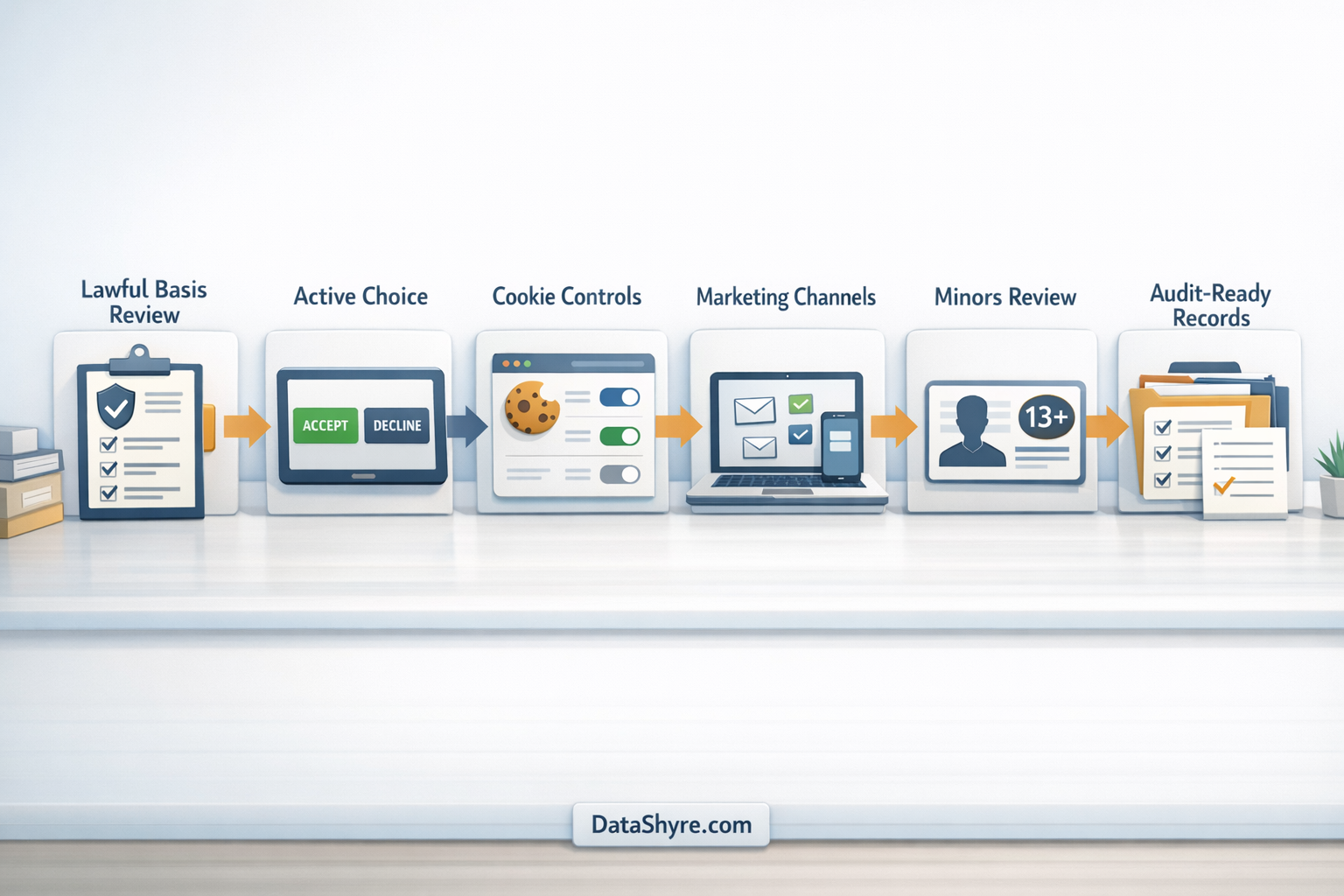
A practical review sequence for this week
If I were pressure-testing an opt-in consent flow right now, I would use this order:
- confirm whether consent is truly the right legal mechanism;
- separate ordinary consent, explicit consent, cookie consent, marketing consent, and minors consent;
- check that the user takes a real affirmative step and that default states are off;
- test whether refusal and withdrawal are genuinely usable;
- verify that browser behavior, message delivery, and downstream tools obey the same choice;
- confirm records show what the person saw, chose, and later changed; and
- rerun the checks after any new tag, vendor, channel, or product change.
That sequence usually reveals more real exposure than another round of copy edits.
Bottom line
In 2026, the useful way to think about opt-in consent is not as a universal checkbox pattern but as a family of different legal and operational tests.
Sometimes the right question is whether consent is valid at all. Sometimes it is whether non-essential tracking waited. Sometimes it is whether marketing consent was channel-specific. Sometimes it is whether explicit consent was needed. Sometimes it is whether a parent, teenager, or California consumer was given the exact choice the law requires.
If your team can identify which version of opt-in consent it is actually using, tie the interface to the right rule, and prove the live system behaved accordingly, the compliance story gets much stronger very quickly.
Sources
- European Commission: Legal grounds for processing data
- European Commission: Information for individuals
- UK ICO: When is consent appropriate?
- UK ICO: What is valid consent?
- UK ICO: How should we obtain, record and manage consent?
- UK ICO: Cookies and similar technologies
- UK ICO: Final storage and access technologies guidance published
- UK ICO: How do we comply with the PECR electronic mail marketing rules?
- UK ICO: What are the conditions for processing?
- California Department of Justice: California Consumer Privacy Act (CCPA)
- California Department of Justice: Global Privacy Control
- California Privacy Protection Agency: CCPA statute effective January 1, 2026
- Federal Trade Commission: Complying with COPPA FAQ
- Federal Trade Commission: FTC Finalizes Changes to Children’s Privacy Rule Limiting Companies’ Ability to Monetize Kids’ Data
—
Published: October 9, 2026. Updated using current official regulator, government, and platform materials available at publication time.