

Cookie Consent Examples: Compliant Designs & Patterns for 2026
Published Keyword: cookie consent examples
Executive Summary
As privacy regulations evolve in 2026, effective cookie consent mechanisms are essential for legal compliance and user trust. This post provides practical, compliant cookie consent examples aligned with current GDPR, CCPA/CPRA, and global privacy standards. Each example includes implementation guidance and regulatory rationale to help organizations build consent mechanisms that withstand enforcement scrutiny while maintaining positive user experiences.
Why Compliant Cookie Consent Matters in 2026
- Regulatory Enforcement – GDPR fines reached €2.1 billion in H1 2026, with improper consent mechanisms representing 37% of penalties[^1]
- User Expectations – 78% of users abandon sites with confusing or manipulative consent requests[^2]
- Legal Validity – Consent must be freely given, specific, informed, and unambiguous under GDPR Article 4(11) and Recital 32
- Global Standards – Similar requirements exist under CCPA/CPRA (California), LGPD (Brazil), and emerging frameworks worldwide
Core Requirements for Valid Consent
Based on current 2026 guidelines from authoritative sources:
| Requirement | GDPR Source | CCPA/CPRA Source | Practical Implication | |————-|————-|——————|———————-| | Freely Given | Art. 4(11), Recital 42 | Civ. Code § 1798.140(m) | No detriment for refusing non-essential cookies | | Specific & Granular | Art. 7(2), Recital 32 | § 1798.135(a)(1) | Separate consent for analytics, marketing, etc. | | Informed | Arts. 13-14, Recital 39 | § 1798.130(a) | Clear disclosure of purposes, storage, sharing | | Unambiguous Indication | Recital 32 | § 1798.185(a)(5) | Clear affirmative action required (no pre-ticks) | | Easy Withdrawal | Art. 7(3) | § 1798.105(a) | Withdrawal as easy as giving consent | | Proof & Records | Art. 7(1) | § 1798.185(a)(6) | Timestamped records of consent choices |
Sources: European Data Protection Board (EDPB) Guidelines 05/2020 (v3.0, 2026), California Attorney General CCPA Regulations (2026 update), ICO Cookie Guidance (2026).
Practical Cookie Consent Examples
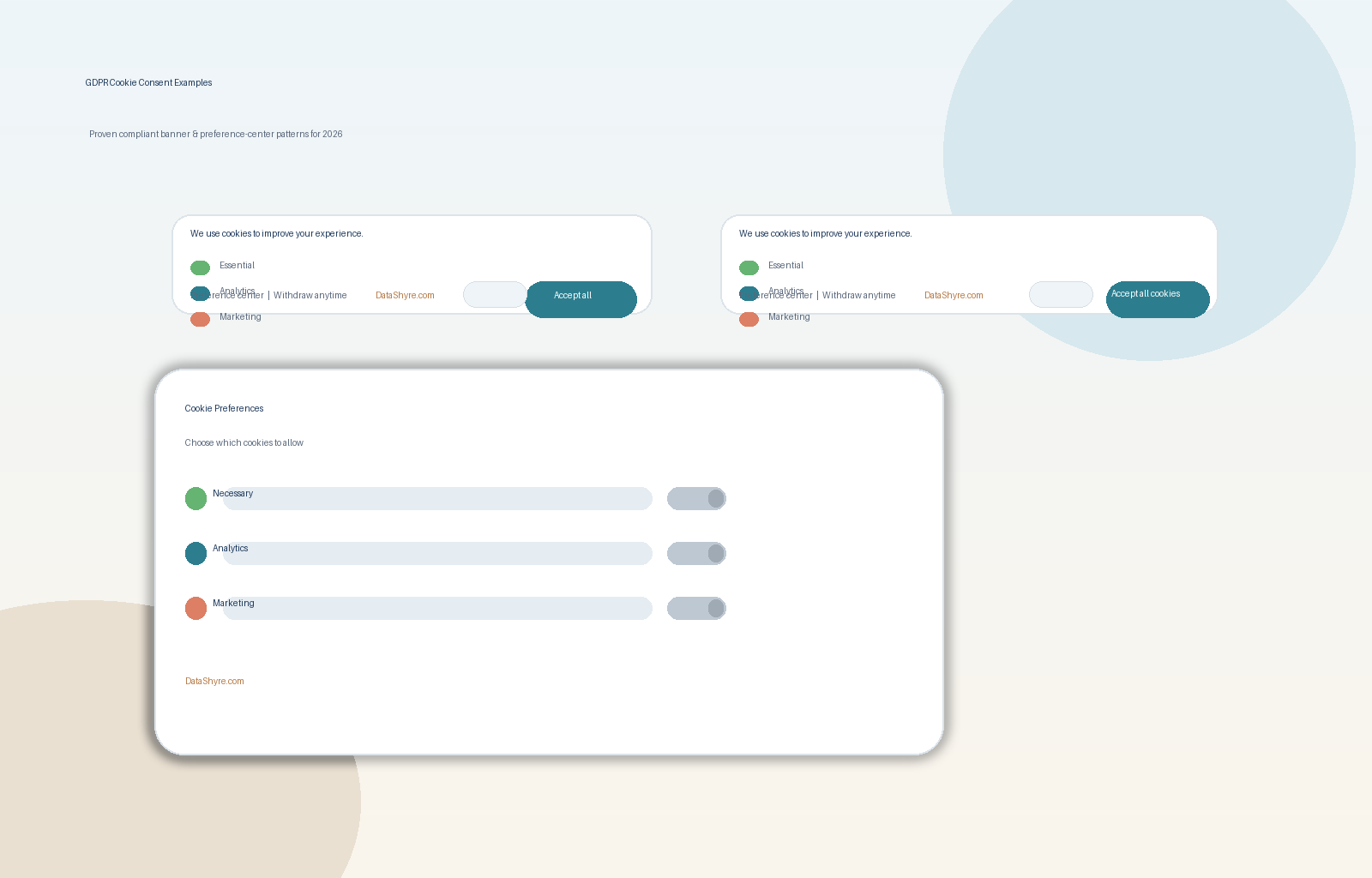
Example 1: Granular Category-Based Banner with Equal Prominence
This design meets GDPR’s granular consent requirement and CCPA’s “Do Not Sell” obligation:
“`html
“`
Why this works:
- Granular controls allow specific purpose consent (GDPR Art. 7(2))
- Equal visual weight for acceptance and rejection (ICO 2026 guidance)
- Clear labels with purpose descriptions (transparency requirement)
- Persistent “Manage Preferences” link for easy withdrawal (GDPR Art. 7(3))
- Necessary cookies separated and non-disabling (strictly necessary exception)
Example 2: Floating Preference Manager with Withdrawal Access
A persistent icon ensures users can modify consent at any time:
“`html
Cookie Preferences
You can update your choices anytime:
Analytics & Performance
Marketing & Advertising
“`
Key compliance features:
- Persistent access satisfies withdrawal requirement (GDPR Art. 7(3))
- Clear separation of purposes with descriptions
- CCPA “Do Not Sell” link for marketing cookies (where applicable)
- Modal dialog prevents background interaction during choice
- Save button confirms affirmative action for changes
Example 3: Layered Notice with Purpose-Specific Consent
For organizations using third-party services with specific data sharing:
“`html
“`
Regulatory alignment:
- Layered approach meets ICC framework requirements for layered notices[^3]
- Purpose-specific descriptions fulfill transparency obligations
- CCPA opt-out link included where marketing involves data selling
- Clear distinction between strictly essential and optional cookies
Implementation Best Practices
- Default to Opt-Out for Non-Essential – All non-essential cookies disabled by default
- Granular Purpose Controls – Separate toggles for analytics, marketing, personalization, etc.
- Clear Purpose Descriptions – Explain what each cookie type does in plain language
- Equal Visual Weight – Make acceptance and rejection options equally prominent
- Persistent Withdrawal Mechanism – Floating icon or footer link accessible site-wide
- Geolocation Considerations – Adjust requirements based on user location (GDPR vs CCPA)
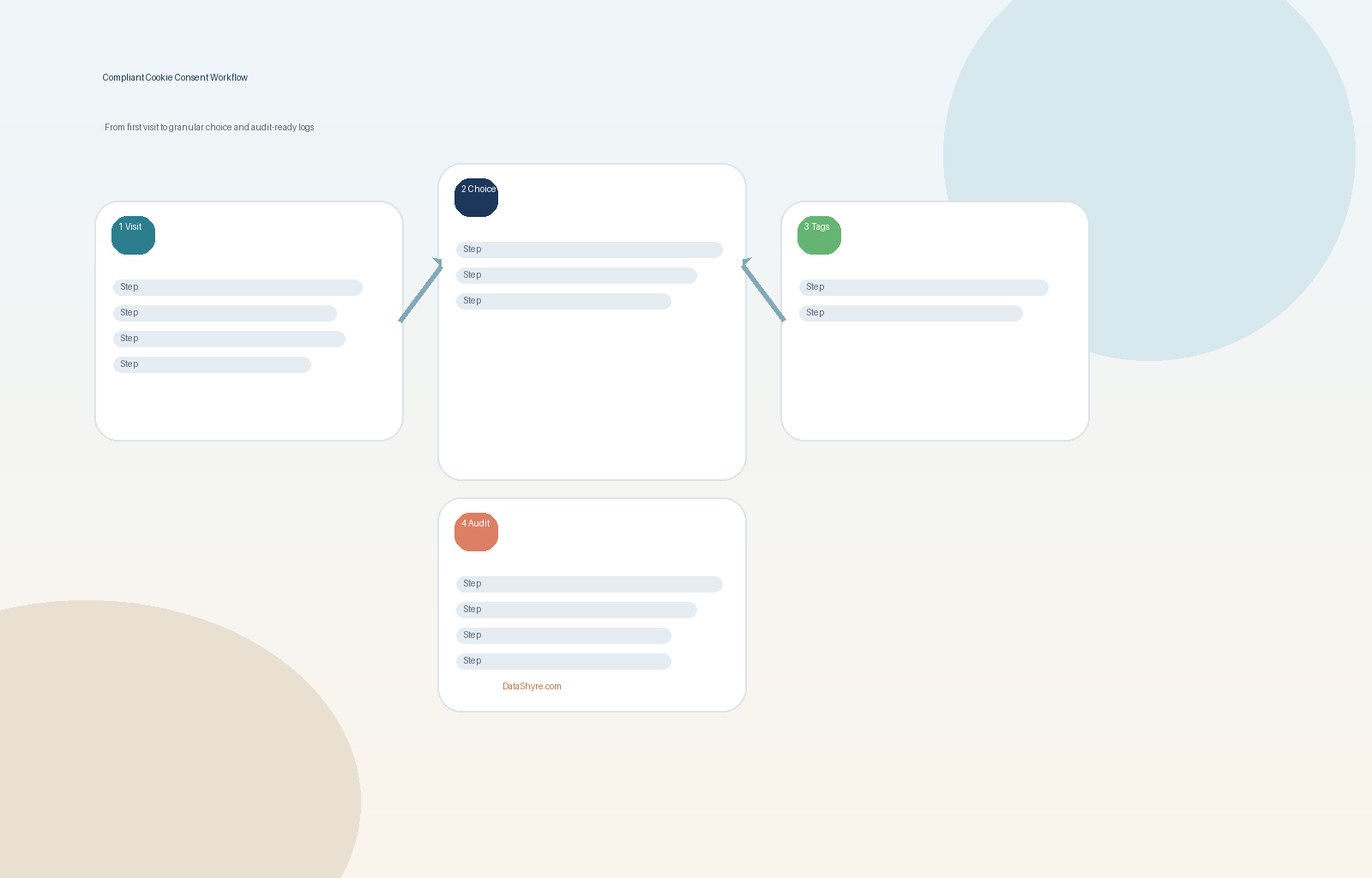
- Consent Logging – Store timestamp, version, and user choices for audit trails
- Regular Review Cycle – Quarterly checks against evolving regulator guidance
- Third-Party Data Transfers – Ensure consent covers any data sharing with advertisers/analytics
- Accessibility Compliance – WCAG 2.2 AA for keyboard navigation and screen readers
Related Resources
- GDPR Cookie Consent 2026: Complete Guide – Full regulatory overview
- CCPA/CPRA Cookie Requirements – California-specific rules
- Cookie Consent Manager Evaluation – Platform comparison
Images
Conclusion
Effective cookie consent examples in 2026 require balancing regulatory compliance with user experience. By implementing granular controls, clear purpose descriptions, and persistent withdrawal mechanisms, organizations can meet GDPR, CCPA/CPRA, and global privacy standards while fostering user trust. Regular review against evolving regulator guidance ensures ongoing compliance as enforcement priorities shift.
Published: October 7, 2026
Keywords: cookie consent examples
[^1]: European Data Protection Board (EDPB), “Annual Report on GDPR Enforcement Activities,” First Half 2026, published July 2026.
[^2]: Baymard Institute, “Cookie Consent usability study: How users perceive and interact with consent mechanisms,” 2026.
[^3]: International Chamber of Commerce (ICC), “Framework for Cookie Consent: Layered Notice Best Practices,” Version 2.1, 2025.