

Consent Management Platform CCPA in 2026: 7 Live Checks Before You Trust It
If you are evaluating a consent management platform ccpa setup on October 3, 2026, the useful question is not whether the banner looks modern.
It is whether the tool can help your site present the right California choices, honor the consumer’s opt-out, process Global Privacy Control, avoid dark patterns, and prove that the ad-tech stack actually changed afterward.
That frame matters because California still does not work like a generic GDPR copy-paste. The California Department of Justice says consumers have the right to opt out of the sale or sharing of personal information, including through a user-enabled Global Privacy Control. The DOJ’s own CCPA page describes GPC as a “stop selling or sharing my data switch.” The California Privacy Protection Agency also shows that the updated CCPA regulations became effective on January 1, 2026. Put those official materials next to the DOJ’s enforcement case examples and the CPPA’s dark-pattern advisory, and the real standard becomes clear: a consent management platform ccpa review is a controls review, not a banner beauty contest.
If you want the closest companion reads first, start with our guides to California consumer privacy, CCPA cookie consent, and consent management platform. This article stays narrower. It is the California-specific live review I would run before trusting a CMP on a production website this week.
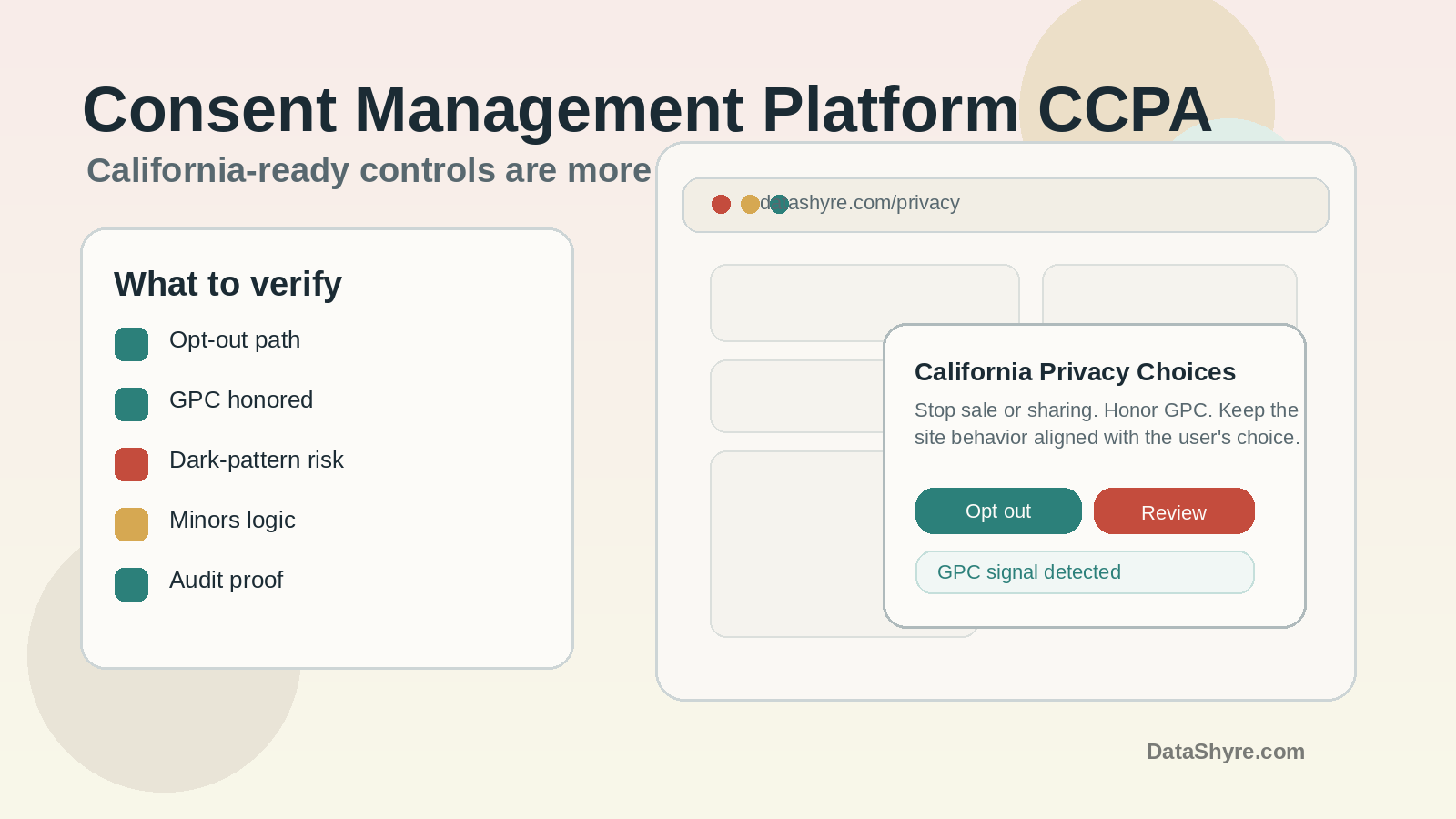
1. Confirm the CMP understands California rights, not only cookie categories
Many teams still buy a consent management platform ccpa tool as if California were only a cookie-banner problem.
That is too small. California’s official materials focus on whether a business gives consumers a usable way to stop the sale or sharing of personal information and whether the business honors that choice in practice. A CMP can help with that, but only if it is connected to the actual ad-tech and sharing flows on the site.
So the first live check is simple:
- identify the tags, pixels, SDKs, and embedded tools that may support sale or sharing;
- map which of them are controlled by the CMP and which are outside it;
- compare that map with the California notice and opt-out language shown to users.
If the tool only changes cookie labels while the downstream sharing logic stays fuzzy, the CMP is ahead of the compliance work.
2. Verify the California opt-out is separate from a generic cookie preference toggle
The DOJ’s enforcement examples are useful here because they show where businesses still go wrong.
One official example describes a retailer whose Do Not Sell My Personal Information link led to a pop-up that only discussed cookies and similar technologies, without providing a mechanism to stop the sale of personal information. Another example describes a people-search business whose Do Not Sell link worked only on certain browsers and sent users through a confusing multi-step flow.
That means a serious consent management platform ccpa review should test whether the tool can support:
- a clear California opt-out entry point;
- an action that actually stops sale or sharing behavior where required;
- a flow that does not depend on account creation or unnecessary verification;
- mobile and desktop behavior that works consistently.
If the CMP only offers a cookie-settings drawer with vague toggles, that may not be enough for the California branch of the problem.
3. Treat GPC as a first-class signal
If a CMP cannot help your site honor Global Privacy Control, it is weak for California work.
The DOJ’s CCPA materials say consumers may submit an opt-out request through a user-enabled global privacy control, and the enforcement examples include retailers that failed to process GPC until they were pushed to fix it. The safest consent management platform ccpa test is therefore operational:
- load the site in a browser with GPC enabled;
- confirm the site recognizes the signal;
- verify that sale or sharing behavior changes in the live requests and tag behavior;
- compare that outcome with what the privacy notice and choice UI promise.
If the tool stores a preference but the downstream stack keeps behaving as if nothing happened, the site has telemetry, not trustworthy control.
4. Review the interface for dark patterns, not just legal wording
The CPPA’s enforcement advisory is direct on this point. Businesses should offer symmetrical choices and use language that is easy for consumers to understand. Michael Macko, deputy director of the CPPA Enforcement Division, summarized the standard in one memorable line:
“Dark patterns aren’t about intent, they’re about effect.”
>
Michael Macko, CPPA Enforcement Division
That matters for any consent management platform ccpa rollout because a California privacy choice can fail even when the legal text looks respectable.
Review whether the CMP makes it harder to opt out by:
- hiding the privacy choice behind extra steps;
- using labels that reverse or blur the result;
- giving acceptance-like actions more visual weight than privacy-protective actions;
- creating mobile flows that are harder to navigate than desktop flows.
The point is not only whether the words are present. It is whether the consumer can use the choice without being steered away from it.
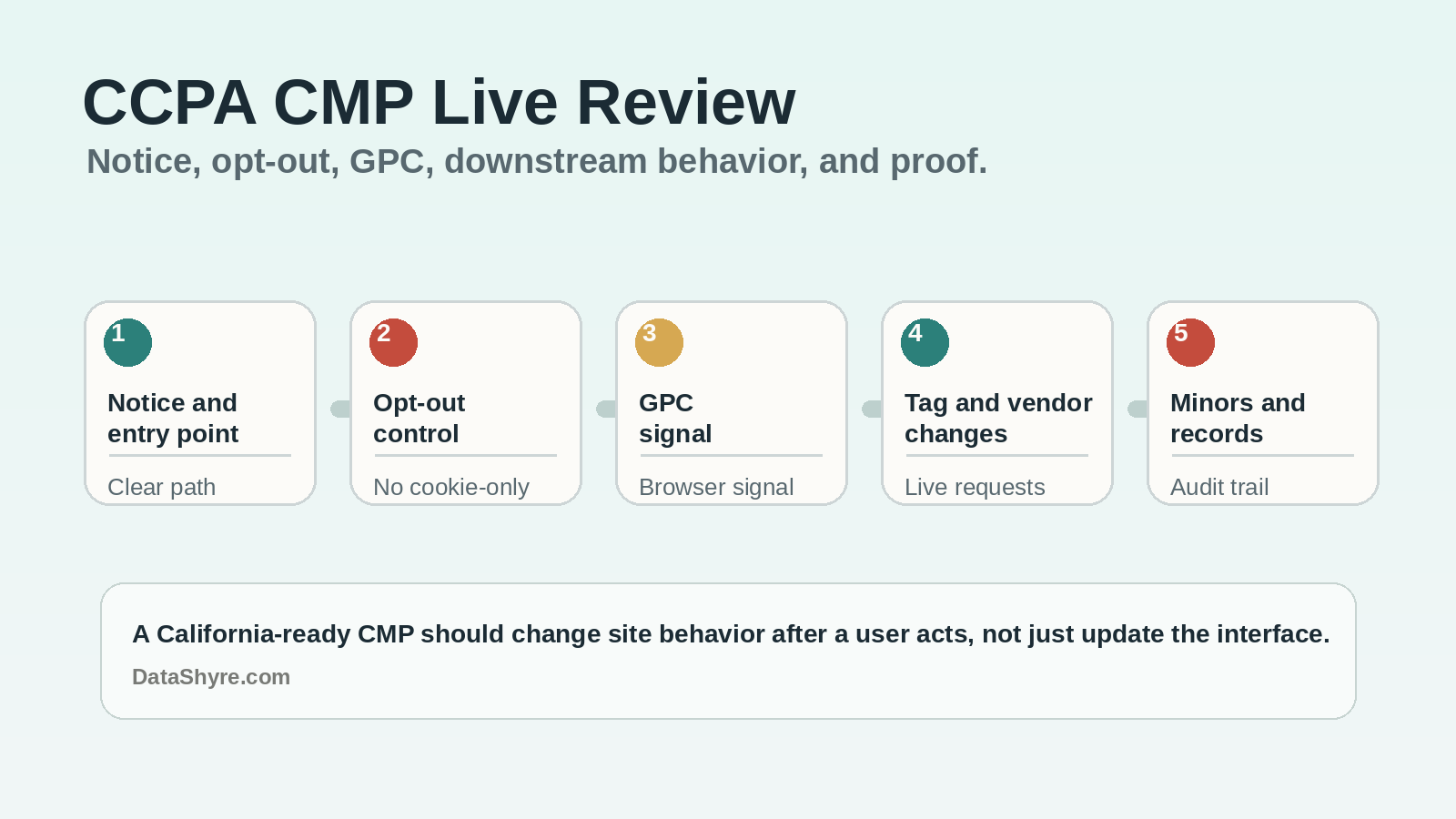
5. Test whether vendor behavior changes after the opt-out
This is where decorative compliance breaks.
The DOJ’s case examples repeatedly point back to the same operational lesson: it is not enough to present a button if the business still makes personal information available to third parties for advertising or related purposes after the user acts.
For consent management platform ccpa, I would test four states:
- first visit before any California choice;
- explicit opt-out through the site’s control;
- GPC-enabled visit;
- return visit after the preference should persist.
Then compare:
- which requests still fire;
- whether identifiers still move to advertising or analytics partners in the same way;
- whether the tool updates tags, downstream vendors, and persistence logic consistently.
If the preference changes the interface but not the data flow, the CMP is not doing the job you actually need.
6. Run the minors path separately
California becomes stricter here.
The DOJ’s current CCPA page says a business may sell or share the personal information of a child it knows is under 16 only with affirmative authorization. For children under 13, that authorization must come from a parent or guardian. For children who are at least 13 and under 16, the authorization may come from the child.
That means a consent management platform ccpa review should ask whether the product can support a distinct minors branch when the property has teen users, child-directed experiences, or age-gated sections tied to advertising or sharing.
At minimum, test:
- whether the service knows when the minors rule is triggered;
- whether sale or sharing behavior stays off until the required authorization exists;
- whether the CMP record, user journey, and downstream vendors all reflect the same state.
7. Keep evidence that the California setup still works after changes
The best consent management platform ccpa implementation is not the one with the cleanest demo.
It is the one that still lets your team prove, after the next release, that the California notice, opt-out controls, GPC handling, and downstream vendor behavior all align.
For a practical record, keep:
- screenshots of the privacy entry points on desktop and mobile;
- a short note showing how GPC was tested;
- evidence of tag or request differences before and after opt-out;
- a list of the vendors or technologies reviewed;
- the ticket, deploy, or release note tied to the review.
That evidence matters because California privacy setups often drift after a marketing tag change, a CMP reconfiguration, or a new vendor embed.
Bottom line
The right consent management platform ccpa in 2026 is not the one that only adds a banner and a settings icon.
It is the one that helps your team support a real California opt-out path, honor GPC, avoid dark patterns, run the minors branch correctly, and prove that the live site changed after the consumer exercised a right.
If your current setup can still pass those seven checks on the production site today, it is much closer to California reality than a CMP that only looks compliant in a sales demo.
Sources
- California Department of Justice: California Consumer Privacy Act (CCPA)
- California Department of Justice: Global Privacy Control (GPC)
- California Department of Justice: CCPA Enforcement Case Examples
- California Privacy Protection Agency: Law & Regulations
- California Privacy Protection Agency: CCPA updates effective January 1, 2026
- California Privacy Protection Agency: CPPA Enforcement Advisory Stresses the Importance of Avoiding Dark Patterns
—
Published: October 3, 2026. Updated using current official California regulator and government materials available at publication time.