

California Data Privacy Protection Act in 2026: What the CCPA, CPRA, and Delete Act Actually Require
If you are searching california data privacy protection act on October 3, 2026, you are usually trying to answer a practical question: what is California’s live privacy framework right now, and what does a website or business actually have to do?
The short answer is that California’s current framework is not one isolated requirement. It is the CCPA as amended by Proposition 24, the current 2026-effective CCPA regulations, and, for data brokers, the Delete Act and the DROP workflow run by the California Privacy Protection Agency.
If you want the adjacent reads first, start with our guides to California consumer privacy, California privacy law delete data, and GDPR vs. CCPA/CPRA. This page is the clearer reset for the search term california data privacy protection act.
What people usually mean by “california data privacy protection act”
In practice, this search term usually points to California’s consumer privacy regime as it stands now.
The CPPA’s current FAQ says it plainly:
“The CPRA amended the CCPA; it did not create a separate, new law.”
>
California Privacy Protection Agency FAQ
That line matters because it clears up a common source of confusion. Many teams treat CCPA and CPRA as two separate operating systems. The CPPA does not. Its current materials say the agency typically refers to the law as the CCPA or CCPA, as amended, and that the CPRA amendments went into effect on January 1, 2023.
So when someone inside a business asks about the california data privacy protection act, the useful interpretation is usually:
- the CCPA rights Californians can exercise now;
- the CPRA amendments that expanded those rights and obligations;
- the regulations the CPPA lists as effective on January 1, 2026;
- the Delete Act branch that applies to data brokers.
What applies right now in California
The CPPA’s live Law & Regulations page is the cleanest high-level map.
It says Proposition 24 amended the CCPA and created the CPPA. It also lists the current California Consumer Privacy Act text and CCPA Regulations as both effective on January 1, 2026. On the same page, the agency separately lists the Delete Act and the Data Broker Registration and Accessible Deletion Mechanism Regulations, also effective on January 1, 2026.
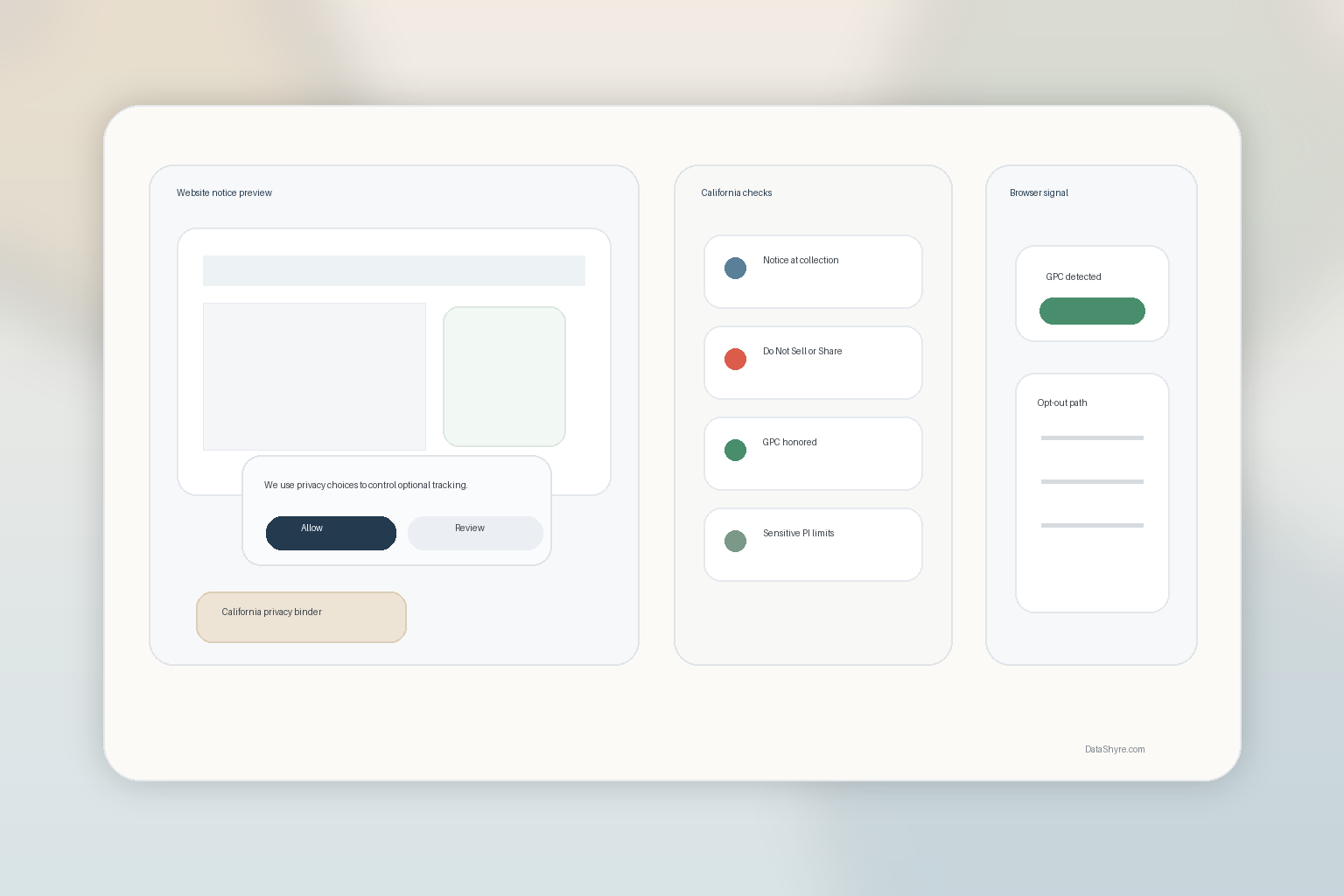
For most operating teams, that means the phrase california data privacy protection act should trigger four checks:
- what rights California residents can use now;
- what notices and choice mechanisms your site or product presents;
- whether your opt-out logic really changes data sharing behavior;
- whether you also fall into the data-broker branch.
The rights and controls businesses usually need to operationalize
The California Department of Justice’s CCPA page is still one of the best plain-English summaries of the rights businesses have to support.
As of today, the official California materials highlight rights to:
- know what personal information a business has collected and how it is used or shared;
- delete personal information, subject to exceptions;
- opt out of the sale or sharing of personal information;
- correct inaccurate personal information;
- limit the use and disclosure of sensitive personal information;
- receive notice before or at the point of collection.
The same DOJ page also says businesses cannot make consumers waive those rights and cannot require account creation just to submit an opt-out request.
That is where california data privacy protection act stops being a vocabulary question and becomes an implementation question. A site may have a polished footer link and still fail in the runtime if ad-tech, analytics, or audience syncs keep firing after an opt-out.
Why GPC is still a live control, not a footnote
If your business sells or shares personal information, California’s official materials keep pointing back to one control that website teams regularly under-test: Global Privacy Control.
The California DOJ’s current GPC page calls it a:
“stop selling or sharing my data switch”
>
California Department of Justice
That same page says businesses that sell or share personal information must offer methods for consumers to opt out, and for businesses collecting information online, one acceptable method is a user-enabled global privacy control like GPC. The DOJ also says covered businesses must honor it as a valid request to stop sale or sharing.
That matters for banner and consent design. A California flow cannot end at “cookie choices saved” if the broader sale-or-sharing path stays unchanged. The opt-out has to reach the actual data flows.
The DOJ’s published enforcement examples still show the same pattern: failures around missing opt-out mechanisms, confusing toggles, broken links, and not processing GPC requests correctly.
The data broker branch changed materially in 2026
This is the part many teams miss when they search for california data privacy protection act.
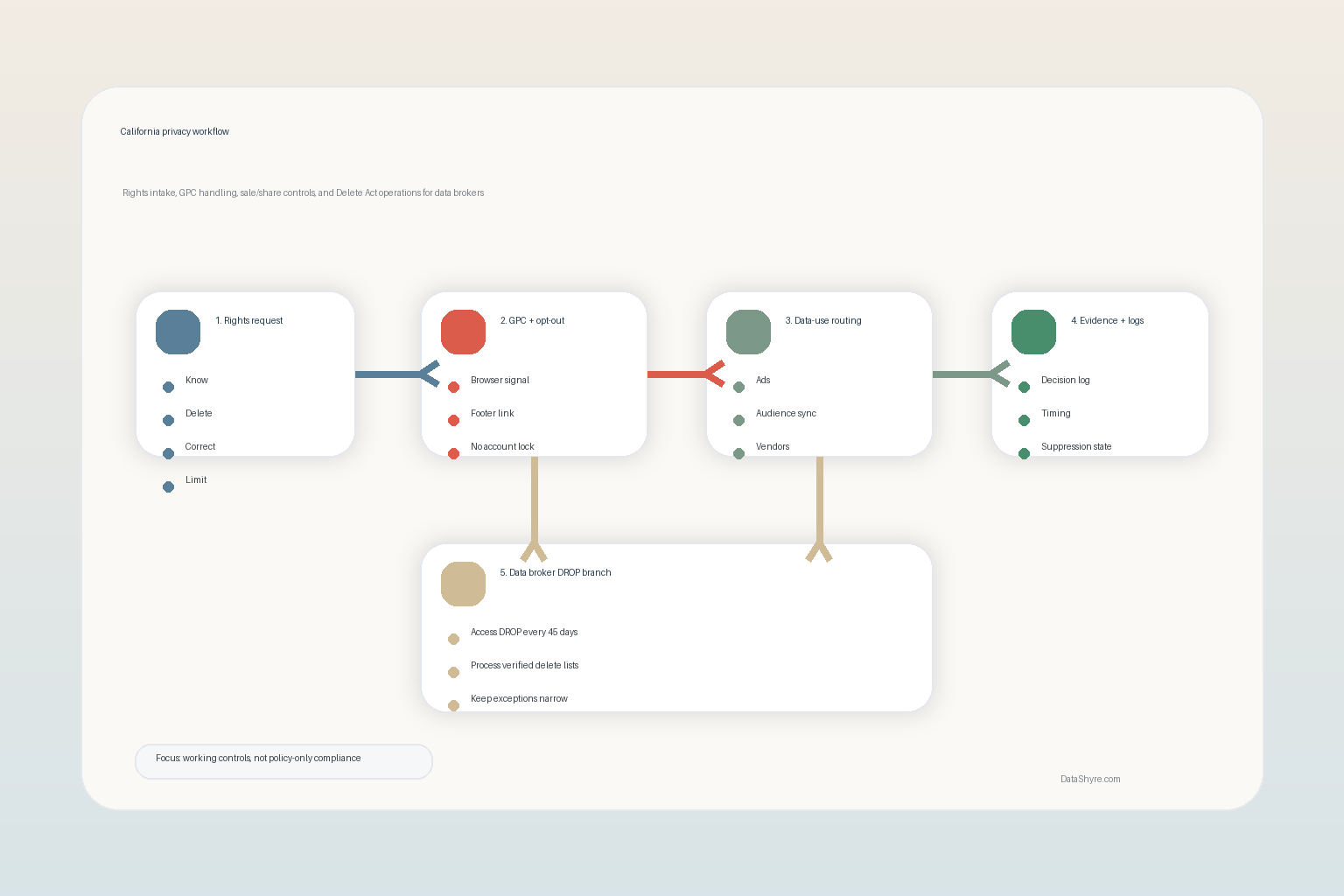
The CPPA’s current data-brokers page says that, under the Delete Act, beginning August 1, 2026, data brokers must access the Delete Request and Opt-Out Platform (DROP) at least once every 45 days and process consumer deletion requests, subject to limited exceptions.
The agency also says the DROP system lets a consumer send a single verifiable request directing every registered data broker maintaining that consumer’s information to delete it. The CPPA’s regulations page for DROP says the rulemaking is complete and that the system requirements regulations became effective on January 1, 2026.
If you are a data broker, the compliance question is no longer just whether you have a deletion email address on a privacy page. It is whether your team can register, access DROP on schedule, process deletion lists, and keep records that match what California expects now.
What the current rulemaking picture means
There is also a useful “what next” signal on the CPPA’s live rulemaking page.
As of October 3, 2026, the agency says several preliminary comment periods closed earlier this year, including:
- Reducing Friction in the Exercise of Privacy Rights on April 6, 2026;
- Opt-out Preference Signals (OOPS) on April 6, 2026;
- Data Broker Audits on May 7, 2026;
- Employee Data and Notices & Disclosures on May 20, 2026.
The same page also says: “The Agency does not have any proposed regulation packages at this time.”
For operators, that means today’s working baseline is the current effective framework, while those closed preliminary topics show where California may keep refining friction, notices, signals, and broker oversight next.
A practical checklist for website and privacy teams
If I were translating california data privacy protection act into work items this week, I would review these in order:
- Confirm whether the business is subject to the CCPA and whether any data-broker obligations apply.
- Check that notice at collection, privacy policy disclosures, and rights intake methods line up with what the business actually does.
- Test the sale-or-sharing opt-out path, including whether the site honors GPC.
- Verify that “do not sell or share” choices change the downstream behavior of tags, pixels, ad-tech, and audience flows.
- Review delete, know, correct, and limit workflows for timing, handoffs, and evidence.
- If the company is a data broker, test the DROP process and the 45-day operational cadence instead of treating it as a future task.
That is the more useful answer to california data privacy protection act than a generic summary of rights.
Bottom line
In 2026, california data privacy protection act is best understood as a live California privacy stack, not a single checkbox law name.
For most businesses, that means the CCPA as amended by the CPRA, plus the 2026-effective regulations, plus a serious review of opt-out mechanics such as Global Privacy Control. For data brokers, it also means the Delete Act and the operational reality of DROP.
If your privacy program still treats California as only a policy-page problem, the current official materials point to a different standard: working consumer controls, working deletion paths, and proof that the system actually follows the choice.
Sources
- California Privacy Protection Agency FAQ
- California Privacy Protection Agency: Law & Regulations
- California Privacy Protection Agency: CCPA Updates, Cybersecurity Audits, Risk Assessments, ADMT, and Insurance Regulations
- California Privacy Protection Agency: Data Brokers / DROP
- California Privacy Protection Agency: DROP System Requirements
- California Department of Justice: California Consumer Privacy Act (CCPA)
- California Department of Justice: Global Privacy Control
- California Department of Justice: CCPA Enforcement Case Examples
—
Published: October 3, 2026. Updated using current official California government and regulator materials available at publication time.