

Is Cookie Consent Required in USA in 2026? The Practical Answer
If you are asking whether cookie consent is required in usa on September 11, 2026, the short answer is usually no in the strict GDPR-style sense.
But that does not mean U.S. websites can ignore consent and tracking controls.
The more accurate answer is that the United States still operates as a patchwork. For many sites, the live compliance question is not “Do we need a universal opt-in banner for every cookie?” It is:
- do we give the right notice;
- do we honor opt-out rights for sale, sharing, or targeted advertising where state law requires it;
- do we recognize browser-based privacy signals where required;
- do we get parental or affirmative opt-in consent where minors’ data rules apply.
For adjacent reading, our guides to California consumer privacy, CCPA who does it apply to, and website privacy checker help with the broader operating context. This article stays focused on the real answer behind is cookie consent required in usa.
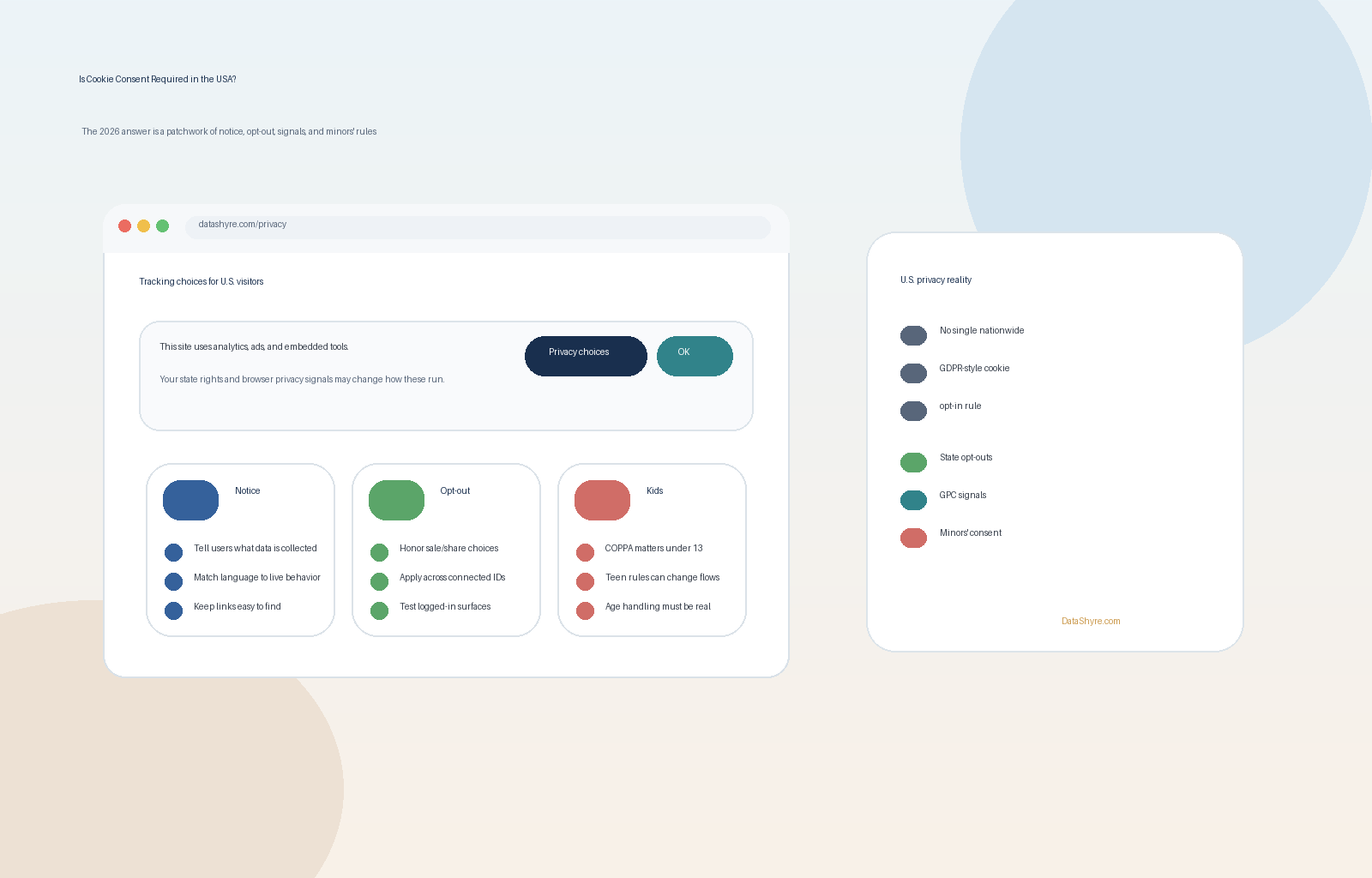
The practical answer: not one nationwide banner rule
There is still no single U.S. rule that works like the familiar EU model where a site broadly asks for prior consent before most non-essential cookies fire.
Instead, the official sources point to a more fragmented system:
- California gives consumers rights to opt out of sale or sharing and to send that request through Global Privacy Control.
- Connecticut gives consumers rights to opt out of sale, targeted advertising, and some profiling, including through an opt-out preference signal.
- The FTC’s COPPA framework creates consent requirements for children under 13 in covered situations.
- California also adds affirmative opt-in requirements when a business knows it is selling or sharing the personal information of a child under 16.
So if you want the direct answer to is cookie consent required in usa, it is better phrased like this:
U.S. law often asks for notice and opt-out controls first, but specific situations still trigger real consent obligations.
When a GDPR-style cookie banner is usually not the legal baseline
For a typical U.S. marketing site aimed at adults, the immediate legal baseline is often not prior opt-in for every analytics or advertising cookie.
That is why copying an EU banner without understanding your U.S. duties can create false comfort. A site may display an “Accept all” banner and still fail because:
- the sale or sharing opt-out does not work;
- the Global Privacy Control signal is ignored;
- mobile-app users have no equivalent opt-out path;
- teen or child data rules are handled incorrectly.
That difference matters because many teams still ask is cookie consent required in usa as if the only choice is banner or no banner. In practice, the harder question is whether the site’s tracking and ad-tech stack actually follows state rights and age-based restrictions.
Where U.S. sites do face consent-like or opt-in duties
1. California: opt-out rights and GPC are real
California’s Department of Justice says consumers may direct businesses to stop selling or sharing personal information, including through a user-enabled Global Privacy Control. The same official page describes GPC as a “stop selling or sharing my data switch.”
That changes the compliance discussion. Even if cookie consent is required in usa is often answered with “not like GDPR,” California still expects covered businesses to honor browser-level opt-out signals where the law applies.
Operationally, that means you should check:
- whether targeted advertising or cross-context behavioral advertising is in scope;
- whether your website recognizes and applies GPC correctly;
- whether the opt-out works across connected identifiers, not just one browser event;
- whether the same control path exists on app or logged-in surfaces where relevant.
2. Connecticut: opt-out rights reach targeted advertising too
Connecticut’s Attorney General explains that residents can opt out of the sale of personal data, the processing of personal data for targeted advertising, and some profiling. The office also says that, as of January 1, 2025, consumers may send an opt-out preference signal such as Global Privacy Control through a privacy-protective browser or extension.
That is one reason the question is cookie consent required in usa cannot be answered with one national yes-or-no rule. A site that serves U.S. traffic may need state-specific runtime behavior even without an EU-style universal opt-in banner.
3. Children’s data: COPPA can require parental consent
At the federal level, the FTC’s COPPA materials still matter. The FTC says COPPA applies to operators of websites or online services directed to children under 13, and to operators with actual knowledge that they are collecting personal information online from a child under 13. The FTC’s business guidance also points companies to approved ways to obtain “verifiable parental consent.”
So if your product, game, app, or embedded experience is child-directed, the answer to is cookie consent required in usa can become a firm yes for at least some collection and tracking practices.
4. California minors aged 13 to 15: affirmative opt-in for sale or sharing
California’s CCPA page says businesses can only sell the personal information of a child they know to be under 16 if they get affirmative authorization first. For children under 13, that opt-in must come from the parent or guardian. For children from 13 to under 16, the opt-in can come from the child.
That is not just theory. It means age-aware ad-tech and identity logic matter if your business model depends on sale or sharing.
Why many U.S. sites still use a consent banner anyway
Even where the law does not strictly demand a GDPR-style first-layer opt-in banner, many U.S. teams still deploy one for practical reasons:
- they serve both U.S. and EU or UK visitors;
- they want one geolocated consent architecture across regions;
- they need a clear UX for opt-out, vendor disclosure, and preference changes;
- their CMP helps translate browser signals and privacy rights into tag behavior;
- they want cleaner evidence if regulators, auditors, or enterprise customers ask questions later.
That can be a smart decision. It just should not distract from the underlying legal logic.
A banner is a tool.
It is not the rule by itself.
Enforcement in 2025 and 2026 shows the real risk
If you are still treating the question is cookie consent required in usa as mostly theoretical, the enforcement picture should change that.
California’s privacy enforcement actions page says that on February 11, 2026, Disney agreed to pay $2.75 million to resolve allegations that it failed to fully effectuate consumer opt-out requests across Disney+, Hulu, and ESPN+, including across devices connected to a Disney account. The same California page also describes 2025 actions involving Jam City and Sling TV over app-based opt-outs and minors’ privacy controls.
Then on September 9, 2025, the California Privacy Protection Agency announced a joint investigative sweep with the attorneys general of California, Colorado, and Connecticut focused on potential noncompliance with Global Privacy Control.
Connecticut’s Attorney General also reported on February 5, 2026 that the office had active investigations under the Connecticut Data Privacy Act, including matters related to the safety of children and teens online.
That does not read like a dormant issue.
It reads like a market where notice, opt-out execution, minors’ protections, and signal handling are all being checked more closely.
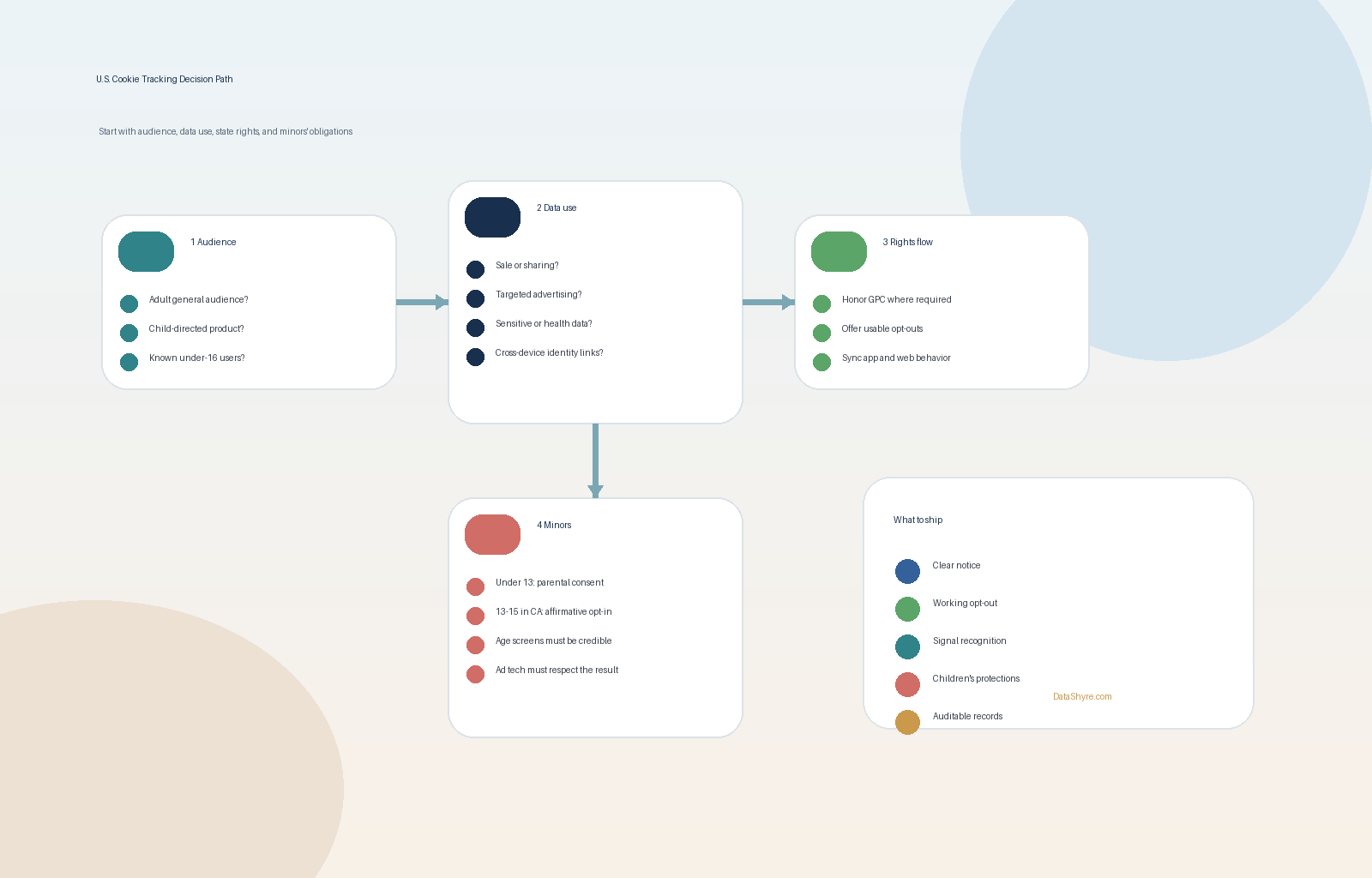
A fast website review if you serve U.S. visitors
If you want a useful answer to is cookie consent required in usa for your own site, review these six points:
- identify whether you sell or share personal information or use targeted advertising;
- confirm whether California, Connecticut, or similar state privacy rights apply to your traffic and business profile;
- test whether GPC or other required preference signals are recognized and honored;
- verify that opt-out paths work on website and app surfaces, not just on one browser screen;
- check whether any child-directed flow, teen audience, or known-under-16 data creates opt-in obligations;
- make sure your privacy notice, rights links, and downstream tag behavior match the live implementation.
That review is usually more valuable than debating banner colors.
Bottom line
The best concise answer to is cookie consent required in usa in 2026 is this:
No, not as a single nationwide GDPR-style rule for every website.
But yes, U.S. sites can still face real consent, opt-in, notice, and opt-out obligations depending on state law, browser privacy signals, and whether minors’ data is involved.
If your site uses advertising, cross-site tracking, account-linked identity, or youth-facing experiences, do not settle for a shallow answer. Test the actual rights flow.
That is where U.S. privacy risk now lives.
Sources
- California DOJ: Global Privacy Control (GPC)
- California DOJ: California Consumer Privacy Act (CCPA)
- California DOJ: Privacy Enforcement Actions
- California Privacy Protection Agency: Joint investigative privacy sweep on GPC
- Connecticut Attorney General: The Connecticut Data Privacy Act
- Connecticut Attorney General: February 5, 2026 CTDPA enforcement update
- FTC: Children’s Online Privacy Protection Rule (COPPA)
- FTC: Children’s Privacy business guidance
This post was updated on September 11, 2026 using current official regulator and government sources available at publication time.