

Data Collection Consent in 2026: When Forms, Apps, and Devices Actually Need an Opt-In
If your team treats every field, prompt, and tracking toggle like it needs a checkbox, you usually end up with worse UX and weaker records. The real question behind data collection consent is narrower: is this collection optional, is the purpose specific, and can the person actually say no?
If you want the broader legal-basis view, start with our data consent guide. If you are mapping how those choices move through downstream tools, our article on consent management covers the operating model. This piece stays at the collection moment itself: the form, app prompt, onboarding screen, or device setup flow where the request first appears.
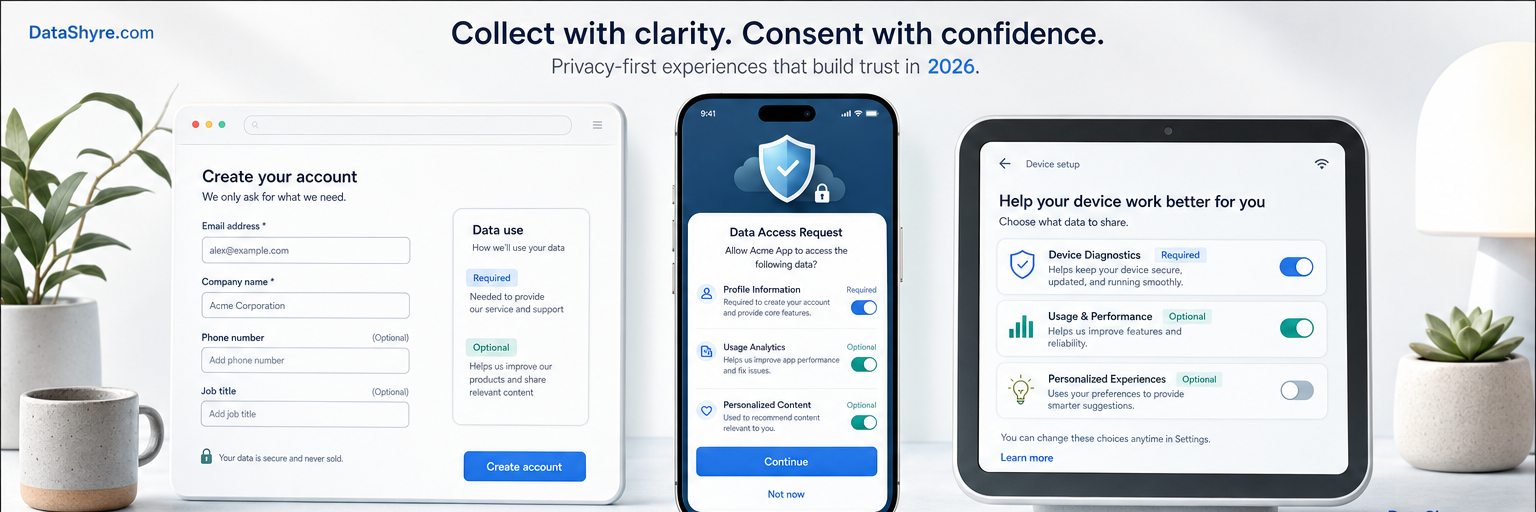
Start with purpose, not the field
The collection screen is not where privacy logic starts. It starts with purpose.
Under UK and EU guidance, consent only works when it is freely given, specific, informed, and unambiguous. That rules out bundled wording, pre-ticked boxes, and any setup flow that forces optional processing into the required path. In the ICO’s June 2026 smart-device guidance, William Malcolm said businesses should “explain why they need it” and give people “meaningful control over how it’s used.”
That is a useful rule well beyond connected devices. A newsletter signup, checkout form, product onboarding screen, or app permission request should separate what is needed to deliver the service from what the business wants for marketing, profiling, or partner sharing. If the user cannot get the expected service without agreeing to the optional part, the consent record is shaky from the start.
When consent is actually required at collection
Most teams do better when they stop asking whether consent sounds safer and start asking whether it truly fits the collection scenario. Three cases deserve a hard opt-in review.
1. Optional marketing and non-essential tracking
If the collection supports email promotions, behavioral advertising, optional personalization, or non-essential tracking, consent is often the right frame in the UK and EU. The collection point should name the purpose clearly, keep choices separate, and let people continue without penalty when the use is optional.
This is where many forms get sloppy. A “keep me updated” box is fine when it stands on its own. It is not fine when it is buried inside terms text or bundled with access to the core service.
2. Children’s data
COPPA remains one of the clearest collection rules in the U.S. Covered services must obtain verifiable parental consent before collecting personal information from children under 13, subject to limited exceptions. When the FTC finalized its 2025 COPPA amendments, Chair Lina M. Khan said the rule now prohibits platforms from sharing and monetizing children’s data “without active permission.”
If your app, game, smart toy, or edtech flow reaches children, the collection screen is not the place for soft wording. Teams need to know exactly what data is being collected, whether third parties are involved, and what proof of parental authorization they can retain later.
3. Secondary uses that break the original context
California is not a blanket opt-in law for adults, but it still matters at collection time. The CPPA regulations effective January 1, 2026 make two things clear: a business needs consent before collecting or processing personal information for a purpose that does not meet the regulation’s baseline requirements, and a new Notice at Collection is required if the business wants to use personal information for an additional incompatible purpose. The same rules also warn against bundling a reasonably necessary service use with an incompatible secondary use and calling the whole thing consent.
That is one reason collection-layer consent is a design problem as much as a legal one. If you collect location, contact, or profile data for one reason and want to reuse it for data brokerage, ad targeting, or another unexpected purpose, you should treat that as a fresh choice problem, not as permission you quietly inherited. The moment a team says, “We already have the data, so we may as well ask for everything now,” the collection layer usually starts drifting away from what the person reasonably expected.
When notice or another basis fits better
This is where data collection consent gets overused. If you need an address to ship an order, an email to provide account access, or security telemetry to protect a session, consent may be the wrong basis because the person is not being offered a real optional choice. A clean notice plus the correct legal basis is often better than a checkbox you cannot honestly treat as optional.
That same logic matters inside product flows. Required fields should be marked as required. Optional fields should be truly optional. Consent should not be a decorative layer pasted over data collection that will happen anyway.
What a good collection screen should show
At the point of collection, the shortest strong pattern is usually the best one. A person should be able to see:
- what data you want;
- why you want it;
- whether it is required or optional;
- whether third parties, ad partners, or downstream systems are involved; and
- how to change the choice later.
That last point matters more than many teams think. The ICO says withdrawal should be as easy as giving consent. The EDPB has made the same fairness point from the design side. As Anu Talus put it, privacy options should be presented in an “objective and neutral way.”
So if your team collects consent in a mobile onboarding flow, a web form, or a device setup screen, the same product needs an obvious route back to those settings later. A one-time prompt with no simple reversal path is not much of a consent experience.
What to record at the point of collection
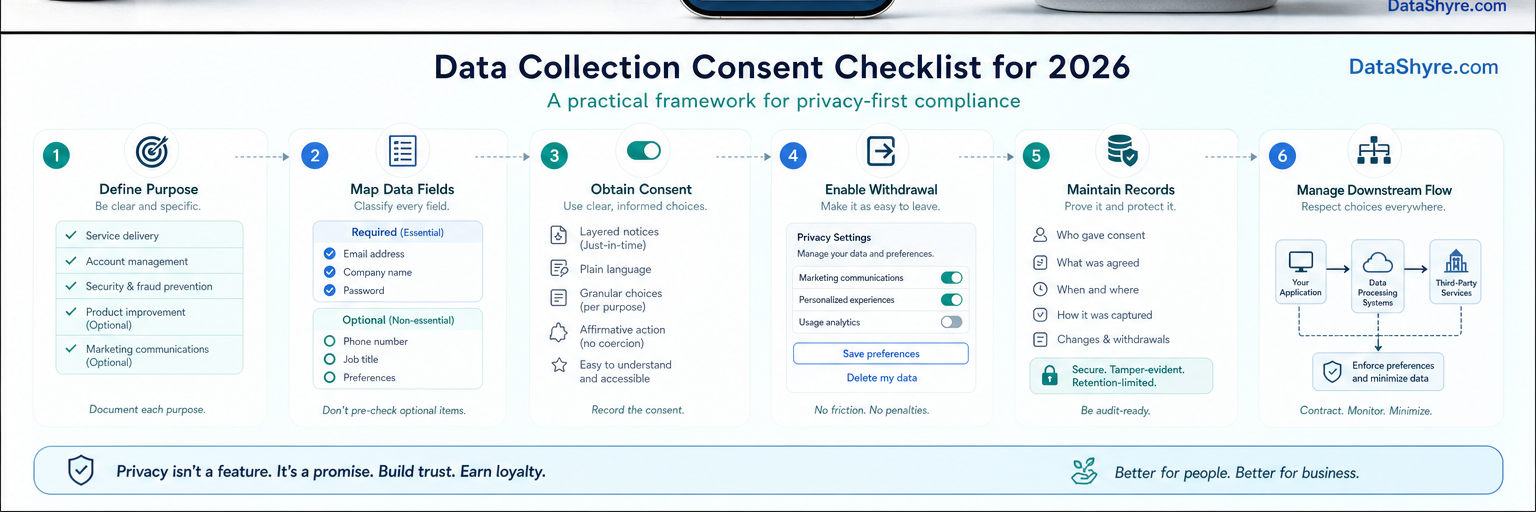
The collection moment is where evidence is strongest, so keep more than a yes-or-no flag. A defensible record usually includes:
- the person, account, or device identifier tied to the choice;
- the date, time, region, and interface where it happened;
- the notice or screen version presented at that moment;
- the exact purposes accepted or refused; and
- later withdrawal or preference changes.
If your privacy team cannot reconstruct what the person saw when the data was collected, the log is weaker than it looks. That is also where a strong CMP or internal workflow helps. The collection event only matters if downstream tools receive the right signal and honor it.
Bottom line
The safest way to handle data collection consent in 2026 is to stop treating it as the default answer for every field. Use it where the person has a real choice, keep the purpose narrow, and make the reversal path obvious. For everything else, be honest about what is required, what legal basis fits, and what your collection screen is actually doing.
Sources
- Information Commissioner’s Office consent guidance
- Information Commissioner’s Office smart device guidance
- European Data Protection Board annual report
- California Privacy Protection Agency regulations
- Federal Trade Commission COPPA rule announcement