

Cookie Consent in 2026: What It Means, Where It Applies, and What to Check
If you are searching for cookie consent on September 12, 2026, the useful question is not whether a banner appears.
It is whether the first choice a visitor makes actually changes what your site does.
That matters because the current regulator guidance is now very explicit about runtime behavior, not only wording. The UK’s ICO says consent requests for storage and access technologies must cover cookies, tracking pixels, device fingerprinting, and similar tools. France’s CNIL is still repeating one of the clearest interface tests in one sentence: rejecting cookies should be as easy as accepting them. And for California-facing traffic, the state’s Department of Justice still treats Global Privacy Control as a valid opt-out path for sale or sharing.
If you want adjacent detail before the broad overview, start with our guides to cookie consent message, consent management and GDPR, and is cookie consent required in USA. This article stays broader. It is the practical baseline I would use before trusting cookie consent on a live site this week.

What cookie consent covers now
The phrase cookie consent is too narrow for the technical problem most teams are actually trying to control.
The ICO’s finalized storage-and-access technologies guidance, published on April 29, 2026, is not limited to classic browser cookies. It expressly covers cookies, tracking pixels, device fingerprinting, and similar technologies. The same guidance says that if no exception applies, organizations must obtain prior consent, provide purpose-specific choices, and make sure the mechanism actually respects the choice the user made.
That is why weak implementations keep failing the same way. A team reviews banner copy, but analytics scripts, advertising tags, embedded videos, or identity-linked tools still activate too early. The interface says one thing and the stack does another.
Where cookie consent actually applies
The answer is not identical everywhere.
EU and UK
For most EU and UK website use cases, the operational rule is still straightforward: if the tracking is non-essential, do not let it start before the user has made a valid choice.
The ICO’s practical checklist is useful here because it stays focused on behavior:
- prior consent where no exception applies;
- purpose-specific and generally granular controls;
- a mechanism that is as easy to refuse as accept;
- a mechanism that can support withdrawal with the same ease later.
The enforcement signal also remains active. On December 12, 2024, CNIL said it had issued formal notices to website publishers over misleading cookie banners and repeated that “rejecting cookies should be just as easy as accepting them.” Then on November 27, 2025, CNIL announced a EUR 750,000 fine against the publisher of vanityfair.fr, including findings that cookies were placed before consent and that refusal or withdrawal mechanisms were ineffective.
California
California is different enough that teams should not clone an EU banner and assume the work is done.
The California Department of Justice says Global Privacy Control is a valid request to stop the sale or sharing of personal information and describes it as a “stop selling or sharing my data switch.” The California Privacy Protection Agency’s current CCPA updates became effective on January 1, 2026. For many ad-supported or identity-linked websites, that means the practical review is not only about whether a banner asks nicely. It is also about whether browser-level opt-out signals and related downstream controls are actually honored.
Publishers and ad-supported sites
There is also a platform requirement that should be treated as its own branch.
Google’s current publisher guidance says partners using AdSense, Ad Manager, or AdMob must use a Google-certified CMP integrated with the IAB Transparency and Consent Framework when serving personalized ads to users in the EEA, the UK, or Switzerland. Google also says that certification is not the same thing as full legal compliance. That is the correct way to read it: publisher eligibility is operationally important, but it does not replace your legal and technical review.
Six checks that still expose weak cookie consent
1. Prior blocking is real on a fresh visit
This is still the fastest way to tell whether your cookie consent setup is substantive or decorative.
If optional analytics, advertising, or personalization technologies activate before the user chooses anything in a prior-consent market, the rest of the interface does not rescue the implementation.
2. Reject is as easy as accept
The CNIL phrasing is still the best quick test.
If Accept all is immediate but Reject all is hidden in a second layer, visually downgraded, or noticeably harder to use on mobile, the design is steering the outcome.
3. Purposes and third parties are understandable
The ICO says users should receive clear information about what the technologies do and about relevant third parties. In practice, that means vague labels like experience or partners are rarely enough.
Most sites are better served by plain categories such as:
- essential;
- analytics;
- advertising;
- personalization;
- embedded third-party content where relevant.
4. Withdrawal works after the banner disappears
This is where a lot of teams overestimate themselves.
The settings path may exist, but the downstream behavior does not always change after the user revises the preference. A return visit, a reopened panel, and a changed choice should produce a changed technical outcome.
5. Regional logic reaches the tracking stack
A broad cookie consent program can look polished while still breaking underneath.
The important question is whether the regional rule path reaches:
- your CMP;
- your tag manager;
- analytics and advertising tags;
- embedded tools;
- opt-out and preference-signal handling where applicable.
For California, that includes Global Privacy Control where the underlying data flows make it relevant.
6. Records can explain what happened later
Sooner or later, someone will ask what was shown, what was chosen, and what changed afterward.
A stronger cookie consent implementation can usually show:
- the version of the notice or preference layer that was live;
- the purposes and disclosures shown at that time;
- the user’s choice and timestamp;
- later changes or withdrawal;
- whether the technical behavior matched the recorded state.
A short review sequence for this week
If I were checking cookie consent on a live property this week, I would do it in this order:
- open a clean browser session;
- check whether optional technologies fire before any choice is made;
- click
Reject alland retest; - make one granular choice and confirm behavior changes accordingly;
- reopen the controls later and verify withdrawal or revision works;
- test the relevant California opt-out or preference-signal path if your traffic and data uses bring it into scope;
- if you are a publisher, confirm the CMP requirement separately from the banner design.
That sequence is usually more revealing than another round of banner copy edits.
Bottom line
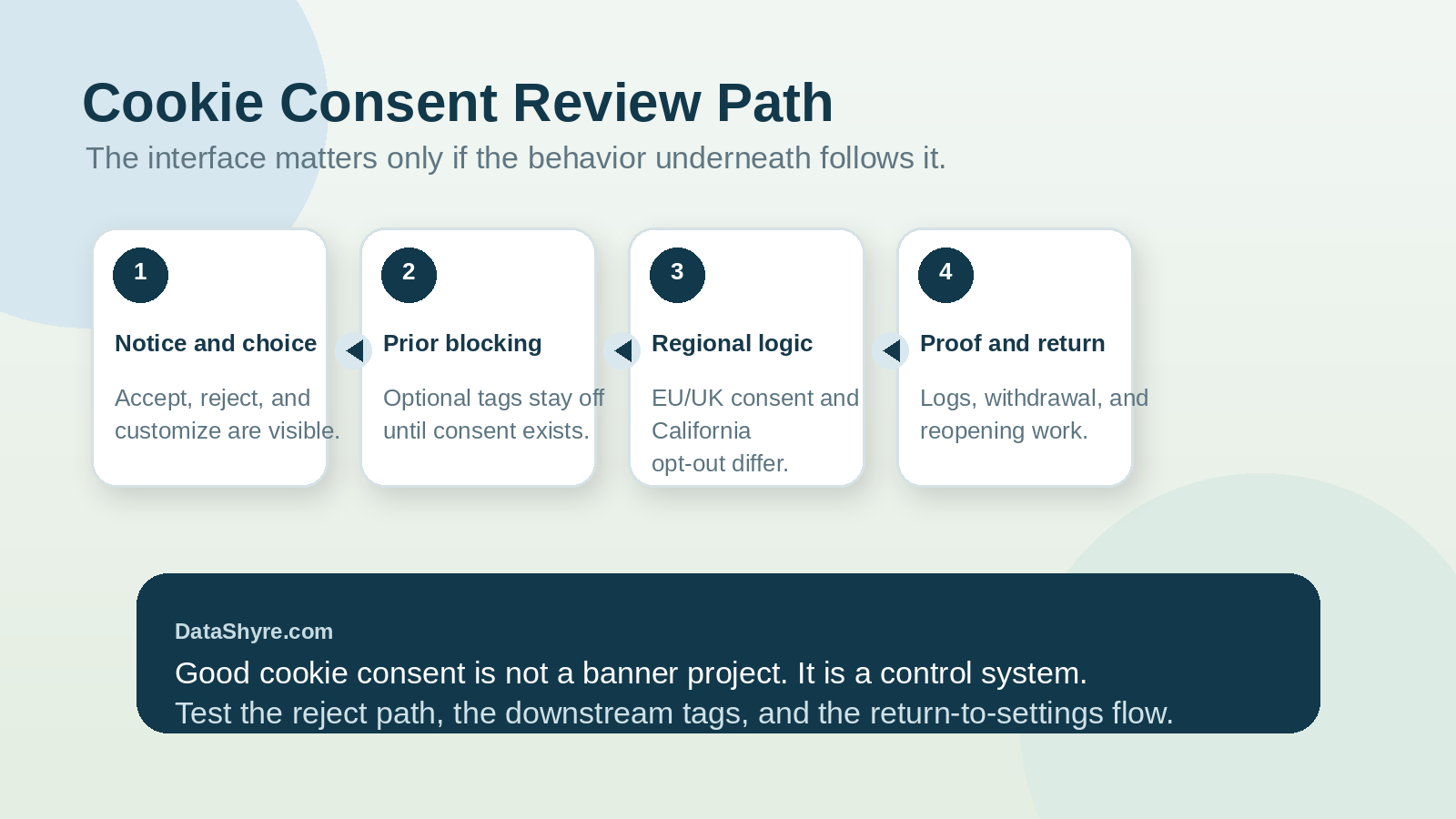
The best way to think about cookie consent in 2026 is not as a pop-up.
It is a control system.
If refusal is easy, optional technologies stay off until they should run, California signals are honored where relevant, publisher requirements are handled separately, and the records actually explain the live behavior, your setup is in much stronger shape.
If any one of those pieces is fuzzy, the banner may look compliant while the implementation underneath it is not.
Sources
- ICO: How do we manage consent in practice?
- ICO: Final storage and access technologies guidance published
- CNIL: Dark Patterns in Cookie Banners
- CNIL: vanityfair.fr fined 750,000 euros for cookies placed without consent
- California DOJ: Global Privacy Control
- CPPA: CCPA updates effective January 1, 2026
- Google AdSense Help: consent management requirements for publishers
This post was updated on September 12, 2026 using current official regulator, government, and platform sources available at publication time.