

WordPress GDPR Cookie Plugin in 2026: 7 Live Checks Before You Trust One
If you are searching for a wordpress gdpr cookie plugin on November 20, 2026, the most expensive mistake is assuming the plugin category solves the problem by itself.
It does not.
A wordpress gdpr cookie plugin can help with consent banners, script blocking, preference centers, or policy text. But the official WordPress and regulator sources still point to a broader operational standard. WordPress says it is still your responsibility to keep the final privacy policy “current and accurate.” Its privacy documentation also says WordPress.org “does not yet have consent tools built,” which is why cookie control still depends on plugin choice and implementation quality. The Plugin Handbook says a plugin handling personal data “should add a section of suggested text” to the privacy policy helper. The ICO’s current guidance still says you “cannot set non-essential cookies” before the user has consented. And GDPR Article 12 still requires privacy information in “clear and plain language.”
That is the right frame for a wordpress gdpr cookie plugin review in late 2026.
The real question is not does the banner look polished.
It is does the live WordPress stack actually defer non-essential tracking, describe the behavior honestly, let users change their minds, and stay accurate after the next plugin update.
If you want nearby context first, start with our guides to GDPR WordPress plugin, WordPress cookie notice, and WordPress GDPR compliance. This page stays narrower. It is the wordpress gdpr cookie plugin review I would use this week before approving one on a production site.
If your team needs help checking whether the banner, tags, policy page, and proof records still match the live runtime, DataShyre can help with implementation review, consent testing, and cleanup work after a plugin rollout.

1. Start with the plugin’s real job, not its category label
The first wordpress gdpr cookie plugin mistake is talking as if every plugin in the category does the same thing.
They do not.
In practice, these plugins usually cover some mix of:
- banner and preference-center UI;
- geolocation or region-based behavior;
- pre-consent blocking or deferral for scripts and embeds;
- consent logging and proof records;
- policy-page help text or cookie declarations;
- integrations with Google Tag Manager, analytics, or ad tools.
Those capabilities are not interchangeable.
A polished banner is not proof that tags wait.
A cookie scanner is not proof that the published policy stays accurate.
A consent log is not proof that reject-all is as easy as accept-all.
So before trusting any wordpress gdpr cookie plugin, define exactly which of those jobs it is supposed to perform on your live site.
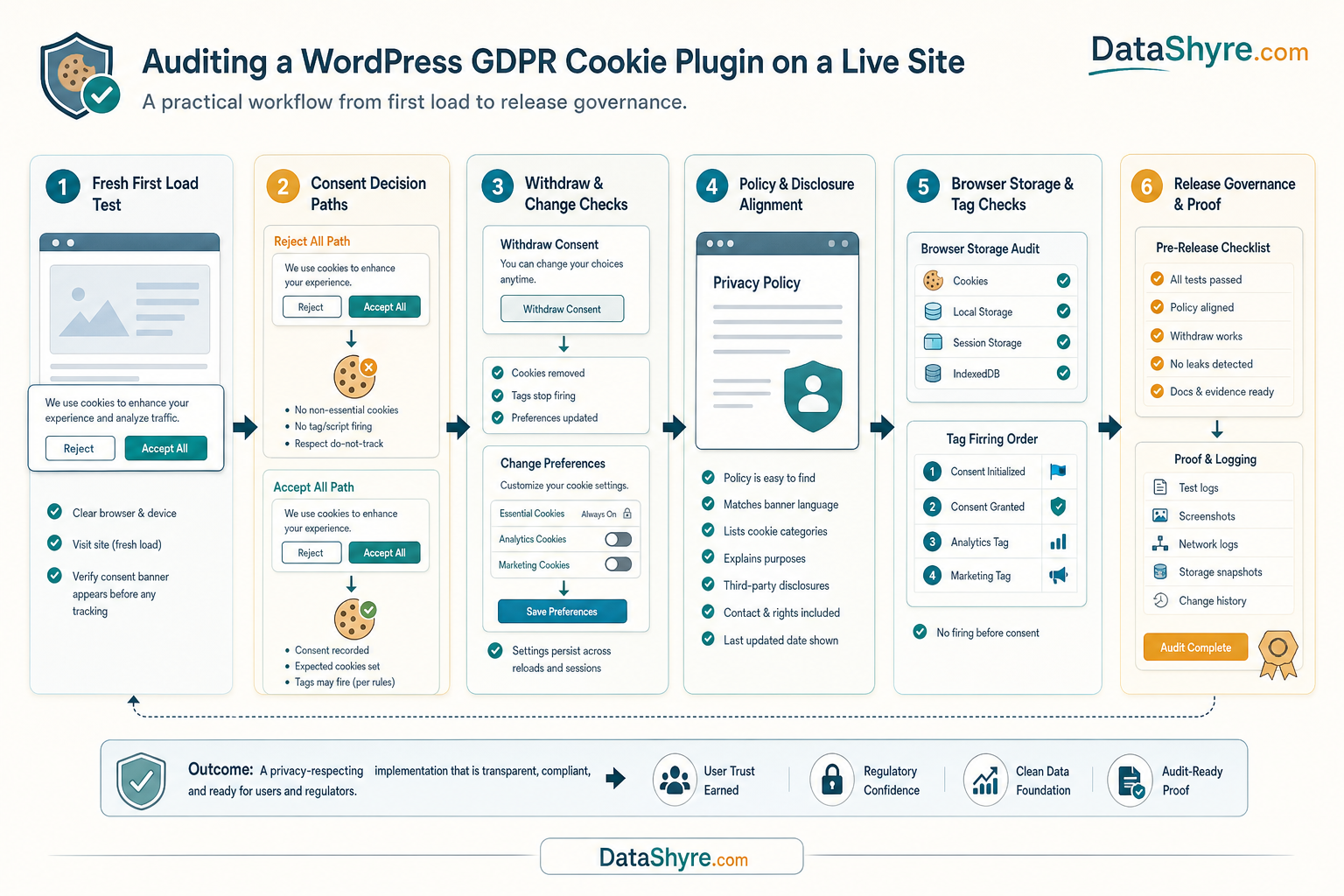
2. Test the first page load before you trust the banner
This is the fastest way to cut through marketing claims.
The ICO’s current cookies guidance is still blunt: you “cannot set non-essential cookies” before consent. It also says users should have an easy way to enable or disable non-essential cookies.
That means a real wordpress gdpr cookie plugin review starts with browser behavior on a clean first load:
- open the page in a fresh browser session;
- do not click the banner yet;
- inspect requests, tags, storage, and cookies;
- see what fires before any positive action;
- repeat on mobile and on the highest-traffic templates.
This matters on WordPress because tracking can arrive from more than the cookie plugin itself:
- theme code;
- page builders;
- analytics plugins;
- marketing embeds;
- WooCommerce extensions;
- tag-manager containers;
- custom scripts in headers or footers.
If the banner looks compliant but the runtime still drops non-essential cookies early, the wordpress gdpr cookie plugin is not doing the job that matters most.
3. Check whether the plugin helps your privacy page tell the truth
This part gets skipped too often.
WordPress’s privacy tooling still helps site owners build a starter policy, and the Plugin Handbook still says a plugin that collects, uses, stores, or passes user data to a third party “should add a section of suggested text.”
That makes a useful wordpress gdpr cookie plugin question:
does the plugin contribute policy text that matches the real deployment?
Look for whether the plugin can help the team describe:
- the cookie categories actually used on the site;
- the purposes those categories serve;
- third-party providers or embeds involved;
- how users refuse or later withdraw consent;
- regional behavior differences when they exist.
If the plugin adds a banner but leaves the policy generic, stale, or incomplete, the site can still fail the transparency test. That risk matters even more now that the EDPB’s March 19, 2026 coordinated enforcement action focuses on “transparency and information obligations.”
4. Test reject, withdraw, and revisit paths across the real WordPress stack
Many teams test only the first accept path because it is the easiest demo.
That is backwards.
A serious wordpress gdpr cookie plugin review should also test:
- reject-all from the first layer when the deployment offers it;
- preferences saved by category;
- reopening the preference center later;
- withdrawing consent after an earlier accept;
- page-to-page behavior after a changed choice;
- behavior on forms, commerce pages, and logged-in states.
This is where WordPress complexity shows up.
The same plugin can behave differently when combined with:
- caching layers;
- optimization plugins;
- form plugins;
- WooCommerce flows;
- video or map embeds;
- multilingual or geolocation add-ons.
If a user can accept easily but cannot reject, revisit, or withdraw without friction, the wordpress gdpr cookie plugin may be giving the business comfort without giving the user real control.
5. Separate cookie controls from rights-request workflows
A wordpress gdpr cookie plugin may be central to consent operations and still cover only one slice of privacy compliance.
WordPress’s current privacy documentation still says its export and erase tools “ONLY gathers data from WordPress and participating plugins.” It also says those erase flows do not remove data from backups or archive files.
That means cookie consent success does not automatically answer:
- what happens to analytics identifiers already collected;
- whether downstream tools still store personal data;
- whether a deletion request reaches third-party systems;
- whether previously synchronized marketing platforms are included.
So when you review a wordpress gdpr cookie plugin, keep it in scope. It can help with consent state. It cannot, by itself, close the full rights-request story.
6. Review Google Tag Manager, embeds, and script order with extra skepticism
This is where many implementations drift away from the plugin demo.
A wordpress gdpr cookie plugin often succeeds or fails based on execution order:
- does the plugin load before other non-essential scripts;
- are scripts truly deferred or just visually hidden behind a banner;
- do embeds wait for consent or still reach out on load;
- does Google Tag Manager respect the plugin’s consent state before tags fire;
- do optimization or performance plugins change script order unexpectedly.
The safest assumption is that WordPress runtime conditions will be messier than the vendor screenshot.
That is why I trust browser evidence more than feature matrices.
If your team is evaluating plugins right now, DataShyre can help verify whether the live firing order, consent state, and published disclosures still line up after GTM, embeds, and cache layers are all in play.
7. Treat the plugin as a release-controlled system, not a one-time install
The long-term wordpress gdpr cookie plugin risk is drift.
WordPress itself says privacy protection is a continuous process and that policy information must stay “current and accurate.” That is the right operating rule.
A stronger review therefore ties the plugin to release governance:
- retest after plugin updates;
- retest after new tags or embeds are added;
- retest after banner text or policy text changes;
- retest after theme, builder, or cache changes;
- keep a proof trail for accept, reject, and withdrawal behavior.
Without that discipline, a wordpress gdpr cookie plugin becomes another checkbox in the admin menu instead of a control the team can defend.
A practical WordPress GDPR cookie plugin review for this week
If I were reviewing a wordpress gdpr cookie plugin today, I would use this order:
- define exactly what the plugin is supposed to control;
- test a clean first load before any click;
- compare the runtime behavior to the policy text;
- test reject, withdraw, and revisit paths;
- keep cookie controls separate from the wider rights workflow;
- audit script order, embeds, and tag-manager behavior;
- tie the result to release re-testing instead of one-time setup.
That sequence usually tells you more than a plugin marketplace page ever will.
FAQ
Is a WordPress GDPR cookie plugin enough for GDPR compliance?
No. A wordpress gdpr cookie plugin can help with consent and cookie controls, but GDPR compliance still depends on accurate notices, vendor review, rights handling, and tested runtime behavior.
Does WordPress include built-in consent management?
No. WordPress’s current privacy documentation still says WordPress.org does not yet have consent tools built, which is why teams rely on plugins for that layer.
If the banner appears before tracking, am I done?
No. You still need to verify what fires before consent, whether reject and withdrawal work, and whether the policy page describes the real setup in clear language.
Official sources used
- WordPress.org Documentation, WordPress Privacy: https://wordpress.org/documentation/article/wordpress-privacy/
- WordPress.org Documentation, Settings Privacy screen: https://wordpress.org/documentation/article/settings-privacy-screen/
- WordPress.org Documentation, Tools Erase Personal Data screen: https://wordpress.org/documentation/article/tools-erase-personal-data-screen/
- Developer.WordPress.org Plugin Handbook, Privacy: https://developer.wordpress.org/plugins/privacy/
- Developer.WordPress.org Plugin Handbook, Suggesting text for the site privacy policy: https://developer.wordpress.org/plugins/privacy/suggesting-text-for-the-site-privacy-policy/
- EUR-Lex, Regulation (EU) 2016/679, Article 12: https://eur-lex.europa.eu/eli/reg/2016/679/oj/eng/
- ICO, Cookies and similar technologies: https://ico.org.uk/for-organisations/direct-marketing-and-privacy-and-electronic-communications/guide-to-pecr/cookies-and-similar-technologies/
- European Data Protection Board, CEF 2026 transparency and information obligations action: https://www.edpb.europa.eu/news/cef-2026-edpb-launches-coordinated-enforcement-action-on-transparency-and-information_ro