

GDPR Compliance Requirements in 2026: 7 Operational Checks Before You Call It Covered
If you are searching for gdpr compliance requirements on November 23, 2026, the most useful correction is this:
the requirements are not only a policy page, a cookie banner, and a vendor questionnaire.
They are the operating conditions that let a company explain why it processes personal data, how it informs people, how it handles rights, how it controls vendors, and what it will do when something goes wrong.
That is also where the current regulatory focus still points. On March 19, 2026, the European Data Protection Board launched its 2026 Coordinated Enforcement Framework action on compliance with the GDPR’s transparency and information duties under Articles 12, 13, and 14. So in 2026, one of the fastest ways to fail gdpr compliance requirements is still to collect data first and explain it badly or too late.
If you want nearby context first, start with our guides to gdpr requirements, gdpr compliant, and gdpr compliant privacy notice. This page stays more operational. It is the review I would use this week before telling leadership that the GDPR program is actually under control.
If your team needs help turning those requirements into working notices, consent flows, records, and implementation checks, DataShyre can help with privacy UX review, consent implementation, and ongoing compliance QA so the published story still matches the live system.

1. Confirm scope, geography, and role allocation first
The first gdpr compliance requirements mistake is assuming the GDPR only matters to companies headquartered in the EU.
The European Commission’s current guidance still says the GDPR applies when an organisation processes personal data as part of the activities of an establishment in the EU, or when an organisation outside the EU offers goods or services to people in the EU or monitors their behaviour there.
That makes scope the first branch to settle.
It also means the role question has to be explicit for each meaningful data flow:
- controller;
- joint controller; or
- processor.
If marketing tools, product analytics, support systems, and embedded vendors are all running, the role map is usually messier than teams think. And if the role map is fuzzy, the contracts, notices, and request workflow are usually fuzzy too.
The Commission also still says SME status does not remove GDPR coverage by itself. Some obligations vary by risk and context, but the first compliance requirement is still understanding whether the law applies to what the business is actually doing.
2. Map every real processing purpose to a defensible lawful basis
Another common gdpr compliance requirements error is acting as if consent solves everything.
It does not.
The GDPR requires a lawful basis for processing, and the EDPB’s small-business guidance still treats the consent branch as narrower than many teams remember. Consent must be “freely given, specific, informed and unambiguous” and must involve a clear affirmative action.
So a serious review should not stop at we have checkboxes.
It should pressure-test:
- what each processing purpose is;
- which lawful basis supports it;
- why that basis fits better than the alternatives;
- whether the privacy notice says the same thing; and
- whether the live workflow still behaves in a way that matches the basis claimed.
This is where gdpr compliance requirements often fail quietly. A business says it relies on contract for account creation, legitimate interests for some analytics, consent for certain marketing, and legal obligation for invoicing or recordkeeping. But if nobody can map those claims cleanly to real systems, the compliance story is unstable.
3. Treat transparency and notices as runtime requirements
This is not a drafting nicety anymore.
It is an active enforcement theme.
The European Commission’s obligations guidance still says information about processing must be provided in a “concise, transparent, intelligible way” and in “clear and plain language.” When the data is collected directly, the information should be given at the time it is obtained. If the data comes from another source, the information generally has to be provided within one month, at first contact, or at first disclosure, depending on the context.
That changes how gdpr compliance requirements should be tested.
Do not only ask whether a privacy policy exists.
Ask whether people are told, at the right moment:
- who the controller is;
- what data is collected;
- why it is used;
- which lawful basis applies;
- who receives it;
- how long it is kept, or how that decision is made;
- whether transfers happen outside the EU or EEA; and
- how rights can be exercised.
The EDPB’s 2026 coordinated enforcement action on transparency is a useful signal here. Teams that still treat notices as footer content instead of collection-point content are betting against the current direction of scrutiny.
4. Keep processor controls, transfer logic, and records aligned
Many teams reduce gdpr compliance requirements to wording and ignore the vendor layer.
That is usually a mistake.
The European Commission’s application and obligations guidance still points to the same operational standard: when a controller uses a processor, there needs to be a contract or other legal act ensuring sufficient guarantees and appropriate technical and organisational measures.
In practice, a useful processor review asks:
- which vendors process personal data on the business’s behalf;
- whether they are processors, controllers, or both in different contexts;
- whether Article 28 terms are in place;
- whether sub-processors are visible and governed;
- whether cross-border transfer exposure has been identified; and
- whether records and notices still match the actual vendor chain.
This is also where the recordkeeping branch matters. Article 30 still covers records of processing activities, and the Commission’s SME guidance says the under-250 exemption does not apply where processing is regular, risky, or involves sensitive data or criminal records.
So one of the most practical gdpr compliance requirements questions is not Do we have a spreadsheet somewhere?
It is Can we show a current map of our processing, vendors, and transfer decisions without rebuilding it from memory?
5. Turn rights handling and retention into usable operations
A program is not meeting gdpr compliance requirements if it can name the rights but cannot carry them out.
The Commission’s materials still point people to rights such as access and erasure, and the EDPB keeps treating rights handling as an operational question, not a branding question.
That means the real test is whether the business can answer:
- where requests arrive;
- how identity is checked when needed;
- who owns the response clock;
- where relevant data sits across systems;
- how corrections, deletions, restrictions, or exports propagate; and
- how retention rules affect what can actually be removed or preserved.
Retention matters here because rights operations often break where old systems, backups, event logs, and vendor tools all behave differently.
If the only privacy workflow is a mailbox and a policy sentence, the system is probably not meeting gdpr compliance requirements in a durable way.
6. Build security, breach response, and privacy by design before the incident
Security is part of the requirement set, not a separate department’s problem.
The GDPR’s breach rules still matter in very practical terms. Article 33 requires controllers to notify the competent supervisory authority without undue delay and, where feasible, within 72 hours after becoming aware of a personal data breach, unless the breach is unlikely to result in a risk to individuals’ rights and freedoms.
The EDPB’s 2026 business guidance on data protection by design and by default also makes the implementation angle plainer than many policy decks do. It tells business owners to design robust “incident response” processes for detecting, containing, reporting, and learning from potential data breaches.
So a real gdpr compliance requirements check should cover:
- access control and least privilege;
- encryption, pseudonymisation, and environment separation where appropriate;
- backup and restoration capability;
- detection and escalation paths for incidents;
- breach-assessment ownership and evidence capture; and
- notice and communication procedures if the risk threshold is crossed.
This is also where privacy by design becomes visible. The requirement is not only to clean up after a breach. It is to make better product and architecture decisions before the breach branch is even triggered.
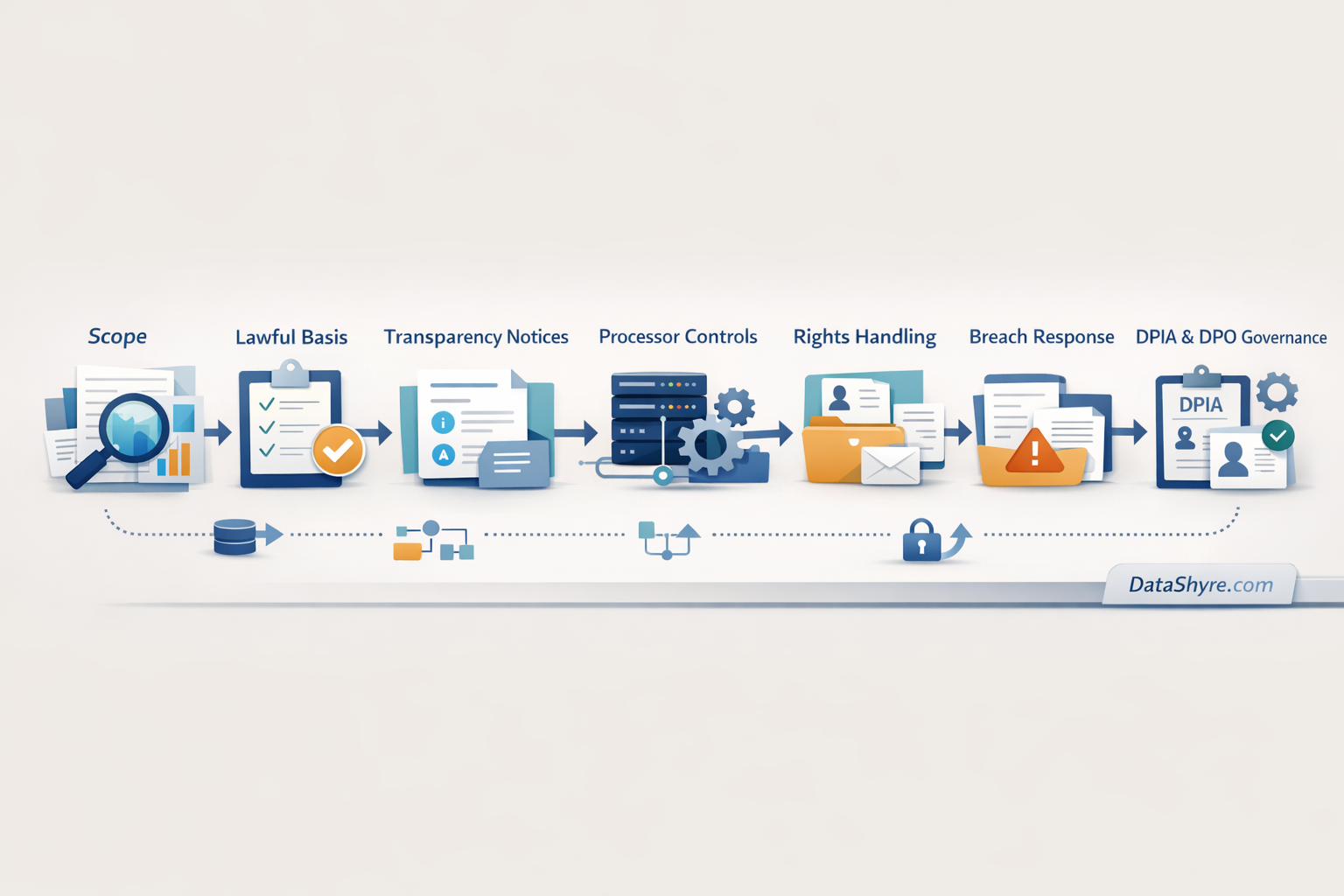
7. Decide the governance branch for DPIAs, DPOs, and accountability proof
The last big gdpr compliance requirements failure is governance drift.
The program exists in principle, but nobody can show who owns it, when a DPIA gets triggered, or why the business concluded a DPO was or was not required.
That is risky because the GDPR still treats high-risk processing, DPO designation, and accountability as live governance questions. The Commission says some SMEs only need a DPO when processing is their main business and poses specific threats to individuals’ rights and freedoms, particularly at large scale. The EDPB also warns that if you appoint a DPO voluntarily, you still have to comply with the GDPR’s rules governing that role.
For many organisations, the right governance review asks:
- which processing activities may require a DPIA under Article 35;
- whether any activity triggers a DPO requirement under Article 37;
- who owns privacy decisions if no formal DPO is required;
- whether that owner can influence product, vendor, and incident decisions;
- what evidence exists to demonstrate compliance when challenged; and
- how changes to the stack trigger re-review.
That last point matters more than it sounds. A new analytics layer, support platform, enrichment feed, or AI workflow can change the program materially. If the governance model does not catch those changes early, the company keeps using old compliance assumptions on a new system.
A practical weekly order for GDPR compliance requirements
If I had to audit gdpr compliance requirements this week, I would use this order:
- confirm scope, geography, and controller or processor roles;
- map major processing purposes to lawful bases;
- compare live collection points against the notice layer;
- review processors, sub-processors, transfers, and records;
- test the rights and retention workflow across real systems;
- review security and breach readiness for the 72-hour branch; and
- decide whether any activity needs a DPIA, a DPO, or a stronger accountability trail.
That sequence tends to find real gaps faster than reviewing policy wording in isolation.
FAQ
Are GDPR compliance requirements only about consent?
No. Consent is only one lawful basis. GDPR compliance requirements also cover scope, transparency, processor controls, rights handling, security, breach response, recordkeeping, and governance.
Can a small business still have meaningful GDPR compliance requirements?
Yes. The GDPR does not disappear because a company is small. Some duties vary by risk, scale, and context, but the law still applies based on what the organisation does with personal data.
Is a privacy policy enough to satisfy GDPR compliance requirements?
No. A privacy policy is only one piece of the transparency layer. Real compliance depends on whether notices, systems, contracts, records, rights workflows, and security decisions all match the live environment.
Sources
- EUR-Lex, Regulation (EU) 2016/679 (GDPR text): https://eur-lex.europa.eu/legal-content/EN/TXT/?uri=CELEX:32016R0679
- European Commission, Application of the GDPR: https://commission.europa.eu/law/law-topic/data-protection/information-business-and-organisations/application-gdpr_en
- European Commission, Obligations: https://commission.europa.eu/law/law-topic/data-protection/information-business-and-organisations/obligations_en
- European Commission, Information for individuals: https://commission.europa.eu/law/law-topic/data-protection/information-individuals_en
- European Data Protection Board, CEF 2026 on transparency and information obligations: https://www.edpb.europa.eu/news/cef-2026-edpb-launches-coordinated-enforcement-action-on-transparency-and-information_en
- European Data Protection Board, Process personal data lawfully: https://www.edpb.europa.eu/sme/be-compliant/process-personal-data-lawfully_en
- European Data Protection Board, Data Protection Officer: https://www.edpb.europa.eu/sme/be-compliant/data-protection-officer_en
- European Data Protection Board, Principles in practice: Key steps for business owners: https://www.edpb.europa.eu/system/files/documents/2026-02/edpb-summary-gdpr-data-protection-design-default_en.pdf
Published: November 23, 2026. Updated using current official EU and EDPB materials available at publication time.