

CCPA Privacy in 2026: 7 Live Checks for Notices, Opt-Outs, and Proof
If you are searching ccpa privacy on November 14, 2026, the shortest useful answer is this:
California privacy is no longer a policy-page project.
It is a live operating system for how a business collects data, explains data use, honors choices, handles requests, and proves what happened afterward.
That framing matters even more in late 2026. The California Privacy Protection Agency says updated CCPA regulations, plus added rules for risk assessments, cybersecurity audits, and automated decisionmaking rights, became effective on January 1, 2026. The CPPA FAQ also still describes “six major privacy rights.” And enforcement is still practical, not theoretical: on October 29, 2026, the California Attorney General announced a $1.8 million Lyft settlement focused on an opt-out path that did not actually work cleanly inside the app, while the state announced a $12.75 million General Motors settlement on May 8, 2026 over the sale of drivers’ data.
If you want nearby context first, start with our guides to CCPA requirements, CCPA law, and California web privacy law. This page stays narrower. It is the ccpa privacy review I would use this week before telling a team that the California privacy layer is actually in good shape.
If your team needs help connecting notices, consent signals, privacy choices, request workflows, and vendor behavior into one working system, DataShyre can help with consent management, DSR automation, and risk management.
1. Start where collection actually starts, not where the policy lives
The first ccpa privacy mistake is treating privacy as something that begins in the footer.
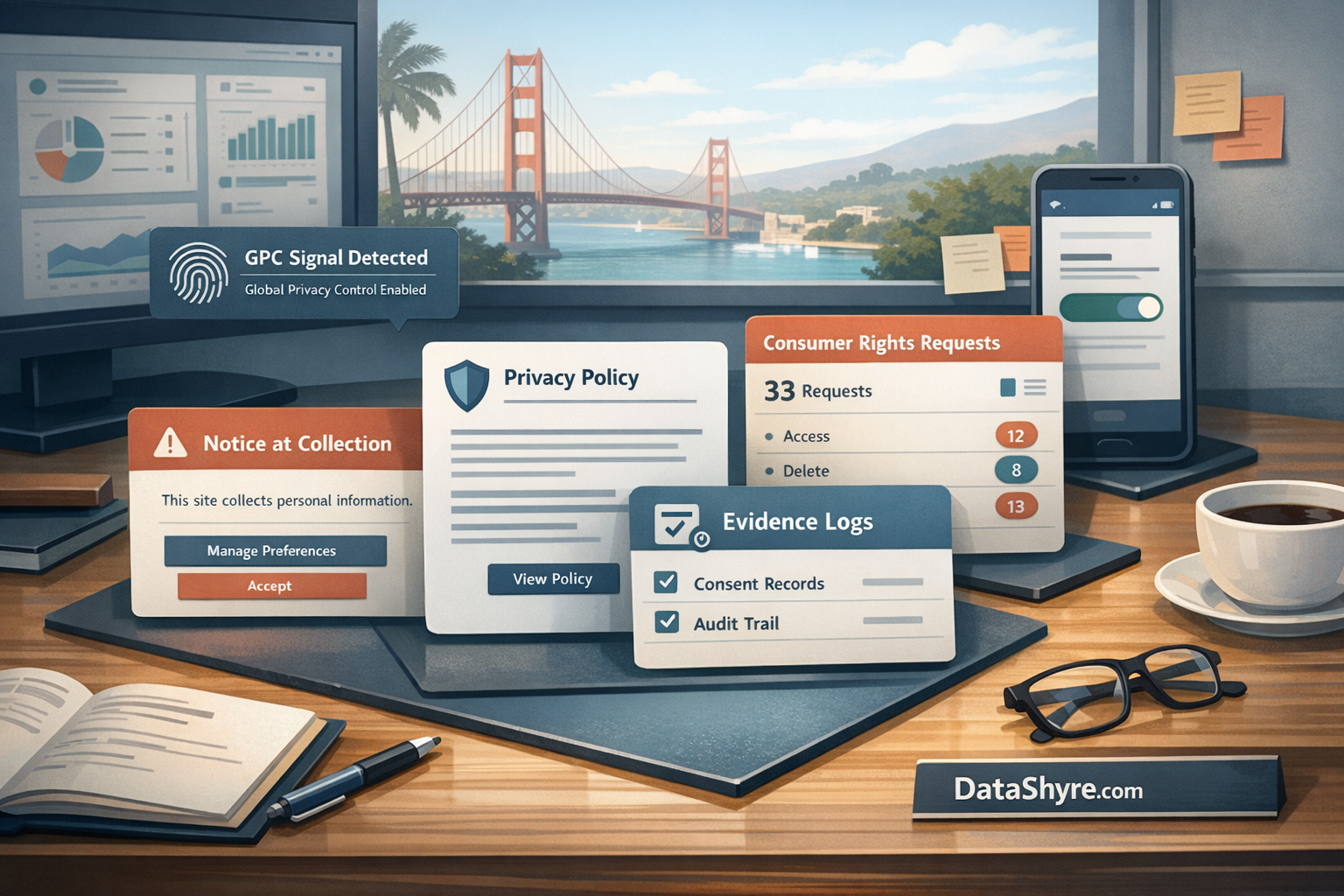
The current California regulations say a notice at collection must be available at or before the point where personal information is collected. They also require the notice to explain the categories of personal information collected, the purposes for which it is collected and used, and whether each category is sold or shared.
That means a serious ccpa privacy review should open the real collection points:
- lead forms and demo requests;
- account creation and checkout flows;
- mobile app sign-up or onboarding screens;
- support, scheduling, or chat tools;
- analytics and advertising tags; and
- any hidden enrichment or partner flow triggered right after collection.
If the live collection flow has moved but the notice layer has not, the privacy program is already drifting.
2. Treat the privacy policy like a route map for rights, not an archive
The CPPA FAQ still tells Californians to look at the business’s privacy policy for rights instructions, and it says businesses subject to the law must post the policy through a link using the word privacy. For apps, the policy should also be available on the download page or in the app’s settings.
That sounds basic, but it is one of the most common ccpa privacy failures.
A useful review should ask:
- whether the privacy policy is easy to find from the homepage, major landing pages, and logged-in areas;
- whether it matches the real categories, purposes, and disclosures;
- whether it explains how to submit delete, correct, and know requests;
- whether it explains opt-out and sensitive-information rights when those rights apply; and
- whether app users can find the same information without being pushed out into a scavenger hunt.
The privacy policy is not the whole control. But if the route map is broken, people cannot reliably reach the rest of the control set.
3. Make opt-out and GPC work where the data actually moves
This is where ccpa privacy becomes a runtime test.
The CPPA FAQ says businesses must honor user-enabled opt-out preference signals that meet the legal requirements, including the Global Privacy Control, as a valid request to opt out of sale or sharing. It also says most covered businesses must still provide a clear link such as Do Not Sell or Share My Personal Information, Your Privacy Choices, or Your California Privacy Choices.
So do not stop at the label.
Test whether:
- sale or sharing is actually happening anywhere in the stack;
- the rights link appears where California users can reasonably find it;
- GPC is detected and applied where required;
- downstream ad-tech, measurement, and partner flows change after the opt-out; and
- the change reaches the systems where the personal information was actually being disclosed.
The real ccpa privacy question is not Did we add the link?
It is Did the choice reach the data flow?
4. Remove friction from privacy choices before California removes it for you
The 2026 regulations say methods for submitting CCPA requests and obtaining consent must be “Easy to understand.”
That principle matters more than many teams admit.
Privacy interfaces fail when they:
- hide the real effect of a choice;
- make rejection harder than acceptance;
- split one action across too many screens;
- break on mobile or in-app surfaces; or
- force people into a policy maze before they can act.
The Lyft settlement is the cleanest 2026 reminder. The Attorney General said Lyft users had to bounce from the app to the privacy policy and back through extra steps, calling that an “illegal and unnecessary barrier” to exercising CCPA rights.
That is the standard I would use for ccpa privacy reviews this week. If a normal person needs patience, detective work, or repeated identity re-entry to use a privacy right, the design is already failing.
5. Run request handling on real clocks, not internal good intentions
Many teams can describe the rights. Fewer can operate them cleanly.
The CPPA FAQ says businesses must generally confirm delete, correct, or know requests within 10 business days and respond substantively within 45 calendar days, with one extension of up to another 45 days when the consumer is notified. The same FAQ says opt-out of sale or sharing and requests to limit the use of sensitive personal information must be completed as soon as feasibly possible, up to 15 business days.
That makes ccpa privacy an operations test:
- are the intake methods clearly designated;
- do requests route to the right internal teams and vendors;
- is verification used only where it should be;
- are confirmations and completions timestamped; and
- can the business show that the underlying systems actually changed?
This is where privacy programs stop being poster copy and become service delivery.
6. Give app flows and sensitive-data paths their own review
A lot of ccpa privacy work breaks because teams test the website and assume the app or logged-in experience works the same way.
California’s FAQ makes two things clear that matter here:
- app users still need a visible privacy-policy route; and
- businesses that use or disclose sensitive personal information outside the statute’s limited purposes must provide a way to limit that use or disclosure.
So if your product has an app, account area, or location-heavy service, give it its own branch in the review. That is especially true when:
- ad targeting happens inside the app;
- precise or near-precise location data is involved;
- support or fraud tooling reuses data for secondary purposes; or
- the logged-in flow exposes different rights or settings than the public website.
The General Motors settlement is a good realism check here. California’s announcement emphasized both the sale of sensitive driving and location data and the importance of data minimization, which means ccpa privacy is not only about the wording of the choice layer. It is also about what the business collected, kept, and later repurposed.
7. Keep a separate branch for data brokers and proof
Not every company is a data broker. But if the business is one, the CPPA’s Delete Request and Opt-out Platform (DROP) branch is current work, not future work.
The CPPA says the DROP regulations became effective on January 1, 2026, and the mechanism exists so consumers can send one deletion request through the agency to registered data brokers. Even outside the data-broker context, the theme is the same: California privacy work has to end with proof.
So the last ccpa privacy check is whether you can actually produce:
- the request record;
- the decision and verification trail;
- the downstream actions taken with vendors and internal systems;
- the final consumer response; and
- the version of the notice, interface, or configuration that was live at the time.
If you cannot reconstruct what happened, the privacy program is weaker than the policy suggests.
A practical CCPA privacy review for this week
If I were reviewing ccpa privacy this week, I would use this order:
- open the real collection points and compare them with notice at collection;
- check whether the privacy policy and rights routes are easy to find on web and app surfaces;
- test the opt-out path and GPC behavior against live data flows;
- remove friction, policy mazes, and repeated identity hurdles;
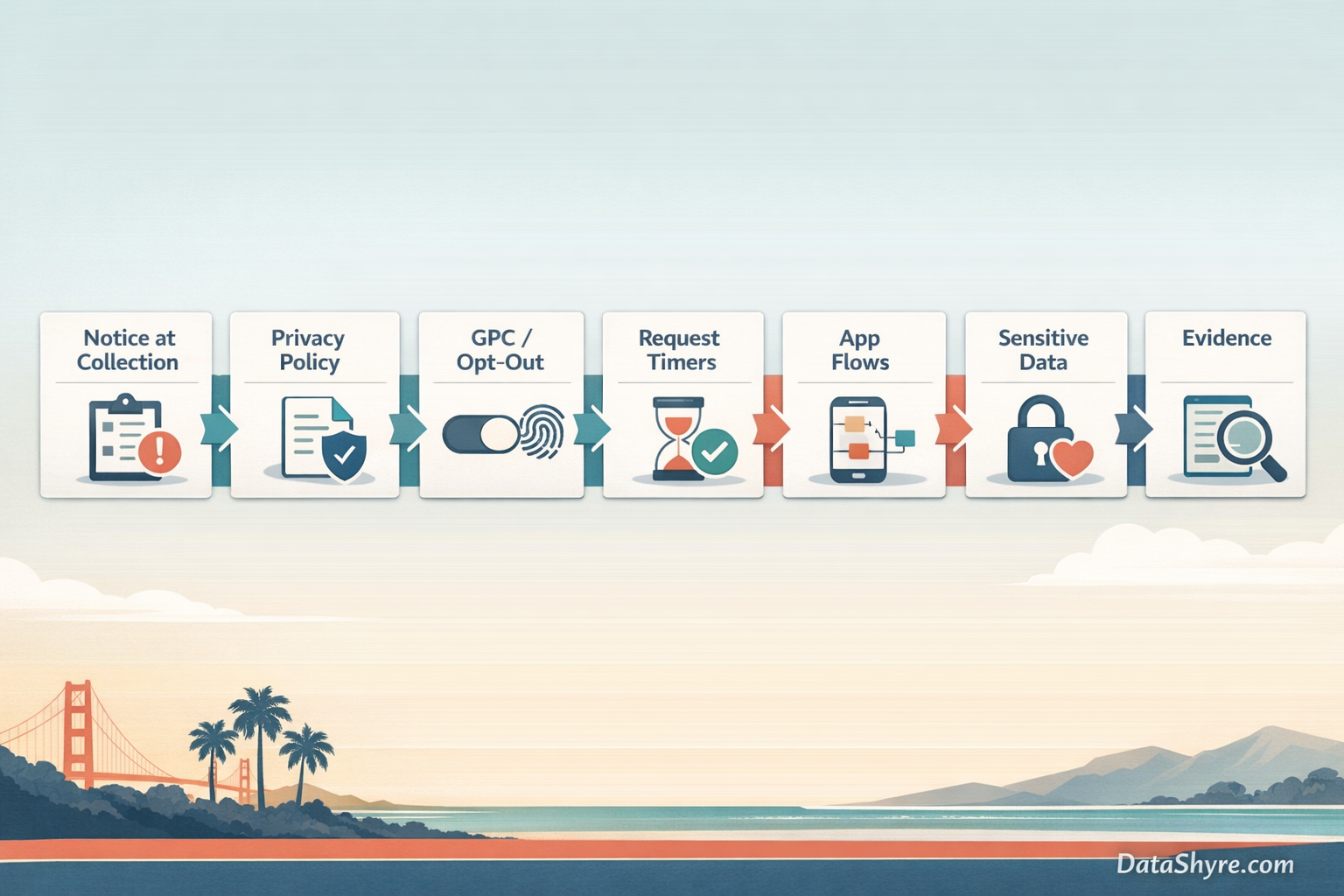
- measure request timing against the 10-business-day, 45-day, 90-day, and 15-business-day clocks;
- review app and sensitive-data use cases separately from the public website; and
- collect evidence that will still make sense later.
That order catches much more truth than a policy PDF alone.
FAQ
What does CCPA privacy actually mean in practice?
In practice, ccpa privacy means people can understand what data you collect, why you collect it, where it goes, how to use their rights, and whether their choices actually change what the business does.
Is a privacy policy enough for CCPA privacy?
No. The privacy policy matters, but California privacy obligations also live in notice at collection, opt-out behavior, GPC handling, request operations, app flows, and evidence.
Does every business need to worry about DROP?
No. That branch is specific to registered data brokers. But the bigger lesson applies more broadly: privacy rights now depend on operational systems, not only on legal text.
Official sources used
- California Privacy Protection Agency FAQ
- California Consumer Privacy Act Regulations, effective January 1, 2026
- CPPA page on 2026 CCPA updates, cybersecurity audits, risk assessments, and ADMT regulations
- California Attorney General press release on the October 29, 2026 Lyft settlement
- California Attorney General press release on the May 8, 2026 General Motors settlement
- CPPA DROP system requirements page