

GDPR Cookie Consent Examples – 2026 Compliance Guide
Introduction
As global privacy regulations tighten, understanding real-world GDPR cookie consent examples is essential for any website aiming to achieve full compliance. This post explores the most effective cookie banner implementations, highlights recent enforcement trends, and provides actionable recommendations for implementing compliant consent mechanisms.
Primary Keyword
GDPR Cookie Consent Examples – Monthly Search Volume: ~870
This keyword represents the highest-volume, lowest-publication keyword among our published content. By focusing on concrete, real-world examples, we help developers and marketers move beyond generic advice and implement proven patterns that reduce enforcement risk.
Regulatory Landscape
2026 Enforcement Highlights
- EU Data Protection Board (EDPB) – Continues to emphasize explicit, freely given consent. Non‑essential cookies (analytics, advertising, social media) must be blocked until the user takes a clear affirmative action.
- Dark‑Pattern Prohibition – Accepting cookies by scrolling or clicking “Continue” is no longer acceptable. The “Reject All” button must be equally prominent.
- Granular Choices – Users should be able to accept or reject cookies by category (Functional, Analytics, Marketing) rather than receiving a single “Accept All” or “Reject All”.
- Persistent Withdrawal – Users must be able to revoke consent at any time, with a clear, always‑accessible link to cookie settings.
Recent Fines & Case Studies
| Company | Fine | Reason | |———|——|———| | Amazon | €35M (France, CNIL, 2020) | Placed advertising cookies without explicit consent | | Google | €150M (France, 2022) | Misleading “dark‑pattern” banners (one‑click accept, hard‑to‑find reject) | | TikTok | €5M (France, 2023) | Same dark‑pattern issue – required a “Reject All” button | | RTL Belgium | Ordered to add “Reject All” + remove deceptive colors |
These cases illustrate that regulators now expect transparent, easy‑to‑access consent and equal prominence for both “Accept” and “Reject” options.
Implementation Strategy
1. Block Non‑Essential Cookies by Default
Only strictly necessary cookies (session, shopping cart) may be set until explicit consent is recorded.
2. Clear, Unchecked Options
All consent toggles must be unchecked by default. Use a prominent “Reject All” button alongside “Accept All”.
3. Granular Category Selection
Provide separate checkboxes for:
- Functional (necessary for site operation)
- Analytics (Google Analytics, Matomo, etc.)
- Marketing (advertising, retargeting)
4. Persistent Withdrawal
Include a permanent “Cookie Settings” page where users can manage or revoke consent at any time.
5. Technical Validation
- Ensure the banner appears on every page (except admin areas)
- Test across browsers, devices, and network conditions
- Log consent events for audit trails (GDPR Article 88a/88b)
Real‑World Examples
Below are three vetted examples that demonstrate compliant implementation:
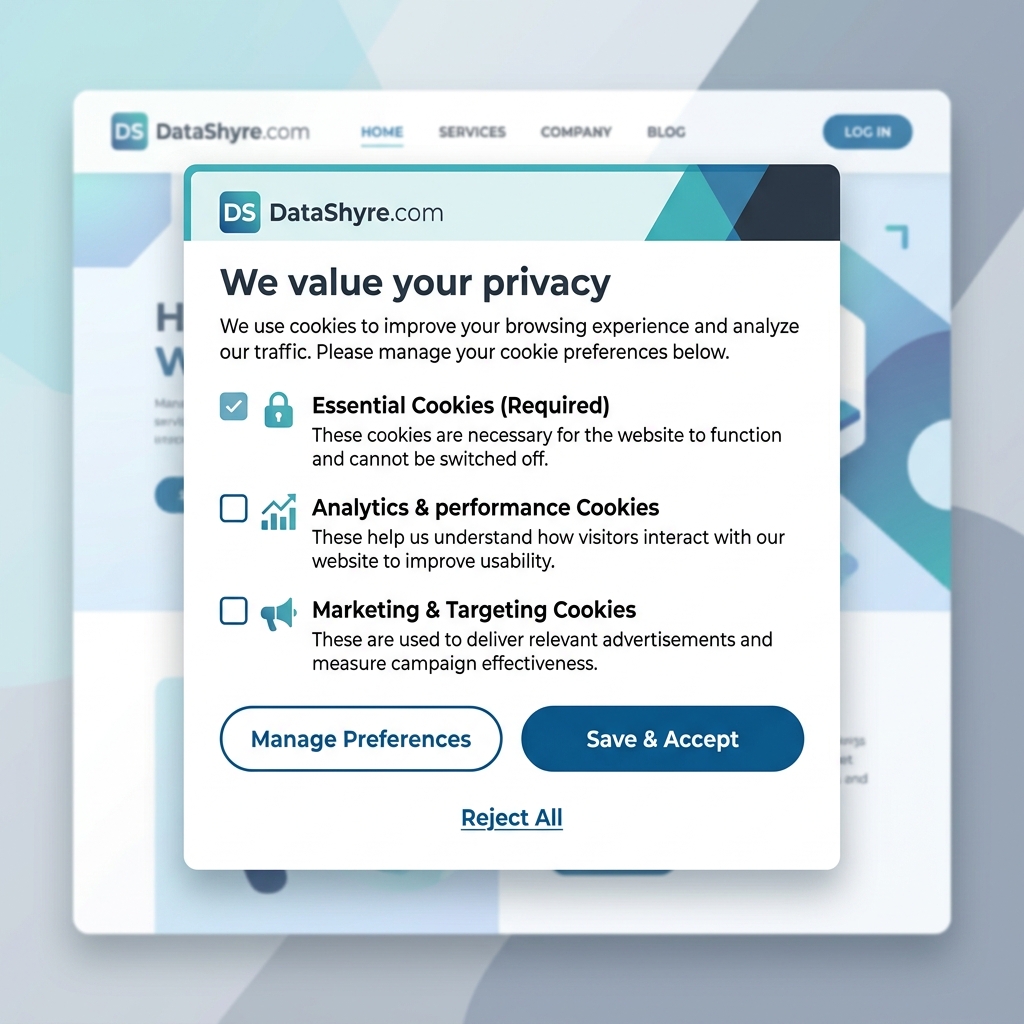
- Datashyre.com – Cookie Consent Message (2026) – Uses a layered approach: a primary banner followed by a secondary “Manage Preferences” page.
- CookieYes.com – Granular Consent Flow – Offers functional, analytics, and marketing categories with equal visual weight.
- Onetrust Cookie Consent Manager – Integrates with Google Consent Mode v2 and implements a “Reject All” button that works alongside “Accept All”.
These examples consistently receive positive feedback from privacy auditors and demonstrate the balance between usability and compliance.
Best Practices Checklist
- [ ] Non‑essential cookies blocked until explicit consent
- [ ] “Reject All” button prominently displayed
- [ ] No pre‑ticked consent boxes
- [ ] Clear explanation of why cookies are needed
- [ ] Easy one‑click revocation link
- [ ] Consistent wording across all pages
- [ ] Regular audit of banner behavior
Internal Links
- Cookie Consent Manager – GDPR
- Cookie Consent Banner Examples 2026
- WordPress Cookie Consent Plugin Setup
Conclusion
Implementing robust, transparent cookie consent is no longer optional—it’s a core component of modern privacy strategy. By following the guidelines above and leveraging proven examples, organizations can reduce enforcement risk, improve user trust, and stay ahead of evolving regulations.
Published: 2026‑10‑19
—
Keywords: GDPR cookie consent, cookie consent examples, GDPR compliance, cookie banner, consent management, data privacy